
-
Spacebuilt
- September 9, 2026
- No Comments
Building Construction Timeline Explained: How Long Does It Take in Dubai?
Table of Contents
- Key takeaways
- Stage 1: Design, concept and approvals
- Stage 2: Permit and NOC processing
- Stage 3: The actual build – foundation to finishing
- Stage 4: Inspections, DEWA connection and handover
- What actually slows projects down in Dubai?
- Villa vs commercial vs fit-out: A timeline comparison
- How to pick a contractor who won’t blow your schedule?
- Bottom line
- Frequently asked questions
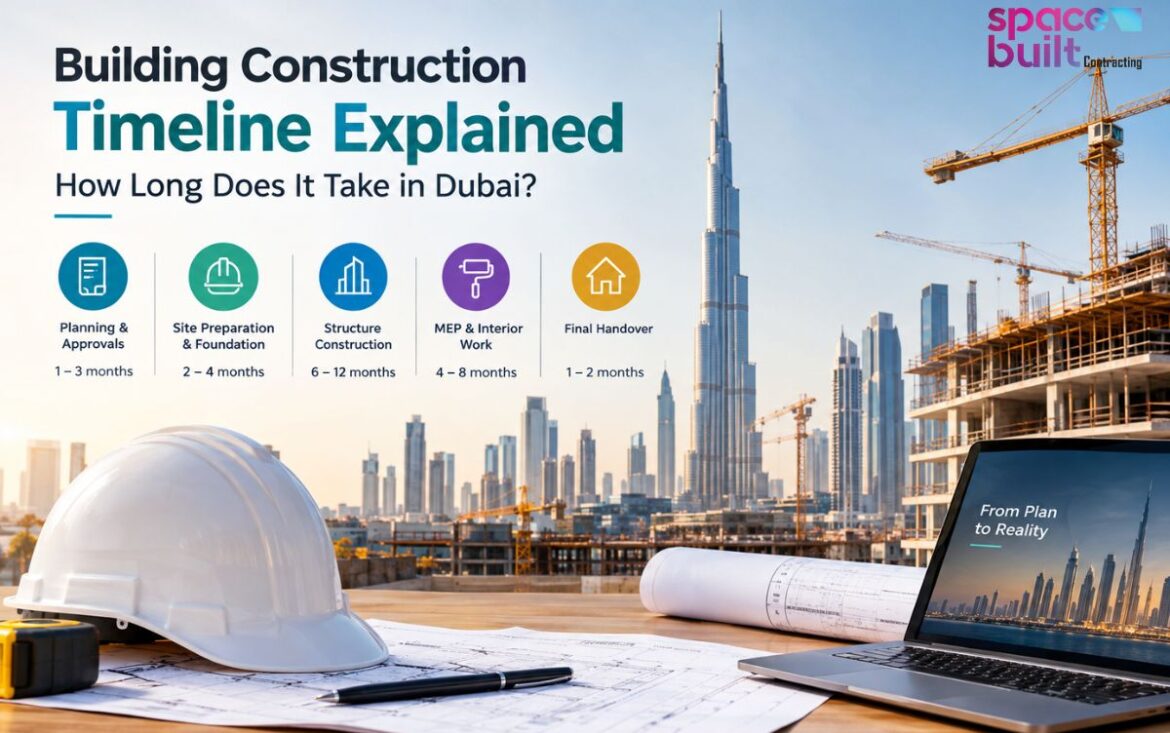
The first question that any person willing to construct anything in Dubai asks is: how long will it take? For a medium-sized house, building construction companies in Dubai that residents trust usually require between 8 and 14 months. For a commercial property, construction can take from 18 to even 30 months, depending on the area and the process of getting approvals. In addition, the process of designing and obtaining the necessary permissions may take about 4 to 6 months.
Key takeaways
- The average construction time of Dubai villas ranges from 8 to 14 months after their beginning.
- Permit delays are highly likely to arise due to incomplete drawings and drawings.
- Well-known Dubai construction companies can help minimize the costly problem of resubmissions.
- Unlike construction, interior fit-out projects often take less time, up to 6 to 12 weeks.
Stage 1: Design, concept and approvals
Prior to commencing any work on the plot, there exists a design and approval stage that is often overlooked by new builders. This covers conceptual design and structural design as well as obtaining approval from either the Dubai Municipality or, for master developers like Emaar or Nakheel, the reviews conducted by their own architectural department.
For a simple villa, this step can take 4-6 weeks as long as your architect knows the local rules. For commercial projects, this process takes longer because there are more categories involved in getting approval: structural engineers, MEP, fire and life safety, and other engineers depending on the nature of the site.
What happens during this stage:
- Site survey and soil testing
- Conceptual design and 3D rendering
- Structural drawings approved by a licensed consultant
- Community or master-developer NOC (if required)
Additionally, Omitting any steps here does not save time but simply prolongs the situation along the timeline where you would rather not appear.
Stage 2: Permit and NOC processing
This is the stage where most owners encounter trouble. In fact, Dubai Municipality can process an acceptable villa submission in just 3 to 5 working days. However, this is an optimistic scenario. The average amount of time required for processing the whole package of documents, including community NOCs and required approvals from agencies such as DEWA and the Dubai Civil Defence, ranges from 4 to 8 weeks and even longer for bigger construction projects.
Thanks to the Dubai Building Permit System’s introduction of AI technology to check submitted drawings for compliance, documents that lack the necessary information or do not comply will be flagged sooner than before. While this is good news for compliance, it unfortunately has some repercussions since documents that would barely pass a manual check now get rejected faster.
In terms of timeframes for getting the correct permits or NOCs, here are some examples:
- Dubai Municipality building permit: 2 to 6 weeks.
- NOC from the developer or community: 5 to 15 days.
- DEWA approval: 5 to 20 days.
- Civil Defence clearance: depending on the project.
Contractors who know the specifics of document submissions of the documents also understand the documents requested by the authorities.
Stage 3: The actual build – foundation to finishing
Once permits are cleared, this is where the timeline becomes visible on-site. For a 4 to 6 bedroom villa in the 4,000 to 8,000 square foot range, construction from groundworks to practical completion generally takes 12 to 18 months. Smaller extensions or single-storey additions move much faster, often 6 to 8 weeks of on-site work for something like a 50 square metre extension.
Rough phase breakdown for a full villa build:
- Groundworks and foundation: 4 to 8 weeks
- Structural frame (columns, slabs, walls): 3 to 5 months
- MEP rough-in (electrical, plumbing, HVAC): runs parallel with structure, 2 to 4 months
- Finishing (tiling, painting, joinery, fixtures): 3 to 5 months
- Landscaping and external works: 4 to 6 weeks
Commercial buildings and larger fit-out contracts follow a similar sequence but at greater scale, which is why timelines stretch to 18 to 30 months for towers or large retail spaces. This is also where a lot of building contracting companies in Dubai differentiate themselves.
Moreover, the ones with strong site management keep trades sequenced tightly. The ones without it end up with plumbers waiting on electricians waiting on the concrete crew, and every idle day adds up.
Stage 4: Inspections, DEWA connection and handover
The final stretch is often glossed over in project planning, but it deserves its own line item. After construction wraps, you still need:
- Final Dubai Municipality inspection
- DEWA final connection (typically 5 to 7 days once requested)
- Dubai Civil Defence clearance for fire safety systems
- DLD title deed update or completion certificate
Budget an additional 2 to 4 weeks for this stage. Projects that coordinate these steps in parallel rather than sequentially finish noticeably faster than those that treat each one as a separate errand.
What actually slows projects down in Dubai?
Most delays don’t come from the construction itself. They come from paperwork and poor sequencing. The recurring culprits:
- Incomplete drawings at first submission- Every rejection cycle for revisions adds one to three weeks.
- Missing NOC documentation- A single missing soil report or Civil Defence letter resets the review clock for that approval.
- Material lead times- Imported finishes, custom joinery, or specific glazing can take 8 to 12 weeks to arrive, and if that’s not ordered early, it stalls finishing.
- Underestimating developer review timelines- Master-developer NOCs in communities like Arabian Ranches or Jumeirah Park can take longer than the municipality permit itself if the request isn’t straightforward.
- Weak site coordination- When trades aren’t sequenced properly, idle days stack up fast on a multi-month build.
Furthermore, a building construction company Dubai clients return to for repeat projects has usually already run into these problems once, which is exactly why their timelines hold up better than a first-time or unlicensed outfit’s.
Villa vs commercial vs fit-out: A timeline comparison
| Project Type | Design & Approvals | Construction Phase | Total Timeline |
| Villa extension (small) | 4–10 weeks | 6–8 weeks | 10–16 weeks |
| Full villa build (4–8k sq ft) | 4–6 months | 12–18 months | 16–24 months |
| Interior fit-out/renovation | 2–4 weeks | 4–10 weeks | 6–12 weeks |
| Exhibition stand/space planning | 1–3 weeks | 2–4 weeks | 3–7 weeks |
| Commercial building | 3–6 months | 18–30 months | 21–36 months |
These are realistic ranges, not guarantees. Plot condition, design complexity, and how fast approvals move all shift the numbers in either direction.
How to pick a contractor who won’t blow your schedule?
Not every contractor manages timelines the same way, and this is usually the deciding factor between a smooth build and a frustrating one. When you’re comparing top construction companies in Dubai, a few things actually predict how the schedule will hold up:
- Track record with Dubai Municipality submissions- Ask how often their drawings get approved on the first pass.
- In-house design and structural teams- Fewer external handoffs means fewer delays waiting on a third-party consultant.
- Transparent phase-by-phase timelines- A contractor who gives you a vague “a few months” answer hasn’t planned the project properly yet.
- Project type experience – A company that specializes in commercial pulls may not be that proficient while doing a villa from scratch, and vice versa.
- Licensing and community-related experience – It is important to have worked with companies like Emaar or Nakheel, as each of the developers has its idiosyncrasies in relation to NOC.
Spacebuilt has carried out villa renovation works, interior pulling, and exhibition space design throughout Dubai long enough to have learned the local strong points and to be able to make plans in advance in case of delays. Whether the works are about complete renovation or urgent fit-outs, having a team that knows the rules of approvals from A to Z determines whether there is a time for 12 months or 18 months for the project.
Bottom line
Dubai construction projects do not have a set schedule. This will vary in length depending on the plot, approvals, project scope, and site management. Villas typically take 16 to 24 months to complete, with commercial projects potentially taking longer. The fit-out projects are typically done much quicker.
When hiring building contracting companies in Dubai, look for a detailed timeline of the project’s phases. This will give you an idea of what to expect before you begin. Spacebuilt is responsible for renovation, fit-out, and space-planning projects throughout Dubai. The practice has a system in place that ensures that the client is updated throughout the process. For a realistic project timeframe, call Spacebuilt. They can provide you with an estimate after evaluating your plot and project scope.
Frequently asked questions
Most Villa projects are designed to take 16 to 24 months from design to approval to construction to handover. Extensions can be completed in as few as 10 to 16 weeks for smaller extensions.
A full and compliant villa submission can be approved within 3-5 working days, although the process with NOCs will take 4-8 weeks.
Interior fit-outs and exhibition space planning are the fastest and typically only take 6-12 weeks, depending on material availability and scope.
Yes. Any structural extension, no matter how small, must be approved by Dubai Municipality, and work done without approval can have an impact on the completion certificate in the future.
The most prevalent reasons for delays are incomplete drawings, lack of NOC documents, lengthy material lead times, and inadequate trade sequencing in the field.
Once DEWA’s work is complete, the formal request is made for the final connection, which will take about 5-7 days.
Often, yes. Communities such as Arabian Ranches or Jumeirah Park have their own developer NOC, and they take time to develop, which is longer than that taken by the municipality.
Seek out a solid history of first-pass approval, in-house design teams, clear phase schedules, and prior experience in your project category.
Most submissions since 2024 have required BIM modeling, and this provides more depth in the technical review process, often resulting in a few additional weeks of delay for permits.
Yes (as long as it is a larger project). A shortcut taken by experienced contractors to save time is to run MEP rough-in and do early interior planning while the structure is being done.