

-
Spacebuilt
- September 5, 2026
- Comment (1)
Why Businesses Prefer Portable Exhibition Stands for Global Events
Table of Contents
- Key takeaways
- Why are portable stands winning over global brands?
- The real cost difference between portable and custom builds
- Speed: why setup time decides exhibitor satisfaction
- Sustainability is no longer optional at trade shows
- Portable vs traditional stands: A side-by-side look
- What to look for in a design partner?
- Mistakes businesses make when choosing a stand
- Final thoughts
- Frequently asked questions
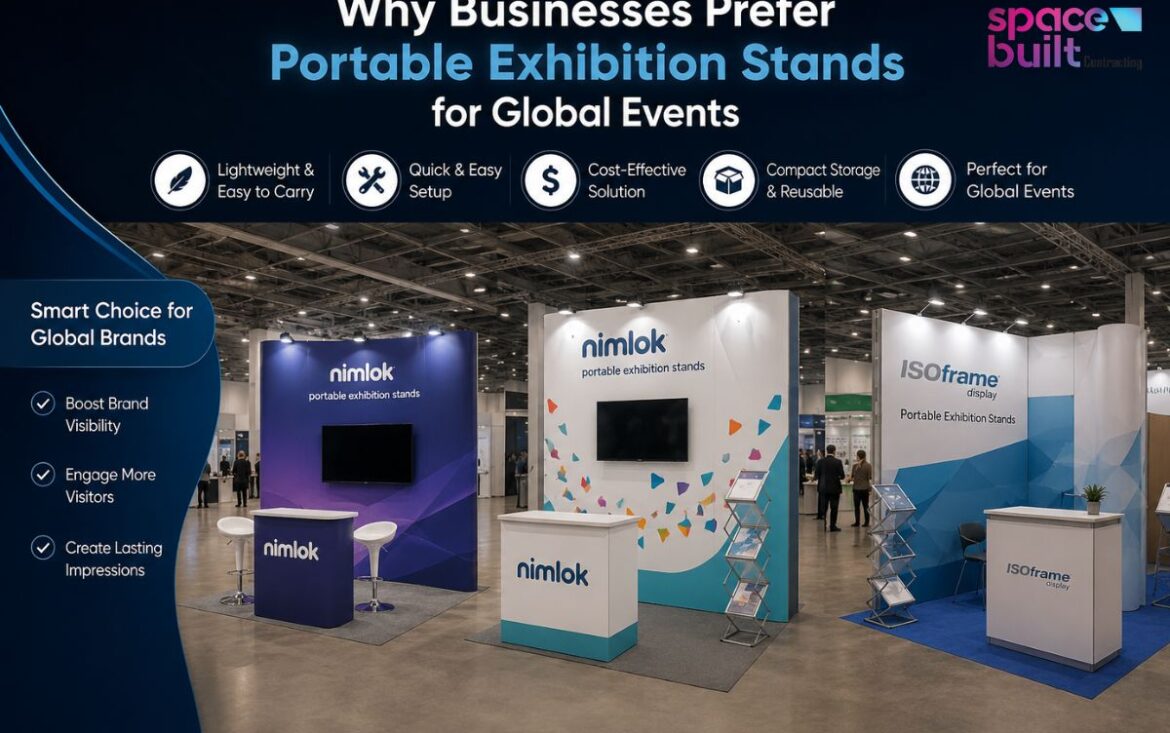
Portable exhibition stands are favored by companies because they are easy to transport, are cheaper over multiple events, and can be assembled much more quickly than unique designs. A single modular stand can be reused at 5-6 events a year, which is why exhibitors are looking for exhibition stand design companies in Dubai that manufacture lightweight and adaptable systems.
The UFI global data for 2024 cites 4.7 million exhibition companies and 32,000 exhibitions taking place worldwide over an area of 138 million square meters of booths. With this scale of operation, businesses cannot bear any delays or unreasonably high shipping fees caused by stand design.
Key takeaways
- The use of portable exhibition stands can cut down on one’s logistics costs, as well as the time it takes to set up the booth without sacrificing its effectiveness.
- In 2024, the global exhibition industry hosted an astounding 32,000 events, with over 318 million visitors attending them.
- Exhibition stand designers utilize modular systems that are easy to ship and quick to put together.
- The top exhibition stand companies in Dubai focus on ensuring material quality, reusability, and shipping.
Why are portable stands winning over global brands?
A decade ago, most companies exhibiting abroad shipped heavy timber structures or rented stands built locally, ones they’d never actually seen before the day they arrived. Both options carried the same risk: you didn’t know what you were getting until it was sitting in front of you.
Portable stands remove that guesswork. They’re built once, tested once, then packed into cases that fit through a standard cargo door. A marketing team flying from Dubai to a trade fair in Frankfurt or Mumbai can check their booth as regular luggage instead of arranging freight forwarders and customs paperwork weeks in advance.
However, this matters more now than it used to. UFI’s 2024 economic impact report puts the exhibition sector’s global GDP contribution at roughly €368 billion, spread across regions with different import rules, venue regulations, and labor costs. A stand designed to hold up against that variability, instead of depending on whatever’s available locally, is simply one less thing to manage.
The firms that have earned best exhibition stand design companies in Dubai status treat this as an engineering problem before they treat it as a visual one. Good looks matter, sure, but a stand that can’t survive three flights and six load-ins isn’t actually useful to anyone.
The real cost difference between portable and custom builds
Cost is where portability earns its reputation. A custom-built stand for a single show can look impressive, then gets thrown out once the event ends. Reused stands change that math entirely.
The savings tend to come from a few places:
- No rebuild cost for each new show, since the same structure ships and reassembles
- Lower freight charges, because modular frames weigh less and pack smaller
- Reduced storage fees between events, since flight cases stack compactly
- Fewer on-site labor hours, which cuts venue-charged installation fees
Therefore, a business exhibiting at four or five shows a year will typically spend less on a well-made portable system over 18 months than it would on two separate custom builds. It’s the reasoning most exhibition stand manufacturers in Dubai now lean on when pitching modular options to clients who exhibit repeatedly.
The catch: cheap portable frames don’t hold up. Thin aluminium tubing and low-grade fabric graphics wear out after three or four uses, and at that point the savings disappear. The cost advantage only holds if the build quality actually matches the reuse plan.
Speed: why setup time decides exhibitor satisfaction
Venues charge by the hour for labor, and most trade show halls give exhibitors a fixed build window, often somewhere between 24 and 48 hours before doors open. Miss that window, and you’re either paying overtime or scrambling the morning of the event.
Portable stands are built around that constraint. Tension-fabric frames, pop-up structures, and modular panel systems generally go from flat-packed to fully dressed in under two hours with a two-person crew. A custom timber build can take a full day and usually needs a specialized install team, either flown in or hired on-site.
Furthermore, there’s a knock-on effect too. Faster setup means faster teardown, and faster teardown means nobody on your team is racing a loading dock deadline at midnight. I’ve seen it play out the same way at almost every show: the time saved on logistics ends up mattering more than the money saved on materials.
Sustainability is no longer optional at trade shows
Reusability isn’t just a cost argument anymore. A growing number of venues and organizers, particularly across Europe and the Gulf, now ask exhibitors to disclose waste plans or actively favor stands built for repeated use over single-event disposables.
Portable systems fit that shift naturally. A frame reused six or seven times produces a fraction of the material waste a torn-down timber stand does. Fabric graphics can be reprinted and swapped onto the same frame, so the structural investment lasts for years even as the branding around it changes.
Moreover, this is one area where exhibition stand design services in Dubai have had to adjust quickly, since UAE-based exhibitors often travel to markets with stricter sustainability requirements than what’s expected at home. Builders who already design for reuse are simply better positioned to meet those rules without redesigning from scratch.
Portable vs traditional stands: A side-by-side look
| Factor | Portable Stands | Traditional Custom Builds |
| Setup time | 1–2 hours, small crew | 8–24 hours, specialized labor |
| Reusability | 5–7+ events per stand | Typically single-use |
| Shipping | Fits in flight cases, air cargo friendly | Requires freight, often local build |
| Cost over 3 shows | Lower total spend | Higher cumulative spend |
| Design flexibility | Reconfigurable layouts | Fixed to original design |
| Sustainability | Lower waste, reusable materials | Higher waste per event |
What to look for in a design partner?
Not every builder handles portability well. Some just shrink a custom design down without rethinking how it packs, ships, or survives repeated use. A few things worth checking before signing on:
- Ask to see a stand that’s actually been used at three or more events, not just a fresh render
- Confirm what happens if a panel cracks mid-tour: is replacement fast, or does the whole stand wait?
- Check whether they handle international freight documentation themselves or leave that to you
- Ask how graphics get updated between shows without replacing the frame
Working with one of the best exhibition stand builders in Dubai usually means these problems got solved on someone else’s show years ago, not on yours.
Mistakes businesses make when choosing a stand
- The most common mistake is choosing based on the render alone. A 3D visual won’t tell you how heavy the crates are, whether the connectors survive rough handling, or how long reprinting graphics takes between shows.
- Another one that comes up a lot: businesses assume portable means smaller or less impressive. That’s outdated. Modern modular systems scale to double-decker booths and large island stands just as easily as small 3×3 spaces. The difference is in the engineering, not the ambition.
- Some exhibitors also skip asking about after-sales support, and it costs them. A stand needs storage, transport coordination, and occasional repairs between events. A design company that disappears after delivery leaves you managing all of that on your own.
Final thoughts
Portable exhibition stands have gone from budget workaround to standard choice for any business exhibiting more than once a year. They cost less over time, set up faster, and hold up to the kind of international travel that used to make custom builds impractical.
Therefore, if you’re weighing options for an upcoming show, Spacebuilt works with exhibitors across the UAE and beyond, building stands meant for repeat use rather than a single night under the lights. Worth a conversation before your next event lands on the calendar.
Frequently asked questions
A modular stand that is well constructed can usually be used for 5 to 7 shows or events before the frames or graphics are replaced, depending on how the stand is used and stored between shows.
Yes. Not only small spaces, but modular systems can now grow to double-decker, island booths. It’s about size and not just about portability.
Most modular stands can be put together with a small crew in 1 to 2 hours, whereas custom timber stands take 8 hours or more.
Usually, yes. Reuse across multiple shows allows for costs to be shared, whereas a custom-built stand is thrown away after one event.
Yes. Most of the modular frames allow for fabric or panel graphic changes, so that branding can change (without having to rebuild the modular frame every time).
Inquire about reusability first, freight handling experience, and after-sales support. The first sketch is the least telling.
Yes. Single-use custom builds create more waste than reusable stands, which is important as more venues ask for waste disclosures.
Inquire about a stand that has been used in several events, ascertain when the stand can be repaired, and who is responsible for the paperwork for the international shipment.



1 Comment
Creative Exhibition Stand Designs with LED Digital Screens
[…] walking. A brilliant LED wall behind an empty, awkward floor plan still gets walked past. The best exhibition stand builders in Dubai will help you out to make everything […]