

-
Spacebuilt
- August 28, 2026
- Comment (1)
Why Office Renovation Projects in Dubai Go Over Budget and How to Prevent It
Table of Contents
- Key takeaways
- Why do office renovations go over budget in the first place?
- Common budget mistakes companies make
- Hidden costs nobody warns you about
- How do design changes inflate renovation costs?
- Choosing the right renovation partner
- What does a realistic budget breakdown look like?
- Questions to ask before signing a contract
- Permits, approvals and timeline delays
- Practical steps to keep your project on budget
- Final thoughts
- Frequently asked questions
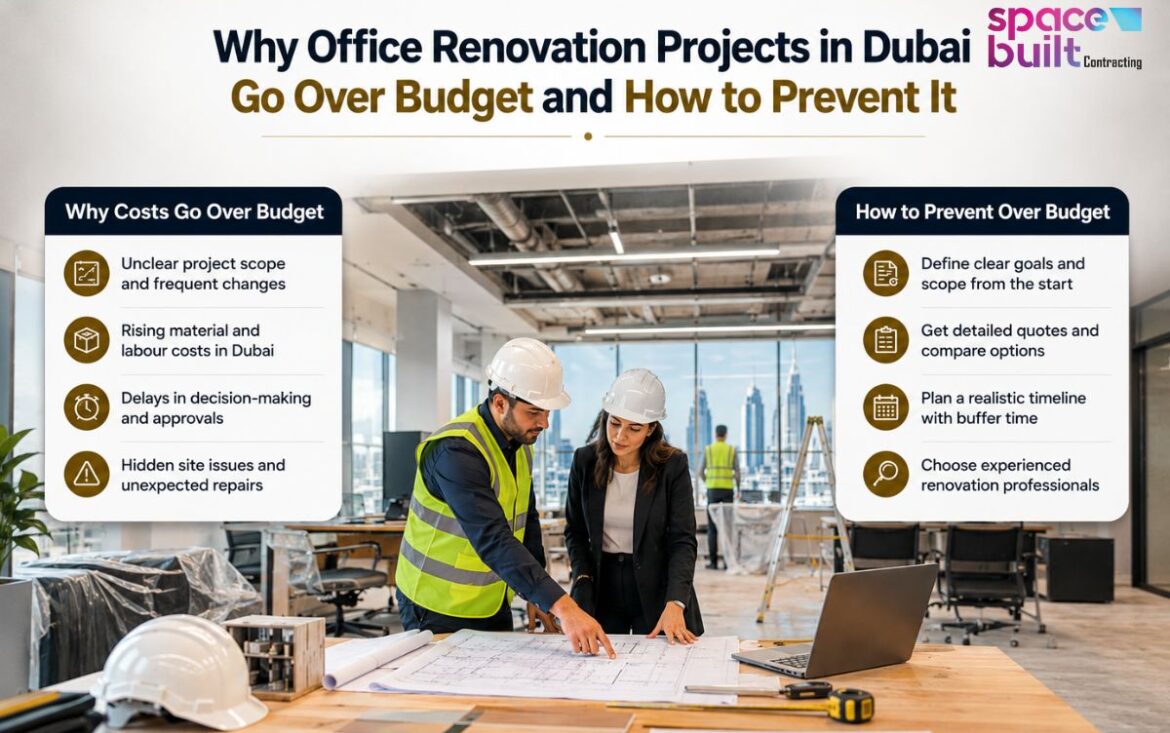
Renovation projects in Dubai commonly exceed their budget limits as a result of incomplete design briefs, changes to the project scope, and unplanned MEP (mechanical, electrical and plumbing) costs seen later during the project. Research shows that construction overruns in Dubai go on average from 5% below the budget to 15% over it, with the average overrun amounting to 5.81%.
However, material costs are not the biggest contributing factor here. Techniques used by the parties involved in the project are often to blame instead. Those companies that succeed in avoiding budget overruns, they do write down everything about the scope, get approvals from civil defense and DEWA, and then add 10%-15% of the anticipated costs in the initial budget.
Key takeaways
- Construction projects in the UAE have an average cost overrun of 5.81%, and project variations can be significant.
- Inadequate pre-construction planning creates more budget overruns than increases in material prices.
- The prepared scope with fixed prices eliminates most cost disputes during the execution of the projects.
- Qualified contractors in Dubai rely on building compliance knowledge to minimize unexpected costs.
Why do office renovations go over budget in the first place?
Most office renovations in Dubai don’t overspend due to one major problem. They accumulate costs slowly and steadily over time until the final bill reflects nothing like the original quotation.
In 2020, five major reasons leading to budget overruns were identified in a report on construction projects in the UAE. These are delays in the approval process, changes to the client’s requirements while the project is in progress, wrong cost estimation in the project plan, improper site management, and numerous changes of orders. These problems are not uncommon in Dubai, but they are common to projects in other regions as well. What makes them so expensive in Dubai is a fast pace of work that needs to be done by business owners, usually squeezed into weekends or off-hours when operations have the least impact on a business, and situations when there is less time to spot problems with the design before they turn into issues at the construction site.
Skip a proper measured survey at the beginning of an office renovation in Dubai, and you will surely encounter at least one of the pitfalls on the list before the project is handed over to the client.
Common budget mistakes companies make
Some patterns show up on nearly every project that runs over.
- Approving a design concept before checking it against the actual ceiling voids, cable routing, and structural columns on site
- Treating the quoted price as final without confirming what’s excluded (often FF&E, signage, or AC ducting modifications)
- Changing furniture layouts after electrical points have already been marked
- Assuming existing partitions can be reused without checking fire rating compliance
The last one catches people out more than they expect. A business owner recently told me they’d priced their entire renovation assuming they could keep the old gypsum partitions. Civil defense flagged them during inspection. That single correction added weeks and a five-figure cost that wasn’t in anyone’s spreadsheet.
Moreover, the teams behind the more dependable office renovation services in Dubai run a compliance check before anyone touches a mood board, not after.
Hidden costs nobody warns you about
Every contractor quote covers the obvious line items: partitions, flooring, paint, ceiling work. The costs that actually break budgets sit underneath those.
| Hidden Cost Area | Why It’s Often Missed |
| MEP rerouting | Only discovered once old ceiling tiles come down |
| DEWA load upgrades | Needed if new equipment exceeds existing electrical capacity |
| Waste disposal and skip permits | Charged separately by most municipalities |
| Snagging and defect rectification | Rarely built into the original timeline or budget |
| Temporary AC or power during works | Needed if the office stays partially occupied |
None of these are unusual. They’re just easy to skip when a quote is built from a floor plan instead of a site walk. The office renovation contractors Dubai businesses keep coming back to are usually the ones who physically inspect the ceiling void and electrical panel before finalizing a number, not after the contract is already signed.
How do design changes inflate renovation costs?
Design changes are the most predictable cause of overrun, and also the easiest one to prevent.
Once demolition starts, every change costs more than it would have on paper. Moving a wall after framing is up means redoing electrical, patching flooring, and sometimes revisiting the fire safety layout. On a standard office fit-out in Dubai, a single late layout alteration can cause delays that range from 3 to 10 working days depending on how much work has been done.
Moreover, many businesses do not realize how important their role is. They are often tempted to keep on making adjustments while construction work is underway, especially when employees start offering their opinions. All changes made halfway through an office renovation in Dubai have consequences for electrical, ceiling, and flooring professionals who have already followed the original schedule of works.
The fix isn’t rigidity. It’s finalizing the layout with the actual people who’ll use the space, not just leadership, before work begins.
Choosing the right renovation partner
Not every contractor structures pricing the same way, and that difference matters more than most people realize until they’re mid-project.
Some quote a lump sum with vague inclusions. Others break down unit rates per square foot for each trade, which makes it far easier to track where money is going if the scope shifts. The second approach takes more effort to review upfront, but it protects you from disputes later.
Look for a contractor who:
- Provides a line-item breakdown, not a single bottom-line number
- Has handled office, not just retail or residential, fit-outs in Dubai specifically
- Can show civil defense and Dubai Municipality approvals from past projects
- Offers a defined defect liability period after handover
Therefore, ask any company offering genuine office renovation services in Dubai to walk you through their approvals process. If that conversation feels vague or rehearsed, treat it as a warning sign before you sign anything.
What does a realistic budget breakdown look like?
A rough but workable allocation for a standard Dubai office fit-out, once you strip out the marketing language, tends to look like this:
| Category | Typical Share of Budget |
| Civil work (partitions, flooring, ceiling) | 35-40% |
| MEP (electrical, AC, plumbing) | 20-25% |
| Furniture, fixtures and equipment | 15-20% |
| Approvals, permits and consultancy | 5-8% |
| Contingency | 10-15% |
That contingency line is where most budgets fail before they even start. Skipping it, or shrinking it to save on the upfront number, is the single most common decision I’ve seen push a project into a mid-way funding scramble.
Questions to ask before signing a contract
A short conversation before signing saves far more money than any negotiation after work begins.
- What exactly is excluded from this quote?
- Who handles civil defense and DEWA approvals, and is that cost included?
- What happens financially if I request a layout change after demolition starts?
- What’s your process if hidden structural issues turn up once ceilings or floors are opened?
- Is there a written defect liability period, and what does it actually cover?
If a contractor can’t answer these clearly in the first meeting, that tells you something on its own.
Permits, approvals and timeline delays
Dubai’s approval process- civil defense, Dubai Municipality, and sometimes the building’s own facilities management- adds a layer that’s easy to underestimate if you haven’t been through it before.
Approval timelines can run anywhere from a few days to several weeks depending on the scope and the building. Projects that treat this as a formality rather than a real scheduling factor are the ones that end up paying for extended rent overlap or delayed move-in dates. That cost rarely shows up on the renovation invoice itself, but it’s a direct result of poor planning around it.
A good chunk of what gets budgeted for an office renovation in Dubai should actually go toward buffer time for approvals, not just materials and labor. It’s one of the cheapest ways to protect a budget that has nothing to do with construction at all.
Practical steps to keep your project on budget
- Get a measured survey done before finalizing any design, not after
- Lock the layout with input from actual department heads, not just leadership
- Ask for a line-item quote and confirm exclusions in writing
- Set aside 10-15% contingency and treat it as untouchable unless genuinely needed
- Schedule approvals and permits into the timeline as fixed dates, not assumptions
- Choose a contractor with documented experience in Dubai office fit-outs specifically
Moreover, every one of these steps is simple on paper. Sticking to them is the hard part, especially once the excitement of a new office design kicks in and everyone wants to move faster than the paperwork allows.
Final thoughts
Renovating office spaces in Dubai is not a budget-busting endeavor, and it’s not that there’s a single issue. They typically originate from minor scope inconsistencies, scope ambiguities, late approvals, or even changes in layouts during construction.
Businesses that are on budget tend to spend more time planning in advance before work is completed. Having a clear plan reduces the chance of costly changes and unforeseen costs later on.
Spacebuilt can assist if you’re looking to renovate or fit out your office. They can support you with Dubai projects, which include clear pricing and approval, and assist you in planning with a realistic space budget.
Frequently asked questions
Fit-outs come in a variety of shapes and sizes, and the cost is dependent on partitions, mechanical, electrical, and plumbing (MEP), and furniture. The price for most fit-outs is between AED 80 and AED 250 per square foot.
The three most common reasons cited in UAE construction projects, according to research, are not the increased costs of materials, but the delayed approval process, client-driven changes during the project, and underestimated planning.
Small to mid-sized fit-outs are typically estimated to take between 4- 8 weeks, although delays for approvals and scope adjustments are common.
Yes. The building will not sign off on most fit-outs that involve partitions, changes to the ceiling, or fire safety systems until the civil defense has given its approval.
You might not always see a quote for FF&E, signage, DEWA load upgrades and waste disposal permits unless you specifically request them when you are quoting.
Experienced project managers suggest that they reserve 10% to 15% of the entire project cost for contingencies that may arise due to structural or compliance problems.
It may be possible with phased or after-hours work, but it’s typically more expensive than an empty renovation because it involves additional power, noise-control, and time requirements.
Selecting the lowest price without verification of the contents, project experience at the office, or the fact that approvals are handled in-house.
Yes. A last-minute change of layout may cost an additional 3-10 working days and require a redo of all electrical and finished flooring.
A realistic quotation also provides a breakdown of each individual item, explicitly lists exclusions, and is based on a site inspection and not a floor plan.





1 Comment
12 Costs to Check in an Office Renovation Quote in Dubai
[…] trustworthy quote for office renovation in Dubai reads like a checklist, not a guess. Once you know the 12 core cost categories and what […]