
-
Spacebuilt
- August 1, 2026
- No Comments
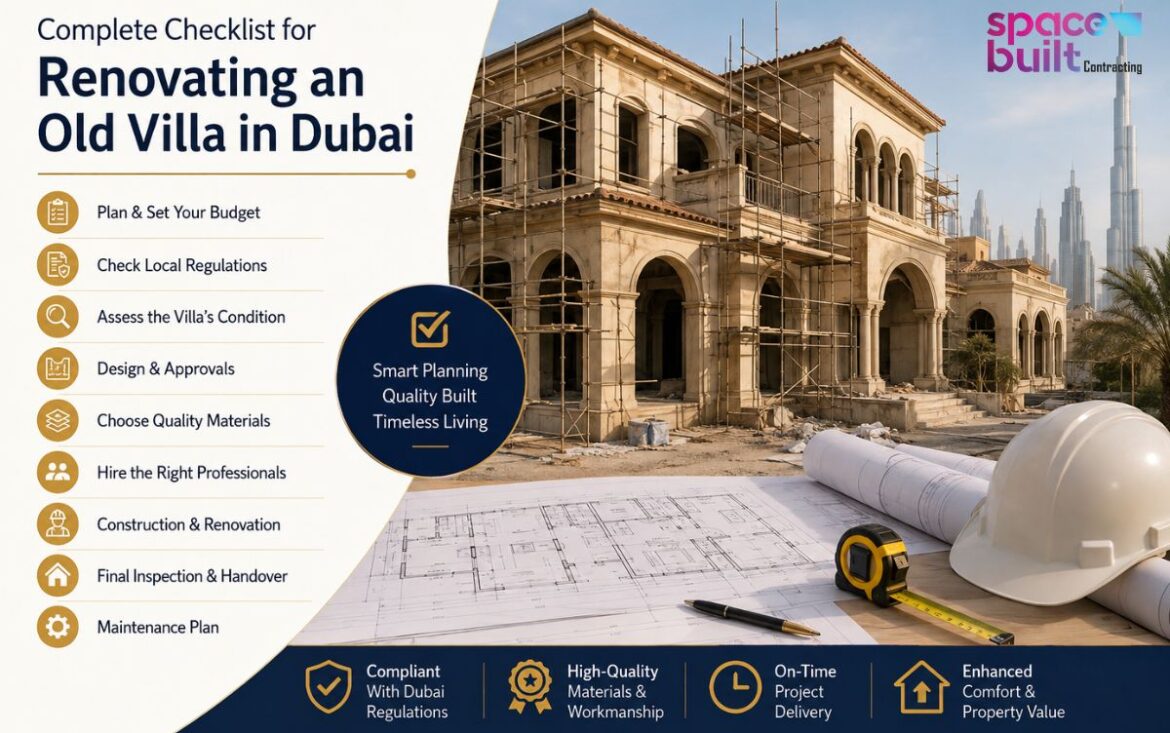
Complete Checklist for Renovating an Old Villa in Dubai
Table of Contents
- Key takeaways
- Why do older villas need a different renovation approach?
- Before you start: structural and legal checks
- Setting a realistic budget
- Space planning: getting the layout right
- Choosing the right contractor
- The renovation timeline: stage by stage
- Common mistakes homeowners make
- Materials that hold up in Dubai’s climate
- Final walkthrough and handover
- Final thoughts
- Frequently asked questions
Key takeaways
- MEP surveys are a must for older properties before planning out the renovation.
- The renovation process of villas usually takes between 10 and 16 weeks.
- Space Planning Consultants Dubai helps to minimize the risk of layout mistakes during the renovation process.
- A DEWA-approved NOC is necessary before utility connections take place.
If your villa was built more than a decade ago, the wiring, insulation, and plumbing behind the walls probably don’t match what a 2026 resident expects. A villa renovation in Dubai isn’t really about tiles and paint. It’s about bringing an old structure up to current standards without tearing out the parts that still work fine. Below is what actually needs attention, roughly in the order it needs attention, based on how these projects tend to go.
Why do older villas need a different renovation approach?
New-build renovations are mostly cosmetic. Old villa renovations are not, and treating them the same way is how budgets blow past their original number. Buildings from the late 1990s and early 2000s in areas like Jumeirah, Umm Suqeim, and Al Wasl were built to standards that predate current DEWA and Dubai Municipality requirements. Copper piping corrodes. AC ducting loses efficiency over the years. Electrical loads that were fine for a smaller household twenty years ago start to struggle once you add modern kitchen appliances and a couple more AC units.
Therefore, homeowners who skip the inspection and go straight to picking finishes tend to find out mid-renovation that a wall has to come down for pipe access, or the panel can’t handle the new layout. A proper survey catches that in week one. Skipping it just moves the discovery later, and later is always more expensive.
Before you start: structural and legal checks
Get this sorted before you pick a single tile.
- Structural survey- A structural engineer should check load-bearing walls, foundation condition, and any cracking. Non-negotiable if you’re planning to remove or relocate walls, which is most people, since older villas tend to be chopped into small, compartmentalized rooms.
- MEP inspection- Mechanical, electrical, and plumbing systems in villas over 15 years old usually need at least partial replacement. Have someone check panel capacity, pipe material, and duct condition before you commit to a layout.
- NOC and permits- Dubai Municipality needs a No Objection Certificate before structural changes go ahead, and your community’s owners’ association, if you’re in a gated community like Emirates Hills or The Springs, has its own separate approval process. Give this two to four weeks. It’s the part almost everyone underestimates.
- Ownership and title documents- If you’ve owned the villa for years, check your title deed matches what’s actually built before filing for permits. A mismatch between paper and reality is a good way to stall an approval for weeks.
Setting a realistic budget
Costs vary, but the patterns hold up across most projects:
| Renovation Scope | Cost Range (AED per sq ft) | Typical Timeline |
| Cosmetic refresh (paint, flooring, fixtures) | 80 – 150 | 3 – 5 weeks |
| Mid-level (kitchen, bathrooms, some MEP) | 200 – 350 | 8 – 12 weeks |
| Full renovation (structural, MEP, layout) | 400 – 650+ | 12 – 18 weeks |
These variations will depend largely on the finish elements chosen and unforeseen circumstances revealed once the work has commenced. So, be prepared to factor in a margin for costs by allocating around 10 to 15% for contingency. Practically every villa renovation Dubai effort has come across one or more surprises in the course of the work, usually related to bad plumbing or outdated electrical systems hidden behind the drywall.
Space planning: getting the layout right
Old villas were built with small and separate rooms: the majlis room, separated on the inside, the traditional kitchen that was completely closed from the rest of the house and the single bedrooms. Customers opting for a renovation today want to achieve an open layout, which implies not just changing finishes, but actually moving walls.
This is where good space planning consultants Dubai homeowners have worked before earn their fee. They’ll look at how natural light moves through the villa across the day, how traffic actually flows between kitchen, dining, and living areas, where the load-bearing walls sit so the layout you want is the layout you’re legally allowed to have, and how much storage you’re short on, because older villas almost always are.
One thing worth saying plainly: not every wall should come down just because open-plan is trendy right now. In a villa with high ceilings and decent cross-ventilation, some separation between kitchen and living space actually helps with cooking smells and noise. The layout should come from how the family actually lives in the space, not from what photographs well.
Choosing the right contractor
This decision determines whether the rest of this checklist goes smoothly or turns into six months of frustration.
When you’re comparing best renovation contractors in UAE for a villa specifically, ask to see completed villa work, not just apartment fit-outs. Villa renovation means structural coordination, external work, sometimes garden or pool areas too. That’s a different scope than interior fit-out alone, and contractors who only do apartments often aren’t set up for it.
Ask directly:
- Do you handle the NOC and permit process, or is that on me?
- Can I see villa projects you’ve finished in the last two years?
- Who manages the MEP subcontractors, and are they DEWA-approved?
- What happens when something unexpected turns up mid-project?
That last question tells you the most. A contractor with a clear answer has done this before. “We’ll figure it out” is not an answer.
The renovation timeline: stage by stage
A typical mid-to-full villa renovation runs something like this:
- Survey and design (2–4 weeks) — structural and MEP assessment, layout planning, material selection.
- Permits and NOC (2–4 weeks) — can overlap with design finalization.
- Demolition and structural work (2–3 weeks) — removing walls, addressing whatever the survey flagged.
- MEP rough-in (2–3 weeks) — electrical, plumbing, AC ducting replacement or upgrade.
- Finishing (4–6 weeks) — flooring, tiling, painting, cabinetry, fixtures.
- Final inspection and handover (1–2 weeks) — municipality sign-off, snag list, walkthrough.
Moreover, stages one and two can run in parallel to some extent. Rushing past the survey to save a week or two almost always costs more time later, once something turns up that changes the demolition plan.
Common mistakes homeowners make
Skipping the structural survey to save money upfront is the most expensive mistake on this list, full stop. It surfaces mid-renovation, when fixing it costs far more than catching it early would have.
Underestimating permit timelines is the second most common. Community NOCs, especially in older gated communities, can take longer than the Municipality’s own process. Build that into your schedule from day one, not as an afterthought.
Choosing finishes before the layout is locked causes real delays. If walls might move, hold off on ordering tile and cabinetry until you know the final floor plan. Reordering after a layout change adds weeks you didn’t budget for.
Additionally, people forget to check AC capacity. Opening up rooms changes the cooling load. Have an HVAC contractor confirm your existing system can handle the new layout, or whether it needs upsizing, before finishing work starts.
Materials that hold up in Dubai’s climate
Temperature change, moisture changes, and dirt impact the choice of materials in Dubai construction more than most people believe.
- Flooring: Porcelain tiles withstand temperature and direct sunlight better than engineered wood floors that typically become deformed with time due to subjection to the sun.
- External paint: Choose heat-reflecting or UV-resistant external wall paint. Normal paint fades and gets dusty significantly faster under Dubai sun.
- Kitchen cabinetry: Moisture-resistant MDF or properly sealed solid wood outlasts particleboard, especially near pool-facing doors.
- Window glazing: Double-glazed windows cut AC load by a meaningful amount, which matters given how much of a villa’s utility bill goes straight to cooling.
Final walkthrough and handover
Walk the villa with your contractor before signing off and go through a snag list room by room. Check outlets, switches, and fixtures work as intended, that doors and windows close properly, and that warranty documentation for AC units, water heaters, and major appliances gets handed over. If walls moved, ask for as-built drawings- you’ll want these on file for resale or future work.
Working with a team like Spacebuilt, this stage should also include a written defects liability period, usually 6 to 12 months, where the contractor comes back and fixes whatever surfaces after you’ve moved in.
Final thoughts
The projects that go smoothly are the ones where someone caught the structural and MEP issues in week one, not three weeks into demolition. Surveys, permits, a real contingency budget- none of it is exciting, but skipping it is where the delays and cost overruns actually come from. If you’re planning a renovation and want one team handling permits, space planning, and contractor coordination together, Spacebuilt works on exactly this kind of project across Dubai’s older villa communities.
Frequently asked questions
Full renovations usually take 12 to 18 weeks. Cosmetic-only updates can wrap in 3 to 5.
For structural changes, yes- Dubai Municipality approval, plus your community’s NOC if applicable.
Anywhere from AED 80 to 650+ per square foot, depending on how much of the villa you’re touching.
Partial renovations, sure. Full ones with MEP and structural work are easier to manage from outside.
Not for cosmetic work, but yes if you’re moving walls, changing floor levels, or the villa is 15+ years old.
Ask for completed villa work specifically, confirm they handle NOC and permits, check MEP subcontractors are DEWA-approved.
Electrical and plumbing behind walls- invisible until demolition starts, and it almost always runs over estimate.
Usually yes, if budget allows. Both involve plumbing, and combining them cuts down on contractor mobilization costs.