
-
Spacebuilt
- September 30, 2026
- No Comments
How to Plan a Villa Construction Project in Dubai from Start to Finish
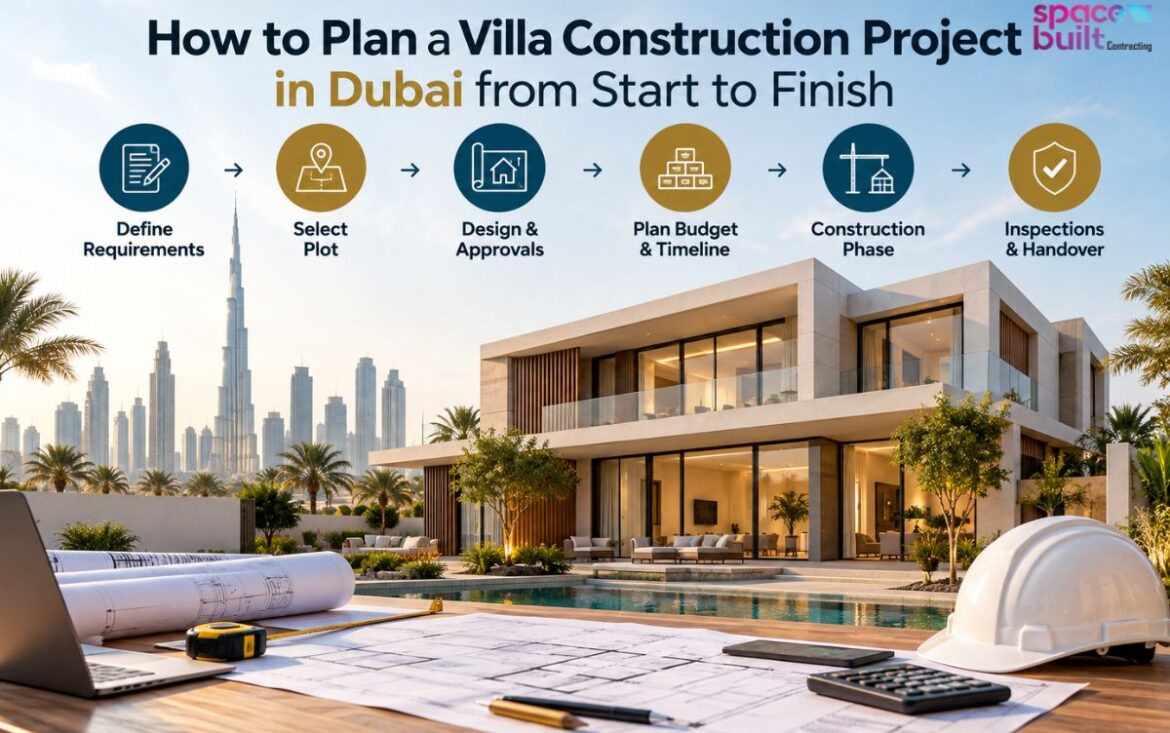
A villa construction in Dubai happens in a specified manner. You first establish your budget, appoint a consultant to clear it with Dubai Municipality, and get the drawings approved by it and the developer in a master community project. After that, you engage a licensed contractor, agree on the materials, and begin construction, which will be inspected.
Moreover, the handover process begins only after the completion certificate is obtained and the utilities are in place. Expect 12 to 18 months from concept to obtaining the keys, two months of which are dedicated to obtaining permits. Delays occur mostly due to mistakes made in sequencing the stages of the process.
Key takeaways
- A construction contract is one of the budget components; the other point is that approvals should be on separate lines.
- Design should be frozen prior to the permit application since any design change later brings additional expenses.
- Do not start the work until the permits and no objection certificates have been obtained.
- To evaluate the proposals of different contractors, use the same drawings and specifications since comparing only the prices is not informative.
Set your brief and budget
Before you meet a designer, write a one-page brief. List the bedrooms, majlis, maid’s room, garage, pool, basement, and any extension you might want later. It takes an hour and saves weeks of redesign.
Then look at cost. Figures quoted in 2026 vary a lot depending on who you ask. Standard-finish villas are often quoted at roughly AED 400 to 600 per sq ft of built-up area. Luxury specifications start around AED 850 and can pass AED 1,400. Use these as a rough guide and nothing more, because a basement, a heavy MEP package or imported finishes can move the number fast.
Beyond the contract itself, your budget needs room for:
- Land, title and registration costs
- Design and site supervision fees
- Government and developer fees
- Pool, landscaping and boundary wall
- Furniture and interior fit-out
- A contingency of 10 to 15 percent
Therefore, any figure you have at this point is an estimate. The top contracting companies in UAE will not commit to a firm price until they can see drawings and a specification.
Check the plot and site conditions
Find out what you can build before you pay for design. Get the title deed and the affection plan, then check permitted use, plot coverage, height limits and setbacks.
If the plot is inside a master community, the developer’s guidelines sit on top of the municipality’s rules. They often control elevation style, colours, boundary wall height and what can go on the roof.
Order a soil investigation early. It decides your foundation type and whether a basement is realistic, particularly where the water table is high. Also find out how far the nearest utility connections are. A long service run adds cost that nobody remembers to budget.
Design and consultant appointment
Your consultant produces the architectural, structural and MEP drawings. For a building permit, those drawings have to be certified by a consultant registered with Dubai Municipality, so confirm the registration before you sign anything.
Design goes from concept to detailed drawings, and the second half is where owners get impatient. Don’t. Door schedules, ceiling heights, AC routing and drainage falls are far cheaper to fix on paper than after the blockwork is up.
However, design for the climate as well. Orientation, shading, glazing and insulation change how the house feels in August and what you pay to cool it. Dubai’s green building requirements, including the Al Sa’fat system, also affect specifications, so bring them up at the start of design and not at submission.
Approvals required in Dubai
Which approvals you need depends on the plot, and they run on separate tracks.
- Building permit: Applied for through the Dubai Building Permit System run by Dubai Municipality. Some areas fall under Trakhees instead.
- Developer NOC: Needed in most master communities, and often required before the permit application can go in.
- Utility approval: Power and water load approval from DEWA.
- Civil Defence: Fire and life safety approval of the design.
For a residential villa, approval usually takes around four to eight weeks. Complex drawings and revision rounds can push that out. Some tracks can run at the same time, so ask your consultant to plan them together and not one after another.
Furthermore, permit fees depend on built-up area, and pools and boundary walls add their own charges. Budget them separately. Nothing should start on site before approvals are issued, and that includes demolition and material deliveries. A stop-work order or a fine will cost you more than the weeks you were trying to save.
Choosing the right contractor
The contractor needs a valid trade licence and registration with Dubai Municipality. That is the starting point, and it filters out fewer firms than you would hope.
Search for the best construction companies in Dubai and you will get a long list, but it mostly tells you who is advertising. Once you have a shortlist, ask each firm for:
- Finished villas of a similar size that you can walk through
- An itemised bill of quantities, not a lump sum
- The names of the project manager and site engineer who will run your job
- Proof of insurance, including workmen’s compensation and contractor’s all-risk cover
- A payment schedule tied to completed milestones
- The defects liability period they offer
Send every bidder the same drawings and specification. If one quote comes in far below the rest, find out what is missing. It is usually external works, MEP allowances or provisional sums that have been left thin.
Think about who will hold the whole project together, too. A villa construction company in Dubai that also does project management, such as SpaceBuilt, can coordinate the consultant, the approvals and the site work through one point of contact. That helps because most delays begin in the gaps between separate parties.
Material planning for Dubai conditions
Order long-lead items early. Aluminium windows, lifts, kitchens, natural stone, custom joinery and smart home systems can take anywhere from several weeks to a few months, depending on where they are made.
Choose for heat, humidity and dust. Coastal plots add salt exposure, which is hard on weak steel and poor waterproofing. Check these in particular:
- Thermal insulation and low-emissivity glazing
- Waterproofing on the roof, in wet areas and around any basement
- Corrosion-resistant fixings and external finishes
- AC equipment sized to the actual heat load
Therefore, have the consultant approve samples in writing, and get your own sign-off too, before anything is ordered. Then keep a simple schedule with each item, its supplier, its lead time and the date it must be on site. When one delivery slips, the trades waiting behind it stand idle.
Construction stages explained
- Site setup and excavation
The contractor mobilises, fences the site, sets out the plot and digs to foundation level. Site access and temporary utilities get sorted here.
- Foundations and structure
Foundations, columns, slabs and beams go up. Concrete is tested and inspected before each pour.
- Blockwork and first fix
Walls rise. Electrical conduits, plumbing and AC ducting go in before plastering starts.
- Plaster, waterproofing and external works
Waterproofing, plaster and external cladding follow. Roofs and wet areas need their protection in place before finishes cover them.
- Finishes and second fix
Flooring, joinery, painting, sanitary fittings, lighting and AC units are installed.
- Landscaping and pool
Landscaping, the pool and the boundary wall usually come last, although pool excavation is sometimes done earlier to keep machinery access clear.
Summer affects the schedule. The UAE’s midday outdoor work break normally runs from mid June to mid September, so check the current rules and plan around them. Heat also slows exterior finishing and makes concrete curing harder to manage.
Inspections and final handover
Inspections happen throughout the build. Your consultant supervises the work against the approved drawings, and Dubai Municipality inspects at key stages. If an item fails, fix it before the next stage covers it up.
Once the building is finished, close-out goes like this:
- The consultant and contractor walk the villa with you and write up a defect list.
- The contractor corrects the snags and the consultant rechecks them.
- Dubai Municipality issues the building completion certificate once its requirements are met.
- Utility connections are made using the completion documents.
- You receive the as-built drawings, warranties, equipment manuals and keys.
Moreover, the contractor normally holds back retention money until the defects liability period ends, commonly around 12 months. Ask for a named contact for warranty issues before you take the keys. SpaceBuilt also offers maintenance services, so follow-up can stay with the same team after handover.
Wrapping up
The best sequence for a villa project is brief, budget, plot checks, Design, Approvals, Contractor, Materials, construction, and handover. Every step guards the next.
No matter whether you are talking to the best contracting companies in the UAE or a smaller specialist, request that they provide you with a clear scope, clear payment terms, and a named team. Choosing the right villa construction company in Dubai is as crucial as the design itself.
Before starting any commitment, if you are thinking about building your villa, you can discuss scope, approvals, and timeline with the SpaceBuilt team. They can be reached at spacebuiltme.com.
Frequently asked questions
The time frame from design to handover of most villas is from 12 to 18 months. Add to that the approvals, basements, custom finishes, and summer slowdowns.
Yes. A building permit is required – drawings need to be certified by a registered consultant. Certain plots require Developer NOC/Trakhees approval.
Most owners put aside 10% to 15%. Typically, it is used when site conditions, design changes, or price movement of materials occur.
Look at its Dubai Municipality registration, similar finished villas, insurance, an itemised quote, and named site staff. Seek to visit a project that has already been completed if possible.
Use the same drawings and specifications with each firm. Next, compare scope, time, cost, and defects cover, not just the price.
Typically, retention is released once agreed defects are rectified, after the defects liability Period, which is commonly 12 months. The exact terms are covered in your contract.