
-
Spacebuilt
- October 9, 2026
- No Comments
Cat A vs Cat B Office Fit-Out in Dubai: What Is the Difference and Which Do You Need?
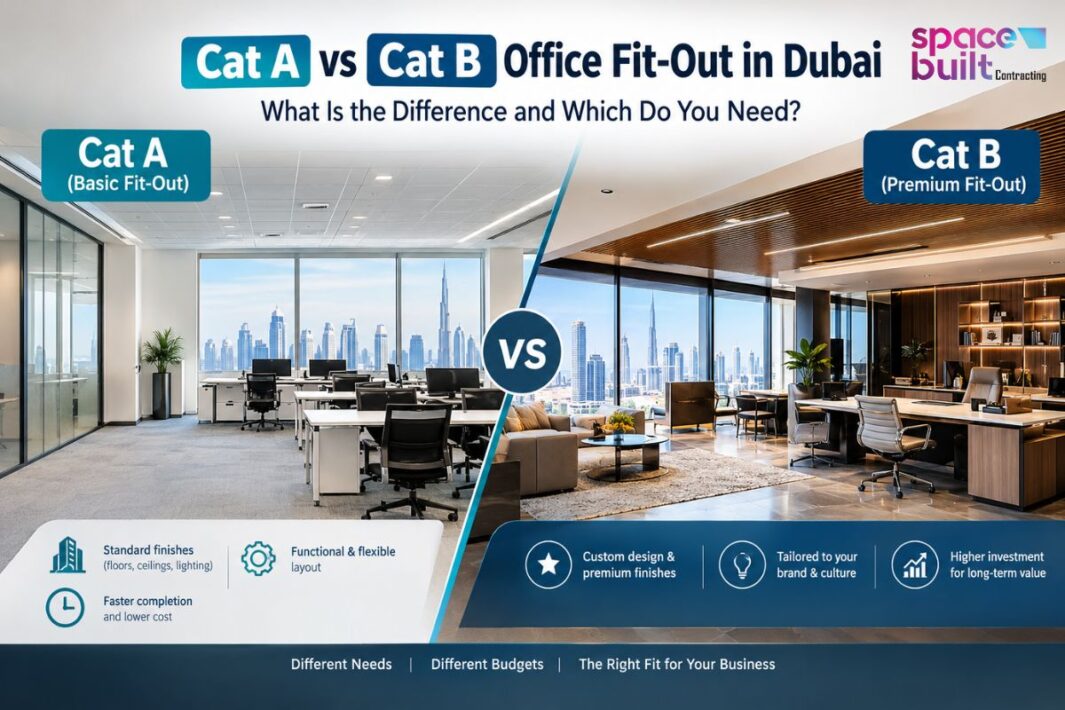
A Cat A fit-out provides an office with its essential first layer of ceilings, as well as lighting, air conditioning, power, and fire systems. Cat B fit-out applies to using this first layer to create your workspace with partitions, furniture, branding, and IT equipment. Therefore, Cat B is what most tenants require. Whether you also need Cat A is dependent upon your lease arrangement.
Commercial offices in Dubai are delivered in different stages of completion. Some office towers offer an apartment with a bare concrete floor, while others give you the finished floor with ceilings and air conditioning in place. These levels define the boundary of the landlord’s and tenant’s work.
The purpose of this guide is to make a comparison of Cat A and Cat B to help you to make a decision when you ask contractors in Dubai to provide you with quotes.
Key takeaways
- Cat A is the base build. Cat B is the layout, finishes, and branding a tenant brings with them.
- Most Dubai tenants require Cat B, and it is up to the lease to determine if the tenant will deliver Cat A.
- Cost & time will vary depending on scope, regulations, and permissions, so get a detailed quote.
- Preview the landlord’s fit-out standards before settling on the design.
What is a Cat A office fit-out?
Category A is a building stage that makes any space usable. This stage refers to a space that lies between a “shell and core” and a fully finished space. There is no planning, no branding, and no furniture.
Typical elements included in a Category A package are:
- Suspended ceiling grid and tiles
- Raised access flooring, typical of many Dubai towers
- Basic lighting installation
- Air-conditioning distribution system, such as fan coils, ducting and distribution vent
- Sprinklers and smoke detectors installed according to the ceiling layout
- Power distribution and data containment
The architectural practices depend on the building concerned. In some Grade A buildings, the developer finishes the Category A stage. In others, a shell building is delivered to the client, who has to finish it. The agreement between the parties and the handover specification clarify which practice is applied.
What is a Cat B office fit-out?
Cat B refers to the tenant’s work. Based on the Cat A specification, it is about creating the office you will actually occupy.
The Cat B scope generally includes:
- Glass and plasterboard partitioning systems, doors and meeting rooms
- Reception area, kitchenettes, break-out and executive/meeting rooms
- Joinery works, including reception counters, storage and wall coverings
- Floor finishes, including carpet tiles, vinyl, tiling or timber look-alike floor
- Feature ceilings and lighting design
- Additional MEP works, including air conditioning for the server room and plumbing; and
- Data cabling, audiovisuals, access control system and CCTV
- Acoustic treatment, furniture and branding
As a result, this is where a significant proportion of your project budget is spent and where most of the consequential decisions must be made.
Cat A vs Cat B: key differences
| Element | Cat A | Cat B |
| Scope | Base services and basic finishes | Complete working office |
| Finishes | Standard, neutral | Tailored to the tenant’s brand |
| MEP services | Core distribution in place | Modified to suit the layout, plus extras |
| Partitions | None or minimal | Glass, gypsum and acoustic partitions |
| Flooring | Raised floor, often unfinished | Final finishes by area |
| Ceilings | Standard grid and tiles | Feature and acoustic ceilings where needed |
| Lighting | Basic ambient lighting | Designed lighting by zone |
| Furniture | None | Workstations, meeting and soft furniture |
| Branding | None | Logos, graphics, signage, colour scheme |
| Approvals | Usually landlord- or developer-led | Landlord NOC, authority permit, Civil Defence |
| Typical user | Landlords, investors, tenants taking an interim step | Tenants moving in to operate |
How much do Cat A and Cat B cost in Dubai?
The cost varies according to the size, level of finish, and condition of the unit used as a starting point. All estimates for 2026 are prone to variability from source to source, so use any figure as a starting point but don’t take any figure as a quote.
The standard-finish Cat B conversion costs around AED 250 to 500 per sq ft, while complete Dubai offices range from AED 300 to 650 per sq ft and higher. The prices for Cat A are largely based on the level of “baredness” of the unit on handover day.
What moves the price most:
- Complete the finish, glazing, and joinery.
- Air conditioning changes and sprinkler and electrical changes have been made.
- The use of IT, audio-visual, and security systems.The use of IT, audio-visual, and security systems.
- Furniture is included in or excluded from the contract.
- The complexity of the layout and number of meeting rooms
- Establishing rules for working hours, service lift booking and deposits
- Design, authority and approval fees
- Reinstatement obligations at the end of the lease
However, ask for an itemised bill of quantities. Carefully read through the exclusions, as furniture, IT, authority fees and utility connections are often charged on top of the main package.
How long does each fit-out take?
Cat A is usually shorter because the work is mostly services and ceilings. Cat B is longer as it requires design, approvals, procurement, and detailed finishing.
Usually, the timeline for Dubai offices is 4 to 8 weeks for smaller spaces and 3 to 6 months for larger spaces. That is for site works and is preceded by design and approvals.
There are five stages in a realistic programme:
- Design and landlord approval
- Authorities and Civil Defence approval
- Purchasing of long-lead items like glass, joinery and furniture
- Site works
- Testing, inspections and handover.
Long-lead items are more of a delay than most people realize. Order them early. Additionally, look at how many fit-out weeks your lease has, as many will have a rent-free period.
Which businesses need Cat A or Cat B?
Generally, Cat A is reserved for:
- A landlord or a developer who is getting a unit ready to sell.
- Investors who would like to have a space they can lease out.
- Tenants who intend to fit out after lease signing.
Cat B is usually for:
- Consultancies, financial services teams, and law firms are the sectors that are most affected.
- Technology companies and regional headquarters
- Companies looking for a brand new office environment which is ready to run.
- Businesses that require special environments like server rooms or client meeting rooms
Moreover, some tenants don’t require either. Fully fitted units and serviced offices are ready to go. They have less control over the design and branding.
Landlord rules and approvals in Dubai
Do not commence work without approval. The order is as follows:
- Landlord or building management NOC: The owner states that they do not object to the works proposed.
- Drawings review: Plans are submitted for review by building management in accordance with its fit-out guidelines.
- Authority permit: The authority is based on locality. The majority of buildings on the Mainland are covered by Dubai Municipality. TECOM districts are in the jurisdiction of Dubai Development Authority. Trakhees covers certain free zones and community areas. Each has its own requirements, such as DIFC and DMCC.
- Civil Defence approval: Fire and Life Safety drawings must be submitted for clearance, and a Civil Defence completion certificate is required for some zones prior to completion.
- Utilities and inspections: Then the coordination and site inspection processes take place and culminate in a completion certificate issued by DEWA.
Fit-out work can only be performed by licensed fit out contractors in Dubai, and additional rules are commonly set by landlords:
- MEP contractor list for approval.
- Restriction on coring, slabbing, and heavy loads
- Employees are not allowed to work during certain hours of the day or night, or to be at work when they hear noise.
- Delivered booked materials.
- For fit-outs, deposits and insurance are required.
Drawing times vary and depend on the authority and the degree of completion of drawings. Other permits are issued in days. Others take weeks when comments come back.
How to choose the right fit-out level?
Use the handover condition as the starting point. The lease and the specification of the landlord in the handover should be read before considering any design.
Then work through these questions:
- What state is the space in? When there’s a Cat A, someone needs to give it to them.
- What is the length of the lease? A short lease means that it is more difficult to defend the investment.
- What does a reinstatement clause mean? There are some leases that will require you to bring the area back to its original state.
- How many and what layout? A heat load check should confirm the existing air conditioning is able to accommodate your plan.
- What is the significance of branding? Client-facing offices usually justify a fuller Cat B.
- How much is the budget and how long is the timeframe? Be honest before design starts on both.
Move into position using Cat B. Only consider Cat A when preparing a unit or intentionally delaying the tenant’s work.
As much as choosing a level is choosing a contractor. When looking for the best interior fit out company in Dubai, you will get a long list of companies to choose from and further narrow it down by these checks:
- A fit-out license in Dubai has been issued.
- Completed office projects similar in size.
- A clear, detailed quotation.
- A realistic programme and approval steps outlined
- Experience in the building or authority in which you are interested.
Furthermore, firms that regularly undertake Dubai fit-out projects are familiar with how the building managers and authorities process submissions, like SpaceBuilt. This experience saves weeks.
Common office fit-out mistakes in Dubai
- Designing before reviewing the lease- Building types are determined by rules of the game and landlord rules.
- Assuming that Cat A is not excluded- Check the source and content of it.
- Ignoring air-conditioning capacity- A Cat A system can be overloaded by more than one meeting room and a glazed room.
- Comparing quotes of different levels of scope- Low price may exclude IT and authority fees or furniture.
- Underestimating approvals– The programme can be delayed if the NOC is not specified or input late from Civil Defence.
- Forgetting reinstatement costs- It can be costly to return the unit to its original condition at the end of the lease.
- Late Delivery of long-lead items- Joinery and special lighting may delay handover.
When all the bidders quote the same drawings and the same exclusions, it is easier to compare office interior fit-out companies in Dubai.
Conclusion
Cat A is responsible for preparing the space. Cat B is yours! But for most Dubai tenants, the real dynamic is what the landlord provides and what you are required to construct, and it’s the lease that determines that.
Make sure to schedule approvals, air-conditioning load, and long-lead items early. Obtain detailed estimates and make an apples-to-apples comparison of estimates. For a second opinion on scope and sequence, please pass on your handover specification to SpaceBuilt for a discussion of a realistic plan.
Frequently asked questions
Base services and standard finishes make up the cost of Cat A. Very little Cat B is available due to its higher cost, which includes layout, joinery, branding, and systems. Both are affected by the starting condition of the unit.
Yes, when the unit already has an appropriate base, or your contractor supplies both Cat A and Cat B. Inspect the air conditioning system and the fire systems first.
This will be determined by the lease. Any landlord can provide Cat A before handover. In shell and core units, the tenant usually pays for the unit’s core, and the owner pays for the shell. Always read the handover specification first before signing.
Small offices will typically be installed on-site in 4 – 8 weeks; larger offices take 3- 6 months. That doesn’t include designing or approving them.
Yes. A landlord NOC, an authority permit, and Civil Defence clearance are normally required. The authority will vary according to the location of your building.
Not always. There are numerous contracts which include construction, joinery and systems, and price loose furniture separately. Make sure to verify this in writing before comparing quotes.
The shell and core is the empty shell, containing building services at the heart. Cat A+ is in the middle between Cat A and Cat B because of the basic furniture that is added to Cat A.
Request information such as licence details, comparable office projects, an itemised quote, a programme, and an explanation of their approvals and handover.