
-
Spacebuilt
- October 3, 2026
- No Comments
What Is Included in a Bathroom Renovation Service in Dubai?
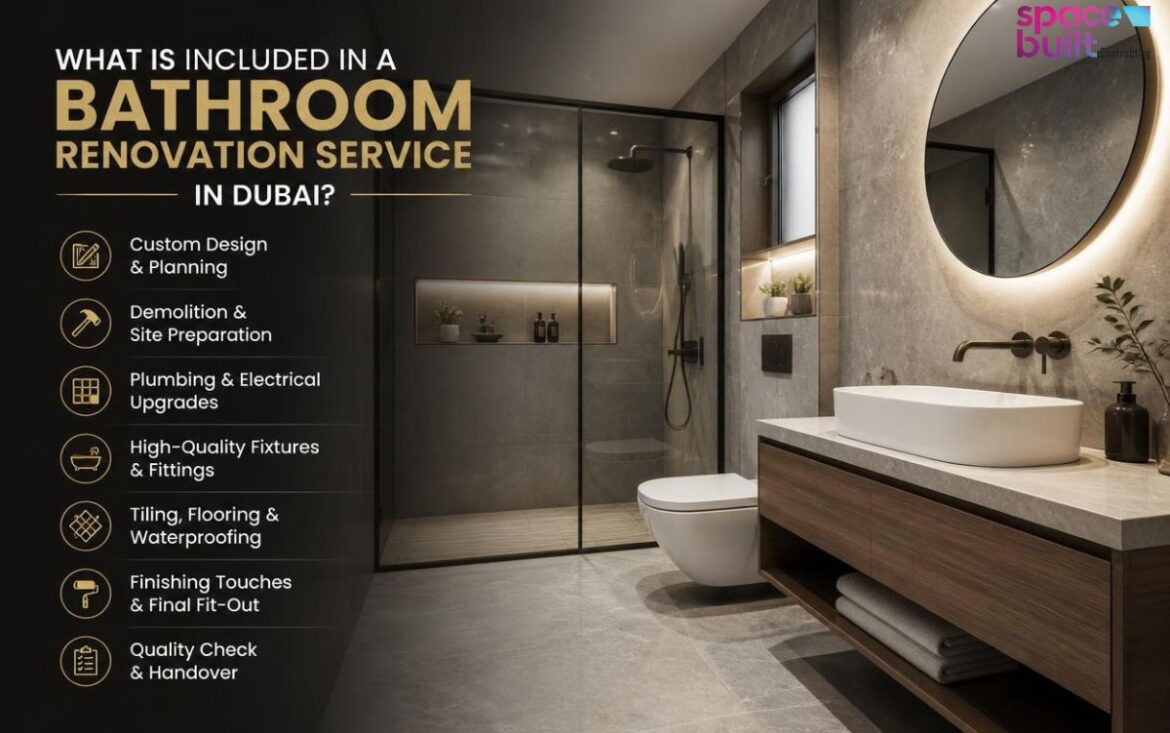
An all-inclusive bathroom renovation service in Dubai includes all processes from doing the site inspection to handing over the finished project. It entails design, request for approval, demolition, plumbing, electrical work, waterproofing, tiling, ceiling work, installation of sanitary ware, fixtures, lighting, ventilation, fitting kitchen cabinets, painting, and final inspection. Quality bathroom renovation services in Dubai manage these different trades under the same program, allowing for contracting just one company instead of separate contractors.
The sections below are organized according to what work is done on site and then how it is done in Dubai. By doing so, one will know what to ask for while requesting a price quote.
Key takeaways
- The full cycle procedure involves the inspection and design stage through approvals, trades, finishing stages, and final checks.
- Waterproofing systems are hidden under tiles; therefore, a flood check should be carried out before starting tiling.
- Typically, apartments and managed communities require written approval from the owners before starting the works.
- Humidity level and imported materials will affect the finish and schedule.
What does a full bathroom renovation cover?
This table shows the main stages. Each one is explained after it.
| Stage | What happens | Why it matters |
| Site inspection | Measurements, checks of pipes, drains, and wiring | Sets a realistic scope and price |
| Design and approvals | Layout, materials, fixture list, building permission | Avoids stop-work orders and mid-job changes |
| Demolition | Strip-out and debris removal | Shows the true condition of the room |
| Plumbing and electrical | New supply, drainage, wiring, protection devices | Safety and long-term reliability |
| Waterproofing | Membrane, corner detailing, flood test | Protects your unit and the one below |
| Tiling, floor, ceiling | Wall and floor finishes, moisture-resistant ceiling | Durability and slip resistance |
| Fixtures and cabinetry | Sanitaryware, taps, vanity, storage, glass | What you see and use every day |
| Finishing and inspection | Painting, sealing, cleaning, snagging, handover | Catches defects before final payment |
Site inspection and measurement
The job starts with a visit, and the quote comes after. Someone from the contractor measures the room, checks the walls and floor, and looks at what sits behind the finishes.
They usually check:
- Pipework, drain positions and water pressure
- Past leaks, damp patches and tiles that sound hollow when tapped
- Electrical load, earthing and socket positions
- Ceiling height, the void above a false ceiling and any AC ducting
- Lift size, access routes and the building’s working hours
Therefore, in apartments, the position of the drain and stack often decides the layout before any design work begins. Moving a toilet a metre sounds easy until the stack says no.
Planning, design and approvals
Design turns your wish list into something a crew can build. You should get a layout drawing, material selections, and a fixture schedule that lists each tap, shower head, and light. A bill of quantities and a timeline belong in there too; otherwise, the price tends to drift.
Approvals deserve attention early. Nearly all communities require a No Objection Certificate (NOC) from the developer, owners’ association, or building management prior to starting work. Frequently, they require a deposit and impose limits on working hours, registration of contractors, and removal of waste.
If there is a change in plumbing configuration, wet areas, or building services, a municipality permit may also be necessary, and this is often filed by a licensed consultant. Moreover, cosmetic remodelling usually requires less documentation, but the building has the final authority on such issues. Reliable home renovation services in Dubai take care of these submissions for you.
Tenants need the landlord’s written consent before anything is ordered or demolished. Rules differ between communities, so confirm with building management and your contractor before you commit.
Demolition and preparation
Demolition is more than smashing tiles. Expect the crew to:
- Remove the old sanitaryware, vanity, accessories and false ceiling
- Strip wall and floor finishes back to a sound base
- Protect lifts, corridors and shared areas
- Take debris out within the hours the building allows
However, care matters because pipes and cables sit closer to the surface than most people expect. This is also when hidden problems turn up, like old leaks or cracked screed. A good team photographs them and tells you before any repair begins.
Plumbing and drainage
Plumbing is rarely just swapping taps. A full scope usually includes:
- New hot and cold supply lines with isolation valves
- Concealed cistern frames for wall-hung toilets
- New drain lines, floor drains or linear drains
- Water heater connections
- A pressure test before anything is closed up
The floor has to slope toward the drain. If it doesn’t, water pools no matter how good the tile is. The pressure test takes little time and costs little, and it finds leaks while the walls are still open.
Electrical work and lighting
Water and electricity share this room, so licensed electricians should do the work to the applicable regulations. It typically covers:
- Moisture-rated light fittings and switches
- Residual current protection and proper earthing
- Sockets placed away from wet zones
- Wiring for the exhaust fan, mirror lights, and water heater
Moreover, layer the lighting. Ceiling downlights give general light, and a fitting at the mirror gets rid of shadows on your face. Warm white suits most homes, and a dimmer helps in the evening.
Waterproofing and ventilation
Homeowners never see waterproofing, and many regret skimping on it. A membrane goes across the floor and up the walls, running to full height inside the shower. Corners and pipe penetrations get extra reinforcement.
Cementitious coatings, liquid polyurethane and sheet membranes are all common. The right one depends on the substrate and the layout.
The flood test is what turns a claim into proof. Water sits on the floor, commonly for 24 to 48 hours, while someone checks the ceiling below. Tiling starts only after the membrane passes. In an apartment, a failed membrane damages a neighbour’s unit, which is expensive and awkward for everyone.
- Ventilation services
Poor airflow is the usual reason a bathroom smells musty. A proper service checks that the exhaust fan suits the room size and is ducted to a suitable outlet, not just into the ceiling void.
Windowless bathrooms depend entirely on extraction. Find out how the building’s shaft or ventilation system works before choosing a fan. A quiet fan in the right spot clears moisture fast and protects the paint, ceiling and cabinets.
Tiling, flooring and ceiling
Tile choice affects safety as much as looks. A few points to settle:
- Floors need slip-resistant tiles rated for wet areas.
- Wall tiles in porcelain or ceramic should have low water absorption.
- Large formats need a very flat base, or the edges sit uneven.
- Epoxy grout in showers resists staining and moisture better than standard grout.
- Corners and changes of plane get flexible silicone, not rigid grout.
For the ceiling, moisture-resistant board and paint hold up far better than standard plasterboard. Add a small access panel near the pipes or water heater so nobody has to cut into the ceiling later.
Sanitaryware, fixtures and cabinetry
This is the part you see every day. It usually includes:
- Toilet, basin and shower tray or wet-room drain
- Tempered glass shower enclosure
- Mixers, shower sets and a hand shower or bidet spray
- Towel rails, hooks, shelves and a mirror
Storage needs materials that tolerate moisture. Marine-grade board, solid surface or high-grade water-resistant laminate with sealed edges is more durable than conventional MDF. An organization that has its own joinery can manufacture a vanity suitable for an awkward place, hence enabling use of small bathrooms in compact apartments.
Furthermore, when comparing the various quotes, it is essential to check if the fixtures are supplied and installed or only installed. Inquire about the spare parts and the warranty for the brands used.
Painting, installation and finishing
Once the wet work is done, finishing begins:
- Moisture-resistant or anti-fungal paint on walls and ceiling
- Fitting the glass, vanity, mirror and accessories
- Silicone around baths, basins and glass
- Deep cleaning and removal of protective covers
Small details show up here. Straight silicone lines, aligned tile joints, and doors that close properly separate careful work from rushed work.
Final inspection and handover
A final inspection should be a walk-through with a checklist, not a glance. It normally covers:
- Water flow, drainage speed and leaks under the vanity
- Electrical tests and the exhaust fan
- Tile alignment, grout and silicone lines
- How doors, glass and cabinets open and close
- A snag list of small defects, fixed before final payment
At handover you should receive warranty details and care instructions for the surfaces and fixtures. If your building holds a deposit, its completion inspection is usually what releases it.
Dubai-specific considerations
Humidity, especially near the coast, keeps bathrooms damp for longer. That makes ventilation, sealed joints, and mould-resistant paint matter more than they would in a dry climate. Good bathroom renovation services in Dubai plan for this at the design stage.
Mineral scale can build up on fixtures, so pick finishes and cartridges that are easy to clean. Water-efficient taps and showers cut consumption and feel much the same to use.
Many tiles, sanitaryware pieces and fittings are imported. Order early to avoid delays, and confirm you can buy extra tiles later for repairs.
Working hours, lift booking, noise limits and waste disposal all come from your building. Your contractor should plan around them.
Cosmetic refresh vs full renovation
| Aspect | Cosmetic refresh | Full renovation |
| Scope | Paint, fixtures, accessories | Strip-out, new plumbing, waterproofing, tiling |
| Approvals | Usually lighter | Often an NOC and possibly a permit |
| Disruption | Short | Longer, with water shut-offs |
| Best when | Structure and tiles are sound | Leaks, an outdated layout or damaged surfaces |
What affects cost and timeline?
- Size of the bathroom and any layout change
- Tile, sanitaryware and fixture selection
- Custom joinery versus ready-made units
- Approval timelines and material delivery
- Condition of the existing waterproofing and pipes
How to choose a renovation contractor?
Shortlisting the best renovation contractors in UAE comes down to a few practical checks:
- A valid trade licence and experience with building approvals
- A written scope, itemised quote and timeline
- Named responsibility for waterproofing, including the method and the test
- Supervised or in-house trades, rather than a chain of unknown subcontractors
- Written warranty terms and references from similar projects
SpaceBuilt is a Dubai-based interior fit-out and renovation company that works through concept and collaboration, budget and planning, approval and fit-out, then handover and support. For home renovation services in dubai, its scope includes renovations, refurbishments and joinery, which helps when a bathroom needs several trades working together.
Additionally, ask every contractor the same questions and compare the answers, not just the prices.
Bottom line
A full bathroom renovation is a sequenced process: Inspect, Design, Approvals, Strip Out, Plumbing, Electrical, Waterproofing, Tiling, Fixtures, Finishing and a Final Check. They rely on each other, which is why it is better to have one accountable team to make things smoother at each stage.
There are a few more variables in Dubai, as humidity, building rules and imported materials come into play, and planning plays a major role, in addition to workmanship. If you’re comparing bathroom renovation services in dubai, you’ll want to see a clearly defined scope, a waterproofing system which is tested, and a written warranty.
If you’re thinking of upgrading, a firm such as SpaceBuilt can look at your space, and inform you what you need and provide you with a scope that you can compare.
Frequently asked questions
A simple task may be weeks of work. The time it takes to change layout, approve and import materials. Waterproofing must be cured and tested to withstand the flood, both of which take time.
In most apartments & managed communities, yes. Usually requires permission from building or developer and may require plumbing changeover permit. Written permission from landlord required for tenants.
Yes, in a full-service. It involves new supply and drainage lines, wiring, protection devices, lighting and fan connections, all tested prior to closure of the walls.
Yes, whenever the tiles come off down to the base. Damage to the membrane should be repaired, and it should be flooded prior to installation of new tiles.
You can if you have a second bathroom. Be prepared for noise, dust, limited working hours and scheduled water cut-offs.
It relies upon size, changes in the layout, materials and fixtures. Request an itemised quote to see what’s in it and to compare similar items.
Please see the quotation for details. Some contractors provide and install, others install only. Request writing, brands and warranties.
Low water absorption porcelain is popular. Use anti-slip coatings on floors, and ensure that the base is level enough for large formats.
Look for the licence, references, written scope, waterproofing method and warranty. If possible, go to a completed project, and check the quotes for the items.
Request a written workmanship guarantee, as well as manufacturer warranties on fixtures. Know what to do and whom to contact if leaks or defects are experienced.