
-
Spacebuilt
- August 26, 2026
- No Comments
Turnkey Construction vs Traditional Construction: Which Saves More Time and Money?
Table of Contents
- Key takeaways
- What does turnkey construction actually mean?
- What does traditional construction actually mean?
- Time comparison: where the delays really come from
- Cost comparison: fixed price vs flexible budget
- Quality control and accountability
- Which option fits which project?
- Common mistakes clients make
- Expert insights
- Conclusion
- Frequently asked questions
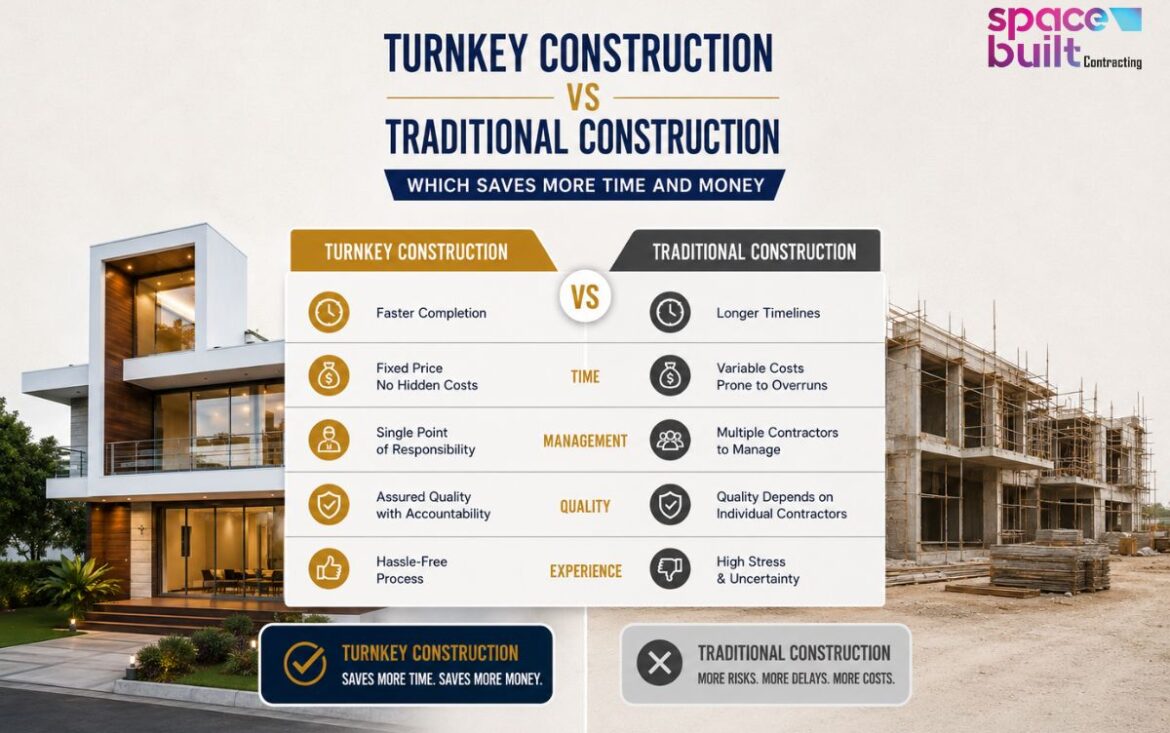
Turnkey construction provides great benefits due to its speed and efficiency. The ability of a company to carry out design, approvals, and building means nothing waits for anyone else, effectively removing delays. According to research on delivery models, the time advantage is calculated to be around 20% or more compared to the traditional design-bid-build, which means tens of months saved in mid-range projects.
Traditional construction gives more control over the project, as the architect, contractor, and suppliers are selected separately, giving clients an opportunity to have a say in every aspect of the design process. However, this brings its own drawbacks – the owner of the project becomes the one who has to monitor the work and resolve conflicts to avoid any budget issues in the future.
Key takeaways
- Projects can be completed 20% quicker by using a turnkey method than by using conventional construction methods.
- Although conventional construction provides flexibility, it can lead to delays and extra expenses if the project changes.
- The Dubai construction market is expected to reach over AED 201.99 billion by 2031, driving the competition.
- Select the greatest project delivery method according to your management time available, not just based on a lower price.
What does turnkey construction actually mean?
With turnkey construction, one contractor will handle everything from design to obtaining permits and actually building the project before handing it over to the client. In the end, the client simply receives the keys to the property and does not need to worry about incoming bills from different parties involved in the project.
The reason for the speed of the turnkey construction process is not necessarily related to the efficiency of the construction work, as the whole advantage comes from the fact that the design and construction process take place under one roof, and as a result, securing the permits and performing quality checks can be conducted simultaneously rather than after the building work is completed.
Turnkey construction has become widespread among builders in Dubai, and this concept is especially common in the case of fitouts, warehouses and mid-size residential construction projects. One of the reasons for the popularity of this form of construction is that often the clients are unable to coordinate the work of various contractors and vendors, as they might be located overseas or simply not have enough time for it.
What does traditional construction actually mean?
Traditional construction, which is sometimes called design-bid-build, divides the process into separate stages. You hire an architect, get the design approved, obtain permits, and put the construction out to bid. Every stage has to be completed before the next one can start.
The advantage is that you have real control. If you are unhappy with the architect, you can change architects. If you want to negotiate separately with the contractor, you can do so without undoing a master contract. The disadvantage is that you are now the coordinator. If the architect runs behind schedule, the contractor does nothing. If a flaw in the design comes to light after construction has begun, you are the one who has to deal with the delay while it is fixed.
Moreover, all this does not mean that traditional construction is a bad approach. It is suitable for people who want to make their decisions over a period of time and have the possibility to manage several relationships at the same time.
Time comparison: where the delays really come from
| Factor | Turnkey Construction | Traditional Construction |
| Design-to-build handoff | Overlapping, same team | Sequential, separate teams |
| Permitting | Runs alongside design | Usually starts after design is finalized |
| Vendor coordination | Handled internally | Client-managed |
| Typical schedule impact | 20%+ faster on average | Baseline |
| Risk of delay from miscommunication | Lower | Higher |
That 20% figure shows up again and again in comparisons between design-build and design-bid-build delivery, and on larger builds it tends to work out to ten months or more saved. Smaller residential or commercial building construction companies in Dubai see a proportionally similar gap, even if the raw number of days saved is less dramatic.
Worth being honest about: turnkey doesn’t make delays disappear. If the contractor is stretched thin across too many jobs, or the client keeps changing the scope after signing, the timeline slips just like it would under any other model. The speed comes from the structure, not from anything magical about the word “turnkey.”
Cost comparison: fixed price vs flexible budget
Turnkey contracts are usually priced upfront and fixed. You know the number before a single wall goes up, which matters a lot if you’re an investor working against a financing deadline. No surprise change order from the architect landing at the same time material costs jump on the contractor’s side.
Traditional construction can look cheaper going in, since you’re paying vendors separately and can shop each one. In practice, the gaps between phases eat into that: waiting for one contractor to wrap up before the next can start, or finding a design problem only after the foundation is poured. Rework is the cost people underestimate most in phased construction, and it’s rarely small.
Moreover, traditional does give you room to trim scope mid-project if money gets tight, which turnkey doesn’t offer as easily. Changing scope on a signed turnkey contract usually means a formal variation process, and that can end up slower and pricier than just adjusting the next stage of a traditional build.
Quality control and accountability
This is where the two models really pull apart. Something goes wrong under a traditional setup, and the architect points at the contractor, the contractor points at the supplier, and the client is stuck refereeing. Under turnkey delivery, there’s one name on the contract. That company owns the mistake and the fix.
For anyone comparing top construction companies in Dubai, this is often what tips the decision, not because traditional contractors do worse work, but because sorting out who’s actually responsible gets genuinely harder once three or four separate parties are involved.
Which option fits which project?
- Turnkey makes sense if you’re working to a fixed deadline, managing the project remotely, or need budget certainty more than you need to control every decision.
- Traditional makes sense if you want to make design calls gradually, already trust an architect, or the project is small enough that coordinating it yourself isn’t a burden.
- A hybrid setup, hiring a design-build firm while keeping an independent project manager to check milestones, works for people who want speed without giving up all oversight.
Common mistakes clients make
Most of the trouble in either model traces back to a few things people do without thinking too hard about it:
- Signing a turnkey contract without a clear scope document, then assuming “everything” was covered.
- Choosing traditional construction without setting aside real time for the coordination role that comes with it.
- Picking the lowest bid without checking whether that contractor has actually delivered a similar-sized project before.
- Never visiting an in-progress or finished site before signing anything.
- Underestimating how much a variation order costs once the scope changes, in either model.
Expert insights
After watching both models play out over enough projects, one pattern holds up: clients who care more about predictability than control tend to end up happy with turnkey, and clients who care more about control than speed tend to end up happy with traditional. Most of the dissatisfaction I’ve seen doesn’t come from either model failing on its own terms. It comes from someone picking the wrong one for what they actually cared about.
Therefore, Dubai’s regulatory side has gotten more detailed too. Municipality approvals and BIM submission requirements aren’t the light-touch process they were a few years ago, and firms offering turnkey project management services in Dubai are generally better set up to absorb that complexity in-house rather than leaving the client to chase it department by department.
Conclusion
Neither model wins outright. It comes down to how much time you have to run the process yourself and how firm your budget needs to be going in. If speed and certainty matter most, turnkey is usually the better call. If you want to control every decision and have the bandwidth for it, traditional construction still holds up fine.
If you’re trying to work out which fits your project, Spacebuilt scopes both delivery models honestly with clients across Dubai before recommending either one, because the right answer depends on the project in front of you, not a template.
Frequently asked questions
No, not always. Turnkey gives you price certainty upfront, but traditional construction can end up cheaper if you manage vendors well and avoid delays. The real difference usually comes down to how much rework and coordination cost you avoid.
Around 20% or more, based on comparisons between design-build and design-bid-build delivery models. On larger projects, that often translates to ten months or more saved.
You can, but it usually goes through a formal variation process that adds time and cost. Traditional construction is more forgiving here since you can adjust plans stage by stage.
Turnkey, more often than not, especially for fit-outs and warehouses where deadlines are tight. Smaller or highly customized projects sometimes go the other way.
You should have one. Without it, you’re taking on that coordination role yourself, and it’s more time-consuming than most people expect going in.
Yes, most turnkey providers scale down for villas and smaller builds. The time savings won’t be as dramatic as on a large commercial job, but the same logic applies.
Depends entirely on what’s written into the contract. Most turnkey agreements include penalty clauses for missed deadlines, which is one clear edge over traditional construction, where responsibility is split across vendors and harder to pin down.
Look at their completed project portfolio, ask for references you can actually call, confirm they’re licensed with Dubai Municipality, and go see a site in person if you can.
It does. With the UAE market on track to keep growing through 2031, good contractors get booked out further in advance, so vetting early matters more than it would in a slower market.
Yes, through a hybrid setup: hire a design-build team but keep an independent consultant reviewing milestones. It suits people who want speed without handing over all oversight