
-
Spacebuilt
- November 14, 2026
- No Comments
Exhibition Stand Design Ideas for Product Launch Events
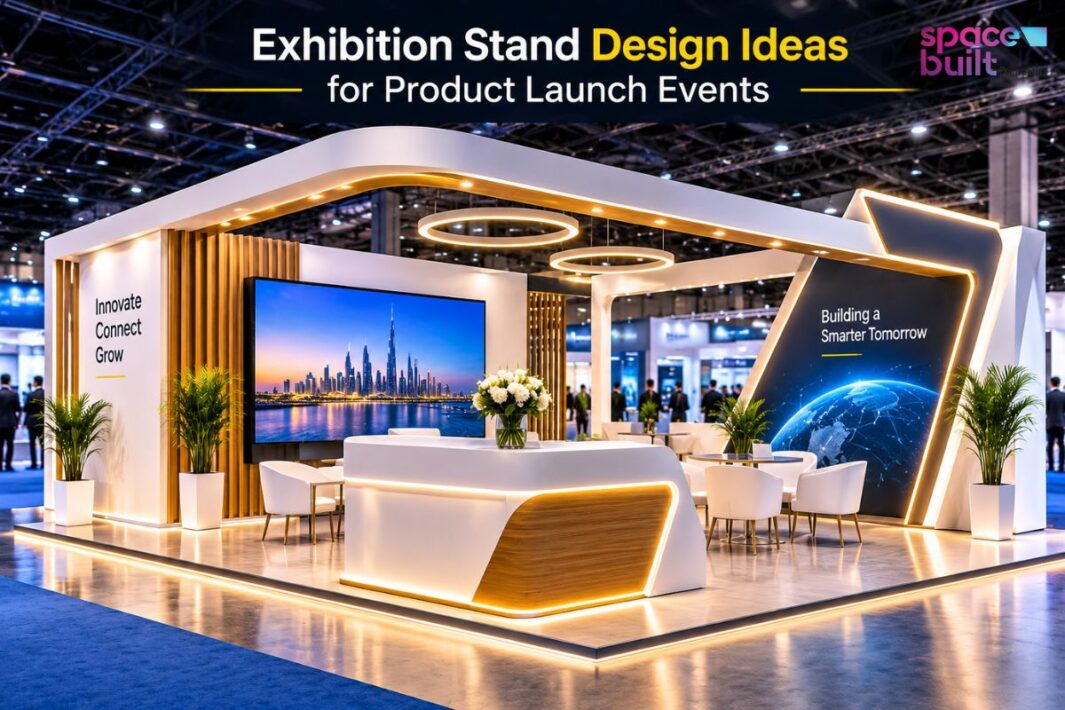
A successful exhibition stand for the product launch relies on the use of space effectively, along with a specific point of attraction and hands-on displays, in order to demonstrate the product in use quickly. The optimal exhibitions lead visitors from entering the booth to the moment of unveiling and further take the viewers through the demonstration zone before reaching the booth’s capture point. Lighting, branded graphics, and a comfortable meeting corner support the story without crowding the floor.
Therefore, brands that design the visitor’s path before deciding on the decorations usually receive more visitors and better leads. Dubai-specific showcases add constraints like high temperature resistance of the materials used and reasons for a very short time frame for construction, and this makes every creative idea feasible.
Key takeaways
- Have a clear launch story and measurable goals to keep in mind before selecting any design element.
- Choose a layout that will emphasize the hero product in the main aisle.
- Include interactive elements that relate to the product functionality.
- Choose a designer who will run the entire process of designing, fabrication, and consulting the venue under a single plan.
What makes a product launch stand different?
A product launch does not simply involve being at a trade show. The stand needs to be exciting about something new, and should be able to start a conversation that visitors can grasp in a short amount of time. Your design is competing with dozens of other booths in a single afternoon, so you have only a few seconds to get people’s attention.
Launch stands, in particular, have more responsibilities than regular stands. Buyers in the sales team, journalists, distributors, and existing customers typically want to see a product in action, hear the message clearly, and be given a clear call to action to take next steps.
Setting clear goals before designing
The first step is to have three measurable objectives written down. This could be the number of demo sessions, the number of qualified leads, media interviews, or orders placed during the event. The layout is designed around each goal. A stand designed to showcase demonstrations requires a large area and seating; a stand designed to cover the news requires a blank backdrop and a private interview corner.
Common launch goals usually include:
- Producing qualified leads from prospective buyers at the event.
- Demonstrating the product in an active or actual situation
- Making moments for press and social media that are shared
- Developing and nurturing distributor and channel relationships
With clear goals in place, it’s easier to justify decisions on lighting, staffing, and more.
How should you plan a launch stand around the product?
Planning starts with the product and not with colours or furniture. When a product is created, ask what it is, who needs it the most, and what attribute of the product will most impress those who need it. That feature is the main topic for the stand.
Build a clear visitor story
Imagine that your stand is a short movie. The visitor should be invited to enter, view the product, seek to comprehend its principal advantage, if they can, taste it, and then have a conversation with someone who answers their questions. This is an example of how the story can be developed on paper before the drawing is started, in order to focus the design. There should be one clear job in each zone on the floor.
Map the Visitor Journey
Walk through the floor plan as a visitor would. Check where they will go in, what direction they will turn, and where they will tend to pause. Viewing lines are very important. The hero product is prominently displayed from the main aisle, doing some of the marketing for the rest of us before we ever step inside.
The following is a typical planning sequence to be followed in a practical setting:
- Confirm the launch message, key product features, and the target audience.
- Create visitor zones like the reveal area, the demo station, and the meeting area.
- Draw lines from the main aisle and other booths.
- Schedule the lighting, graphics, and staffing for each zone.
- Set up a contract with the venue management and the build contractor to lock the schedule in.
Therefore, by finishing these steps early, the chances of costly changes during the actual production are reduced.
Which layouts work best for launch events?
The layout depends on several factors like floor size, traffic, and budget. These layouts are most commonly seen at product launches, each of which is ideal for a particular type of story.
- Open Island Stands
Open islands permit visitors to stroll around the product from all sides. They are ideal for larger machines, vehicles, and equipment where a 360-degree view is important. They require more space on the ground and route planning of walkways to ensure that people do not obstruct exits, but their disadvantage is that they occupy more space on the ground and require careful planning of the walkways.
- Corner Stands
The corner booth tends to have more visibility than an inline booth, and is typically open onto two aisles. They are suitable for medium-sized launches. Hero display should be on the angled corner, since it reaches out to people from both sides.
- Two-Level Stands
The building has two levels to allow for the use of a private meeting room or VIP lounge on the upper floor, with most of the reveal taking place on the ground level. This setup is ideal for brands that have a high number of guests or executives that want a serene environment for discussions. Look for venue height limits and staircase specifications early, as it may take some time to get approvals.
Let’s have a quick look at the similarities and differences of the most popular choices:
| Layout | Best Use | Floor Space Needed | Visitor Flow | Relative Budget |
| Open island | Large products, vehicles, machinery | Large | Excellent, walk-around | High |
| Corner stand | Mid-sized launches | Medium | Good, two aisles | Medium |
| Inline stand | Small products, tight budgets | Small | Limited, single aisle | Low |
| Two-level stand | VIP hosting and meetings | Medium to large | Strong with upper lounge | High |
Which design ideas make a launch stand out?
While creative ideas are important for making a stand stand out, the best ideas also work to tell the product story. The following are some design ideas that have proven to be effective at launch events.
- Create a Product Reveal Moment
A reveal is what makes the product an event. You could choose a backdrop that rolls out, a rotating platform, or a lighting sequence where she moves the product into the spotlight at a predetermined moment. Make the reveal low-tech and repeatable. A quick peek every half hour can attract people without slowing down the flow of passersby.
- Use Large Visual Screens Wisely
LED walls and projection can take the brand story throughout the hall. Display them to demonstrate the key features of the product, actual customer cases, or a brief launch video. Do not clutter the screen with a lot of logos. The movement should be smooth, and there should be no difficulty reading any text at several metres’ distance.
- Keep Graphics Clean and Bold
Use one headline, one supporting line, and one call to action on each wall. After all, busy graphics with small text get lost in a crowded hall. High contrast between background and lettering makes messages readable in mixed lighting.
- Plan Lighting and Sound with Purpose
Lighting directs attention. Spotlights in the meeting areas are lit hot, while other lights are diffused and subtle, providing natural contrast and direction. Sound should be kept to a minimum and should not be competing with neighbouring stands. Headsets or a small speaker zone can help if there is a need for audio, keeping the rest of the hall quiet.
- Use Brand Colours with Restraint
Brand colours are ideal for the back wall, floor accent, and details of furniture. Avoid placing the product in a bright red or orange space; instead, make it the focal point of the stand.
How can interactive features boost engagement?
Interactivity provides points of interest for visitors to pause and linger. They also gather info that your sales group can follow up on post-event. The important thing is to match features with the product and not just to add screens for the sake of screens. If the product has customizable options, it makes sense to use a touch screen configurator, while a live demonstration suits machinery that needs to be seen working.
The table below compares popular interactive features:
| Feature | What It Does | Best For |
| Touchscreen configurator | Lets visitors customise the product | Consumer and industrial products with options |
| AR or 3D viewer | Shows product details at real scale | Complex or large equipment |
| Live demo station | Shows real performance in action | Machinery and technology |
| Branded photo spot | Creates shareable social content | Consumer launches and media events |
| QR lead capture | Sends brochures and collects contact details | Every launch, regardless of category |
One element that really needs attention is the capture of leads. When scanning a QR code, users should only be directed to a short form that requires only the information that your sales team actually requires. Long forms can decrease completion rates, and visitors may abandon the form before completing it. Schedule a follow-up email or call before the event to prevent loss of interest.
Which materials suit Dubai exhibition halls?
Dubai’s exhibition conditions are challenging ones. It frequently occurs under high-pressure deadlines, and stands are subject to heavy foot traffic, regular handling, and constant equipment movement over several days of the show. Halls are air-conditioned, but the material is still a critical factor in terms of durability, weight, and look.
Common material options include:
- Lightweight and strong aluminium frames and mouldings.
- Laminated MDF or veneer panels, providing clean and consistent finishes
- Tempered glass for product display cases and partitions.
- Fire-rated panels in areas of venues where required by venue rules
- Modular parts which can be reused at other events in the future
There are a number of brands that introduce products in various shows throughout the year, so reusable modular systems should be taken into consideration. Inquire with your builder how they maintain their stored parts and if you can change the design for the various floor sizes.
Moreover, good exhibition stand manufacturers in Dubai will always be able to come up with designs that bring in a lot of efficiency and cut costs while maintaining a high-quality finish.
What should a launch stand budget cover?
Exhibitions have a range of prices, and there is a need to be aware of what is driving the cost. All of these factors contribute to the size, materials, custom fabrication, technology, graphics, lighting, freight, labour for installation, and dismantling. It might be the case that a low quote does not include the freight, electrical connections, or venue charges, and this can be a costly omission.
As you’re getting quotes for Dubai exhibition stand design, request a line-item quote. A clear breakdown allows you to easily compare offers and identify where you can save without compromising the launch. You may, for instance, specify fewer custom parts in the Hero display, but still retain the full customization of the Hero display.
Cost categories to review include:
- Concept design and 3D visualisation
- Structure fabrication and finishing
- Graphic printing and installation
- Audio-visual apparatus and interactive hardware.
- Electrical, lighting and internet connectivity.
- Freight, installation and supervision on site
- Dismantling and storing for reuse.
Always have a contingency plan for changes in graphics, extra power points, or venue needs. Additionally, it’s a good idea to ask if the builder can reuse parts for his next launch, as this can save you money on your next event. When considering the cost of fabricating a stand, get written quotes from the best exhibition stand design companies in Dubai; you will know the average market rate for your stand design.
How do you choose the right stand partner?
One of the most critical decisions in the project is the choice of a partner. Seek a group that can be creative in design and skilled in fabrication. The very best exhibition stand design firms in Dubai provide concept development, project handling, on-site supervision, and in-house production, which means that what you approve on screen is actually the layout you see on the ground.
If you’re looking for exhibition stand design services in Dubai, then select three companies and compare them using a brief. This is a demonstration of how each of them understands your story, how they deal with constraints, and how clearly they communicate. The top exhibition stand builders in Dubai also tend to excel in their project schedules and have clearly defined processes, so request to view these as well.
What to check in a portfolio?
Search for launch stands that are similar to your product category. There’s different engineering to a machinery launch than there would be a beauty product reveal. Inquire if the work was constructed in the UAE, how long it took for every project to be approved to come down, and whether they did their own venue paperwork.
Questions to ask before signing
How a partner will work with you is evident in good questions. Consider asking:
- Will there be one person responsible for the build?
- Do you make your own or outsource work while placing orders?
- What are your venue approval and electrical certification procedures?
- What will you do if the product is delayed or doesn’t fit?
- Have you recently launched a product or service, and can you tell me about it?
Qualified teams respond to these questions in a clear and written manner. If there is a vague answer, this is a red flag. Spacebuilt can help with exhibition stands and space planning, eliminating the need for brands to coordinate separate vendors to discuss design and build.
What mistakes should you avoid at a launch?
A successful campaign doesn’t always happen, even in a well-funded campaign. These errors are mostly due to late planning or planning in the team’s interest instead of the visitors’. Avoid the following:
- Flooding the stand with too many messages or products.
- Hiding the hero product behind furniture or tall graphics
- Relying on the last day of build-up to use the available lighting
- Forgetting to take the lead out of the water and then not planning the next steps.
- Not taking time to prepare for venue approvals
- Making a nice-looking stand in the render but one that is difficult to man.
A simple test can help. Have a group meeting to stand at the main aisle and try to guess what it is, the main benefit, and the next step within 5 seconds. Otherwise, make it as simple as possible to make it before it is made.
Conclusion
A successful exhibition stand is based on a well-defined concept, an attractive lead product, and professional preparatory work. For a proper approach to the booth, the stall should be taken as a full-fledged path for visitors, allowing all design decisions to contribute to the achievement of the goals connected with the product launch.
Moreover, start with defining your objectives, select the layout that suits your space, and implement interactive components only when they serve the product. If you are ready to proceed, request exhibition design proposals from your partners among the best exhibition stand builders in Dubai, set their quotes against your initial requirements, and choose one of the most creative solutions with the help of experienced professionals like Spacebuilt.
Frequently asked questions
Begin 4-6 months before the event. This allows for concept approval, fabrication, and venue paperwork. Time crunch projects usually end up costing more and being less refined.
Select one of the exhibition stand design companies in Dubai that has a history of launches and in-house design and fabrication. Request references before signing.
A designer develops the concept, while the builder builds, assembles, and tears down the stand. Some companies will provide both, making it easier to coordinate.
Yes, often, because with experienced teams there will be fewer last-minute surprises, rework, or delays in a tight build window. Don’t make your decision until you request reference.