
-
Spacebuilt
- August 21, 2026
- No Comments
Step-by-Step Building Construction Process in Dubai: From Concept to Handover
Table of Contents
- Key takeaways
- Why does the construction process matter in Dubai?
- Step 1: Concept and feasibility study
- Step 2: Design development and permit approval
- Step 3: Contractor tendering and selection
- Step 4: Site mobilization and foundation work
- Step 5: Structural build and MEP installation
- Step 6: Interior fit-out and finishing
- Step 7: Inspection, testing, and handover
- Villa construction vs. commercial construction
- What separates the top construction companies?
- Common mistakes that delay projects
- Expert insights for a smoother handover
- Final thoughts
- Frequently asked questions
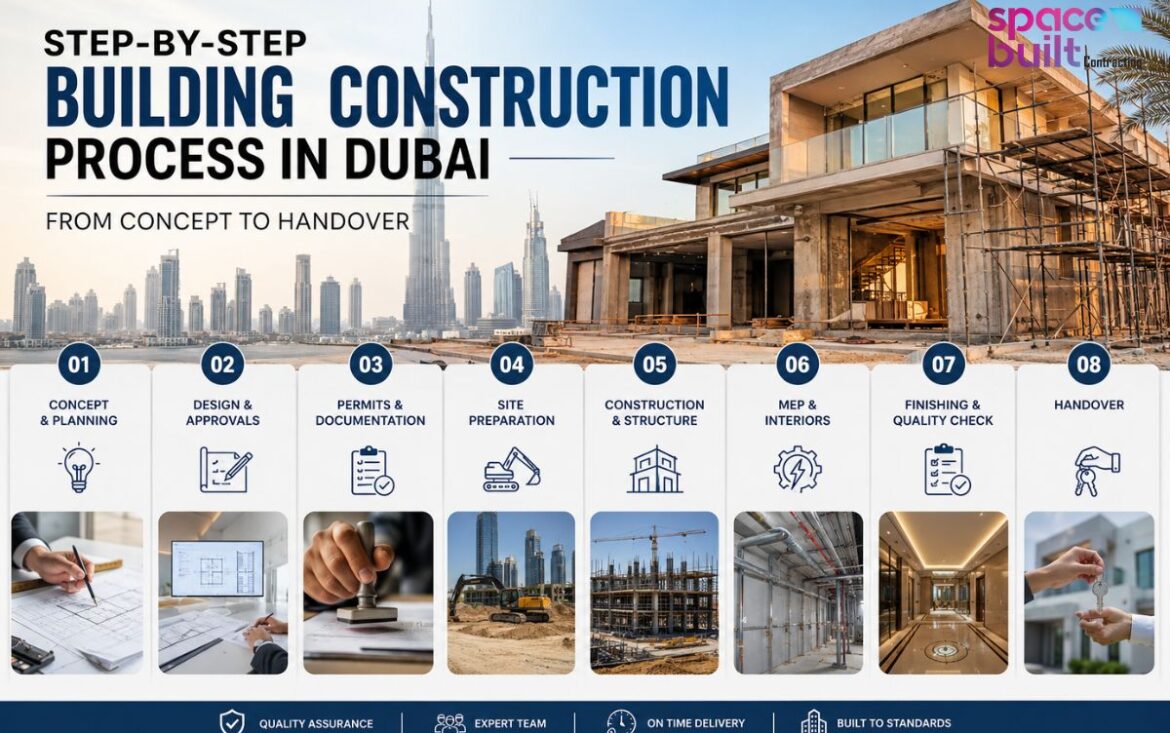
The construction process in Dubai comprises seven stages of construction, including feasibility study, designing and obtaining permission from Dubai Municipality or any other relevant free zone authority, contractor tendering, mobilization of site and laying of foundation, construction, installation of building utilities and services, interior finishing, and final inspection before sale.
A licensed contractor doing building construction in Dubai will take 8 to 14 months for a mid-sized villa, and 18 to 30 months for a commercial building, depending on the plot size, speed of approval, and the nature of the design. The construction industry in the UAE is valued at $44.5 billion in 2026, with Dubai receiving nearly half of the market share. Getting the order of construction in sequence, especially at the stage of permits, is what determines the success of project completion and on-time completion.
Key takeaways
- In Dubai construction, there are seven phases, with feasibility preventing the scenario of expensive budget overruns.
- The process of obtaining the permit often takes the longest, as keeping in mind the updated requirements for BIM in Dubai.
- BIM checks take weeks; thus, experienced companies have planned their timelines in a way to leave the necessary buffer time.
- Building construction companies in Dubai rely on in-house teams to keep to their timelines.
Why does the construction process matter in Dubai?
The construction industry of Dubai is not an insignificant industry, and it does not seem to slow down either. The UAE construction market is going to reach the amount of $44.54 billion in 2026 and will continue to grow by 5.64% each year until it becomes $55.81 billion in 2031, with about 47.2% of activities carried out in Dubai in 2025. Such a market is likely not to go through only one approval authority. Depending on the location of a project and whether it falls under the authority of the Dubai Municipality, free zone authority, or a master developer, you might have all three of them to communicate with simultaneously.
Therefore, being aware of the whole sequence of events helps both homeowners and developers to avoid committing two mistakes that usually make almost all projects impossible to accomplish.
- The first mistake is to submit the construction design plans before verification of the required rules on the chosen plot.
- The second mistake is to hire a contractor before the official approval for constructing the project is obtained.
Both mistakes cause delays, and delays on the construction project site in Dubai are not cheap. Building construction company Dubai are beneficial in this matter.
Step 1: Concept and feasibility study
A feasibility study is the first step in any project, even if this step seems like delaying things when you want to start doing something. Here, three questions must be answered: is the land zoned correctly, can the required money be obtained, and what are the restrictions imposed?
In the case of villas, the plot has to be checked according to the regulations imposed by Dubai Municipality, and they may vary from one community to another. For example, Arabian Ranches have a height limit than Jumeirah Golf Estates. In the case of commercial projects, it would also mean finding out if the site belongs to the Dubai Municipality, a free zone such as DMCC, or a master developer like Emaar or Nakheel.
A realistic feasibility study starts with an approximate cost estimation and a site investigation that includes an evaluation of the soil conditions of the land. Taking shortcuts like skipping the soil testing process in order to save a few weeks is one of the costly shortcuts that we come across. Making changes to the foundation afterwards will be much more costly than carrying out the required tests.
Step 2: Design development and permit approval
This is the phase of the process where the architectural drawings will be stamped by an authority that is going to take the design to the next level. The concept drawings are transformed into architectural, structural, and mechanical drawings that can be forwarded by means of the Dubai Municipality’s eSubmission system or the system of the respective authority.
Since January 2024, most submissions also require BIM (Building Information Modeling) files rather than flat 2D drawings. That added a layer of technical review that didn’t exist a few years ago. Expect several rounds of comments back and forth before final approval, especially on drainage, fire escape routes, and parking ratios.
Realistic timeline for this stage:
- Villa (standalone, standard plot): 6 to 10 weeks
- Small commercial fit-out: 3 to 6 weeks
- Mid-rise commercial or mixed-use: 10 to 16 weeks
A villa construction company in Dubai that has worked in a specific community before usually moves faster here, simply because they already know that community’s recurring objections and design around them from the start.
Step 3: Contractor tendering and selection
Once permits are in hand, or sometimes running in parallel to save time, it’s time to select a contractor. Larger projects go through formal tendering: the design package goes out to three or four top construction companies in Dubai, each submits a priced proposal, and the client compares them on cost, timeline, and track record.
However, smaller residential projects often skip formal tendering and go direct to a single contractor, particularly if that firm handled the design phase too. There’s a trade-off either way. Tendering usually gets a better price but adds two to four weeks. Going direct is faster but relies more on trust in the contractor’s estimate.
Before signing anything, check the contractor’s DED trade license and Dubai Municipality classification, their track record on similar-scale projects, and whether their quote separates structural, MEP, and finishing costs clearly or bundles everything into one vague number. A bundled quote is harder to audit later when variations come up, and variations almost always come up.
Step 4: Site mobilization and foundation work
This is the visible start of construction: site fencing, welfare facilities for workers, excavation, and foundation work. Depending on soil conditions, Dubai sites often need piling before the foundation slab goes in, particularly near the coast where sabkha (soft, salt-affected soil) is common.
Foundation work for a villa typically takes 4 to 8 weeks. For a commercial building with a basement or piling requirement, it can run 10 to 16 weeks. This stage is also when utility connections (DEWA for power and water) get initiated. Those approvals run on their own timeline, so it’s worth starting them early rather than waiting until the structure is finished.
Step 5: Structural build and MEP installation
Once the foundation cures, the structural frame goes up: columns, beams, slabs, and for taller buildings, the core. MEP rough-in (the pipes, ducts, and conduits that go inside walls and slabs before they’re closed up) happens alongside the structural work, not after it. Coordination between the structural and MEP teams matters most right here, because once the concrete pours, mistakes are locked in.
Furthermore, this is typically the longest phase by calendar time. A two-story villa structural shell usually takes 3 to 5 months. A mid-rise commercial building can take 8 to 14 months depending on floor count and structural complexity. Weather isn’t usually a major factor in Dubai the way it is elsewhere, but the summer heat does slow outdoor concrete work and affects worker schedules under the UAE’s midday work ban, typically enforced June through September.
Step 6: Interior fit-out and finishing
With the shell complete and MEP systems installed, attention shifts inside: flooring, wall finishes, kitchens, bathrooms, joinery, and paint. This is also where most of the visible design decisions get made, and where clients tend to request the most changes. It’s worth planning for that financially rather than treating it as a surprise.
Fit-out timelines vary enormously based on finish level. A standard villa interior takes 6 to 10 weeks. Moreover, a high-end villa with custom joinery and imported finishes can take double that. Commercial fit-outs depend heavily on tenant requirements and can range from a few weeks for a simple office to several months for a retail flagship or restaurant.
Step 7: Inspection, testing, and handover
Before anyone moves in, the building goes through a series of inspections: Civil Defense fire safety checks, DEWA final connection inspection, and Dubai Municipality’s completion certificate review. Snagging (identifying and fixing minor defects) happens in parallel, and it’s normal for this list to run into the hundreds of items on a large project, most of them cosmetic.
Once inspections pass, the developer or contractor issues the Building Completion Certificate, and DEWA activates permanent power and water. Only then does formal handover happen, along with warranty documentation and as-built drawings. Skipping the as-built drawings request is a mistake we see often. They matter later for any renovation or maintenance work.
| Stage | Typical Duration (Villa) | Typical Duration (Commercial) |
| Feasibility & concept | 2–4 weeks | 4–8 weeks |
| Design & permit approval | 6–10 weeks | 10–16 weeks |
| Contractor tendering | 2–4 weeks | 3–6 weeks |
| Site mobilization & foundation | 4–8 weeks | 10–16 weeks |
| Structural build & MEP | 12–20 weeks | 32–56 weeks |
| Interior fit-out | 6–14 weeks | 8–24 weeks |
| Inspection & handover | 2–4 weeks | 4–8 weeks |
Villa construction vs. commercial construction
The seven-stage framework applies to both, but the details diverge quickly. A villa construction company in Dubai usually deals with community-specific architectural guidelines, single-family MEP loads, and a client who’s living through decisions in real time. Commercial construction deals with tenant fit-out coordination, higher fire and life-safety requirements, and often a phased handover across multiple floors or units rather than one single date.
Material selection differs too. Villas lean toward finishes chosen for aesthetics and daily comfort. Commercial buildings prioritize durability and code compliance, since a retail unit’s flooring has to survive years of foot traffic in a way a bedroom floor doesn’t.
What separates the top construction companies?
Not every contractor with a trade license operates the same way. The firms that consistently rank among the top construction companies in Dubai share a few traits: in-house structural and MEP teams rather than fully subcontracted work, a transparent variation-order process, and a documented track record with Dubai Municipality on projects similar in scale to yours.
Price shouldn’t be the only filter. A quote that’s 20% below the others on your shortlist is worth questioning, not celebrating. It usually means thinner materials, an incomplete scope, or an expectation of variation orders once work starts.
Common mistakes that delay projects
A few patterns show up again and again on delayed projects:
- Starting design before confirming plot-specific regulations, which forces a redesign mid-process
- Choosing a contractor purely on lowest price without checking their DM classification or portfolio
- Underestimating fit-out timelines, especially for custom joinery or imported materials with long lead times
- Treating utility connection (DEWA) as an afterthought instead of initiating it during foundation work
- Not budgeting for variation orders, which are almost inevitable on any project running longer than four months
Expert insights for a smoother handover
Contracts should specify who pays for delays. Not just contractor delays, but delays caused by authority review times too. Municipality review can move faster or slower depending on submission season and staffing, and that’s genuinely outside anyone’s control. Splitting responsibility clearly in the contract avoids disputes later.
It also helps to request weekly, not monthly, progress photos during the structural phase. Once walls close up around MEP work, problems that would’ve taken an hour to fix become a demolition job. Catching them early is cheap. Catching them after finishing starts is not.
Final thoughts
Building in Dubai isn’t complicated once you see the sequence clearly: feasibility, design and permits, contractor selection, foundation, structural build, fit-out, and handover. Where projects go wrong is almost always at the seams between stages, not within them. Coordination between design, structural, and MEP teams matters more than any single phase on its own.
If you’re planning a villa or commercial build in Dubai and want a team that manages that coordination end to end, Spacebuilt handles projects from concept through handover under one roof. Fewer separate contractors usually means fewer surprises and fewer weeks lost to miscommunication.
Frequently asked questions
A standard villa takes roughly 8 to 14 months from permit approval to handover. Commercial buildings typically run 18 to 30 months depending on size, floor count, and fit-out complexity.
Dubai Municipality approves most projects, though sites within free zones or master-developer communities like Emaar or Nakheel go through that developer’s own architectural review first.
Yes. Even small extensions require Dubai Municipality approval and a licensed contractor, since unpermitted structural changes can affect your property’s completion certificate later.
BIM is 3D digital modeling required for most Dubai Municipality submissions since January 2024. It adds technical review depth, which typically extends permit timelines by a few extra weeks.
Costs vary widely by finish level and location, generally ranging from mid-range to premium pricing per square foot. Getting itemized quotes from your villa construction company in Dubai is the only reliable way to compare.
Snagging is the list of minor defects fixed before handover. The completion certificate is Dubai Municipality’s official confirmation that the building meets code and is safe for occupancy.
Yes, but the UAE’s midday work ban, typically enforced from June through September, restricts outdoor work during peak heat hours, which can slow structural and site-based phases.
Check their DED trade license, Dubai Municipality classification, portfolio of similar-scale projects, and whether their quotes separate structural, MEP, and finishing costs clearly.
Most contracts include a delay-penalty clause, but it should distinguish between contractor-caused delays and authority-review delays, which are outside the contractor’s control.
Broadly yes, both follow the same seven stages, but commercial projects involve stricter fire codes, tenant coordination, and often phased handovers rather than a single completion date.