
-
Spacebuilt
- September 23, 2026
- No Comments
Common Construction Delays in Dubai and How to Prevent Them
Table of Contents
- Key takeaways
- What causes construction delays in Dubai?
- Design and approval delays
- Material and supply chain delays
- Labour and site coordination issues
- Weather and seasonal factors
- Contractual and payment-related delays
- How to prevent delays before they start?
- Choosing the right team from day one
- Bottom line
- Frequently asked questions
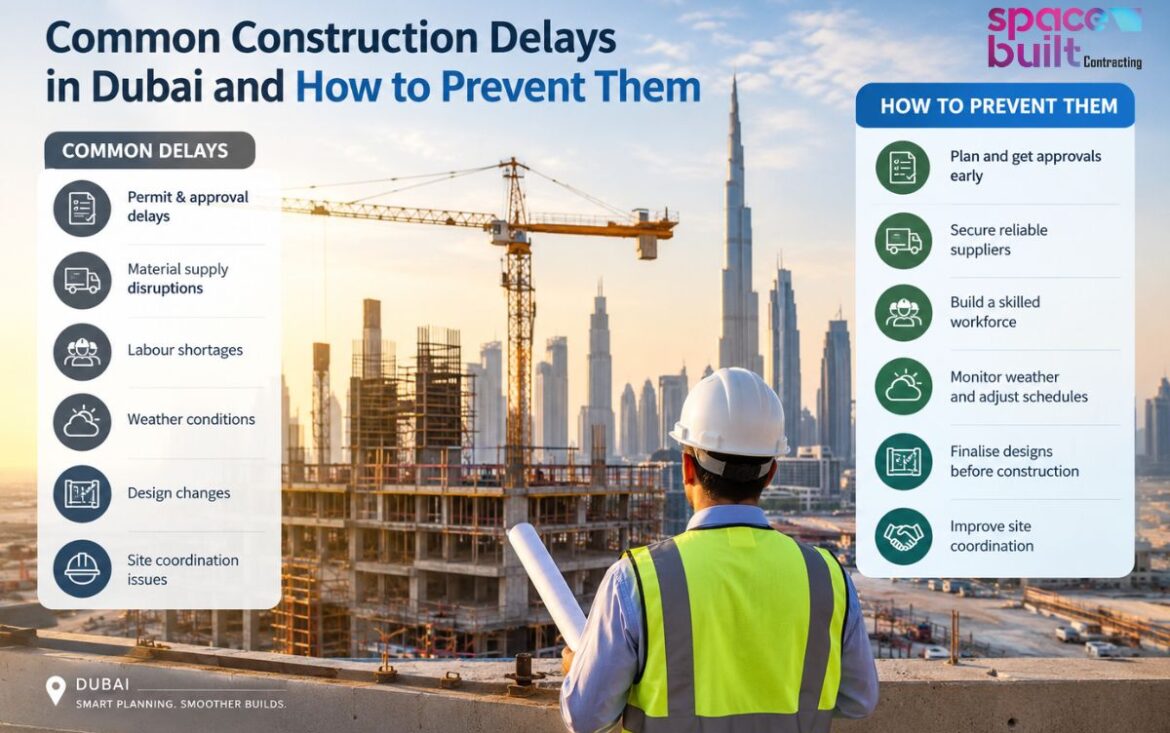
In Dubai, construction delays can be attributed to the same few factors: delays in approvals, delayed delivery of materials, workers being absent, and contracts lacking clarity concerning who covers a change of mind. Studies on construction in the UAE continually find fault with the same things:
- Coordination issues between consultants
- Contractors and clients
- Original timelines that are utterly unrealistic
Fixing these is not particularly complicated. However, the fixes to these issues must be put in place before the first bricks are laid and not after delays occur.
Key takeaways
- Most delays in Dubai construction come down to slow approvals, sourcing headaches, or contracts nobody read closely. Not bad luck.
- Bringing in an experienced villa construction company in Dubai from the design stage means less rework and fewer permit rejections later.
- Summer heat restrictions and Ramadan hours aren’t surprises. They’re on the calendar every year, so build them into the schedule instead of discovering them in June.
- A clear payment and variation clause does more to prevent disputes than almost anything else in the contract.
What causes construction delays in Dubai?
Dubai builds fast, and that’s partly the problem. Projects get greenlit before the drawings are fully coordinated, and that gap between what’s approved and what’s actually resolved on paper tends to resurface later as a delay.
Therefore, research into UAE construction delays keeps surfacing the same cluster: poor coordination on electromechanical works, contracts handed to whoever bid lowest without checking if they could actually deliver, slow approvals, late material delivery, and clients tacking on scope mid-build. This isn’t specific to villas. Commercial fit-outs and industrial builds run into the same wall.
A few others worth flagging:
- Contract durations set optimistically, before anyone’s dealt with actual ground conditions or design complexity
- Labour and equipment that can’t keep pace with what the schedule assumes
- Design approvals sitting on someone’s desk longer than planned
Design and approval delays
Permit approval in Dubai has genuinely sped up. Villa applications now run through a mostly digital process, and the municipality has been piloting AI reviews that can cut turnaround time from days to minutes for straightforward cases. “Straightforward” is the word for doing all the work there.
Moreover, applications still bounce back when drawings don’t match the Dubai Building Code, when plot planning documents are missing something, or when structural, mechanical, and electrical submissions contradict each other. Every rejection resets the clock, and that’s the part people underestimate.
What actually helps:
- Running compliance checks internally before submission, against the current Building Code
- Keeping structural, MEP, and architectural drawings in sync so reviewers aren’t catching contradictions between them
- Submitting through the Building Permit System with the building card filled out the first time, since incomplete paperwork is one of the most common reasons for rejection
A villa construction company in Dubai that handles permitting in-house tends to move through this faster, mostly because the people answering the municipality’s questions are the same people who drew the plans.
Material and supply chain delays
Material delivery delays show up near the top of nearly every study on UAE project timelines, and it’s not mysterious why. Specialised glazing, certain steel sections, imported fittings, a lot of finishing materials- these aren’t sitting in local warehouses in bulk. They’re ordered against the project timeline, and a hiccup at the port, in customs, or in a supplier’s own production run lands straight on site.
Ways to reduce the exposure:
- Lock in long-lead items like elevators, specialist glazing, and imported fixtures at contract signing, not after the crew has already mobilised
- Get lead times from suppliers in writing, not a verbal “should be fine”
- Keep a backup supplier lined up for the categories that go sideways most often, like tiles, sanitaryware, and electrical fittings
However, construction companies in Dubai with long-standing supplier relationships usually get priority on batches when demand spikes, and that matters more than people expect once the market picks up.
Labour and site coordination issues
Labour coordination between trades comes up constantly in surveys of UAE contractors. It’s rarely a shortage of hands. It’s sequencing, getting the right trade on site at the right moment, and stopping one late trade from holding up the next three behind it.
What actually moves the needle:
- Weekly, not monthly, check-ins between contractor, consultant, and the key subcontractors during active build phases
- One person on site who can make day-to-day calls without waiting on approval from head office
- Method statements agreed before mobilisation, so trades aren’t figuring out sequencing on the fly
Top contracting companies in UAE generally run tighter labour scheduling, mostly because they’ve built repeatable processes across dozens of jobs instead of starting from scratch each time.
Weather and seasonal factors
Dubai’s summer heat is not a surprise. It just gets treated like one when nobody’s planned around it. Midday work bans typically run from mid-June to mid-September, cutting into outdoor working hours for a set window each day. Ramadan shortens the working day across the sector for roughly a month too.
Both are on the calendar every single year. A schedule that pretends otherwise was never realistic in the first place, which is exactly the kind of issue that keeps turning up in delayed research.
Planning around it means:
- Scheduling concrete pours and roofing work outside the midday heat window
- Padding the timeline for Ramadan instead of assuming normal output
- Pushing indoor and finishing work into the summer stretch where it makes sense
Contractual and payment-related delays
Money disputes and vague contract language sit near the top of what drives disagreements on UAE sites, according to research into the sector. Late payments to contractors or subcontractors slow down procurement and labour. Variation clauses that don’t spell things out lead to arguments over who covers the cost when the client changes their mind partway through.
Spelling these out in the contract upfront saves weeks later:
| Contract Element | Why It Matters |
| Payment milestones tied to verified progress | Fewer arguments over what’s owed at each stage |
| A clear variation or change order process | Work doesn’t freeze while pricing gets argued over |
| Defined penalty and extension-of-time clauses | Both sides have an agreed basis for delay claims |
Furthermore, clients who work with a villa construction company in Dubai that pushes for a properly worded contract, even if it takes an extra week to agree on, usually end up with far fewer arguments once the build is underway.
How to prevent delays before they start?
None of this is glamorous. It’s mostly having the hard conversations early instead of letting them surface mid-build.
- Coordinate structural, MEP, and architectural drawings before submission, not during construction
- Set a timeline that actually accounts for permit review time, seasonal restrictions, and known material lead times
- Order long-lead materials early and get supplier timelines in writing
- Build a weekly coordination rhythm from day one
- Put payment terms and variation procedures into the contract instead of leaving it to “we’ll sort it out”
This doesn’t kill risk entirely. Ground conditions can still throw a curveball, and supply chains can still slip somewhere out of anyone’s control. But most of what shows up in Dubai construction delay surveys is avoidable with basic planning, not luck.
Choosing the right team from day one
The biggest lever a client actually has is who they hire. Construction companies in Dubai differ a lot in how they handle coordination, permitting, and suppliers, and that difference is usually the reason a project finishes on time or doesn’t.
Spacebuilt has worked across villa renovation, interior fit-out, and exhibition space projects in Dubai, and the pattern holds up: projects that stay on track are the ones where design, permitting, and procurement are run as one connected process, not three departments passing files to each other. It’s less a trick and more just not letting gaps open up between stages.
Worth asking any contractor directly:
- How do you handle a resubmission if the first permit application gets flagged?
- What’s your process for ordering long-lead materials?
- Who’s my one point of contact once construction actually starts?
Bottom line
Delays on Dubai construction projects don’t come out of nowhere. They trace back to approvals that weren’t cross-checked, materials ordered too late, labour that wasn’t sequenced properly, and contracts that left too much unsaid. A villa construction company in Dubai that treats these as things to plan for, rather than things that just happen, gives a project a real shot at staying close to schedule. The ones that run smoothly aren’t lucky. Someone just did the unglamorous work of thinking about delays before they showed up.
Frequently asked questions
It varies a lot, but permit issues, material delays, and scope changes commonly add weeks to months beyond the original schedule, depending on size and how well things are coordinated.
Yes. Midday heat restrictions in peak summer and shorter Ramadan hours both cut into daily productive time if nobody’s planned for them.
Coordinate structural, MEP, and architectural drawings before submitting, and check them against the Building Code beforehand.
Mostly. Locally stocked basics rarely cause problems. Imported glazing, elevators, and specialist fittings are usually where things stall.
Often, yes. Experienced construction companies in Dubai tend to have supplier relationships and permit familiarity that cut delay risk, which can offset a higher quote.
Clear payment milestones, a defined variation process, and agreed penalty or extension-of-time terms.
Submitting complete, cross-checked documents the first time is the biggest thing within a client’s control.
Long-lead items like elevators or imported glazing should be locked in at contract signing, not after the site is already mobilised.