
-
Spacebuilt
- July 27, 2026
- No Comments
Luxury Bathroom Renovation Ideas Inspired by Dubai Hotels
Table of Contents
- Key Takeaways
- Why do Dubai hotel bathrooms set the global standard?
- Signature design elements worth stealing
- Materials that define a five-star bathroom
- Layout and space planning lessons from luxury hotels
- Lighting, fixtures, and smart technology
- Common renovation mistakes to avoid
- Comparing renovation approaches
- Choosing the right renovation partner
- Questions worth asking before you sign anything
- Conclusion
- Frequently asked questions
Key Takeaways
- Dubai’s luxurious hotels utilize natural stone, multi-level lighting, and large-scale bathrooms to their utmost potential.
- Skilled bathroom renovation companies in Dubai help limit expensive errors in bathroom layout and plumbing.
- Various space planners in the emirate will make it easy for you to turn small bathrooms into luxury apartments.
- Leading renovation firms in the UAE select the proper layout before making expensive choices.
Step into a bathroom at Burj Al Arab or Atlantis and something shifts. It’s quiet. Spacious. You slow down without meaning to. None of that happens by chance. Hotel designers make deliberate choices about material, lighting, and layout, and a surprising number of those choices can be copied at home. This piece looks at what actually makes Dubai hotel bathrooms feel expensive, and how to get that same feeling through bathroom renovation services in Dubai without needing a hotel-sized budget.
Why do Dubai hotel bathrooms set the global standard?
Hospitality brands in Dubai treat the bathroom as its own event, not something you rush through. Designers on five-star projects get to work with imported stone, custom joinery, and enough square footage to prioritize comfort over efficiency. You can tell.
For homeowners, the great thing is that logic scales down perfectly. A hotel suite bathroom might be 25 square meters; however, zoning wet and dry areas, using warm ambient light, and having a single strong focal point will suit a guest bathroom of 6 square meters just as well.
Why does this actually work psychologically?
Hotels design bathrooms to slow guests down on purpose. Soft light, clear counters, one consistent material palette. It cuts down on visual noise. Once you notice that, you stop chasing whatever’s trending and start chasing quiet, which is closer to what luxury actually means here.
Signature design elements worth stealing
- The Freestanding Tub
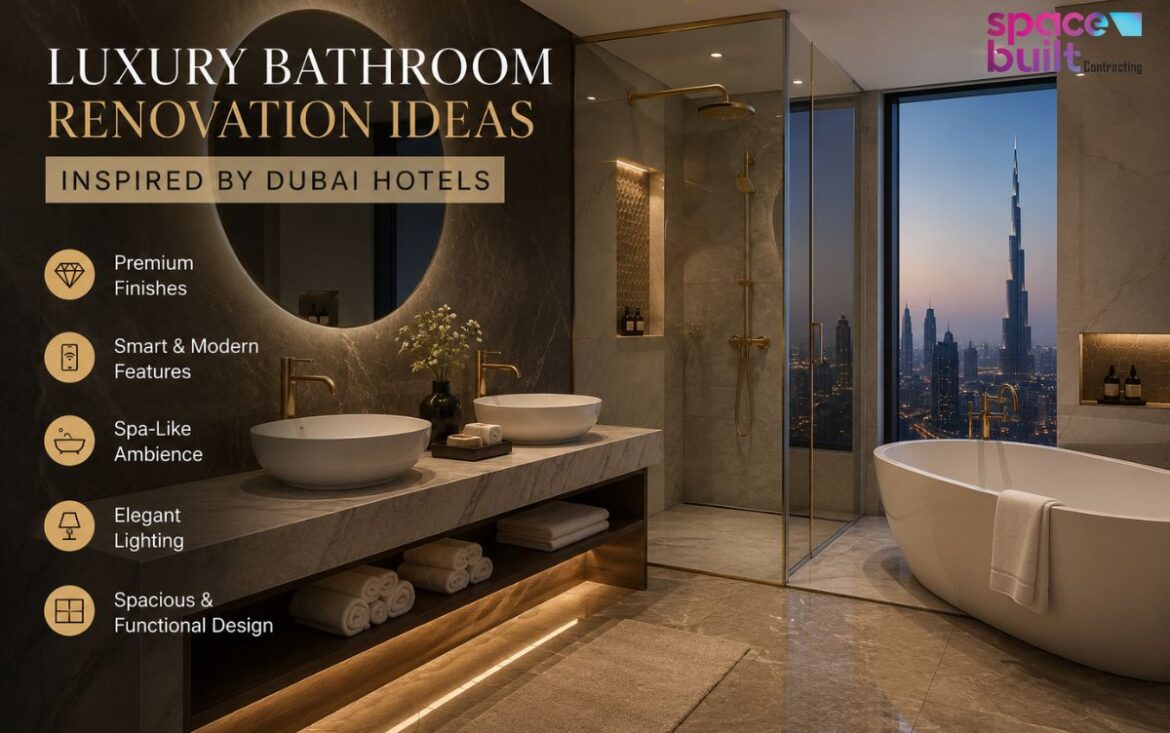
The luxurious bathrooms in Dubai are often designed with freestanding tubs, which are normally located near a window or an impressive wall feature. Installation of this type of tub is simpler because it does not need to have a frame, which would hide the plumbing.
- Walk-In Rain Showers
Frameless glass, a rain shower head, a small bench. That’s the standard now in premium suites. At home, it usually means pulling out the shower tray and switching to a linear drain, a small change that reads as a much bigger one visually.
- Vanities That Do More
Hotel vanities are rarely just a mirror over a sink. Expect double basins, a floating counter, maybe a backlit anti-fog mirror. Homeowners are often surprised these details don’t cost as much as they assumed, as long as they’re planned before tiling starts, not after.
- Warmer Color Choices
Beige. Taupe. Warm grey, sometimes with a bit of soft gold. Bright white tile, which used to be everywhere, has mostly given way to tonal, textured surfaces that look good in photos and feel warmer to actually stand in.
Materials that define a five-star bathroom
- Natural Stone and Large-Format Tile
Marble, travertine, large porcelain slabs. Fewer grout lines is a big part of why hotel bathrooms feel seamless. Large-format tile also makes a small bathroom read bigger, since your eye isn’t tripping over a grid every few centimeters.
- Brushed Metal Over Chrome
Brushed brass, matte black, and brushed nickel have mostly replaced chrome in upscale UAE properties. They hide water spots better too, which actually matters given how hard Dubai’s water is.
- Warm Wood, Used Carefully
Teak or oak-look cabinetry, sealed against moisture, gives contrast next to all that stone. It’s borrowed from spa design, and it works particularly well in guest and master bathrooms.
Layout and space planning lessons from luxury hotels
Layout is the real difference between a bathroom that photographs well and one that actually works day to day. This is where bringing in space planning consultants Dubai early, before tiling or plumbing gets finalized, tends to pay off.
- Keeping Wet and Dry Areas Apart
Hotels separate the shower and tub from the vanity and toilet, usually with a half-wall or glass partition. It keeps steam and splashing contained, and the room reads as more organized because of it.
- Leaving Room to Move
A common mistake is squeezing in oversized fixtures at the expense of floor space. Hotel designers generally leave at least 900mm clear near the vanity. Small rule, but it translates directly to a home bathroom.
- Working Around What’s Already There
A decent space planning consultant in Dubai will usually try to keep the toilet and main drainage close to the existing lines. That one decision alone can bring costs down without hurting the design.
Lighting, fixtures, and smart technology
- Light in Layers, Not One Fixture
It is rare for hotels to use only one source of overhead light. Expect a combination of recessed ceiling lights, vanity sconces, and lighting under cabinets to accomplish this task. By using these different lighting methods, hotels are able to create the soft glow of bathroom illumination without any dark, shadowy areas.
- Touchless Fixtures
Motion-sensor taps, digital shower controls, heated towel rails. These are showing up more in Dubai’s luxury developments, and they’re genuinely useful for households with kids or older residents, not just a nice-to-have feature.
- Ventilation Nobody Thinks About
It’s an unglamorous detail, but hotels spend real money on extraction to stop mold and fogging. Any serious renovation should include an exhaust fan sized properly for the room, not just a swap-in replacement of whatever was already there.
Common renovation mistakes to avoid
- Skipping the waterproofing check. A leak behind luxury tile costs far more to fix than one behind standard tile.
- Picking fixtures before the layout is locked. This is how plumbing rework and blown budgets happen.
- Treating ventilation as optional. Poor airflow shortens the life of both stone and wood finishes.
- Underestimating lead times. Imported stone and custom vanities can take weeks to land in the UAE.
- Skipping the space planner. Fixing a bad layout after tiling has started is expensive and disruptive.
Comparing renovation approaches
| Approach | Typical Timeline | Best For | Worth Knowing |
| Full renovation with space planning consultants in Dubai involved | 4–8 weeks | Homeowners who actually want the layout changed | Higher planning cost upfront, better result long term |
| Cosmetic upgrade (tile and fixtures only) | 2–3 weeks | Budget-conscious refreshes | Layout stays the same, limitations stay too |
| DIY partial renovation | Varies | Small guest bathrooms only | Waterproofing risk goes up |
| Contractor-led renovation through bathroom renovation services in Dubai | 3–6 weeks | Most residential projects | Reasonable balance of cost, quality, reliability |
Choosing the right renovation partner
Plenty of companies advertise bathroom renovation services in Dubai without any real hospitality-grade experience behind them. It’s worth asking directly whether they’ve handled hotel, villa, or high-end residential fit-outs, because the sourcing and finishing standards aren’t the same as standard residential work.
However, Spacebuilt tends to stand out here for that reason. A team with a background across renovation, interior fit-out, and exhibition work knows how to source the finished hotels use, without hospitality pricing attached. While evaluating the best renovation contractor in UAE, make sure to get a look at images of actual projects completed by the contractor and identify who is performing waterproofing and plumbing tasks rather than subcontracting those tasks.
Questions worth asking before you sign anything
- Can you show bathroom-specific project photos, not just general renovation work?
- Who’s handling waterproofing, and will that be guaranteed in writing?
- What’s the realistic lead time on imported materials?
- Will someone visit the site before the final quote?
Conclusion
The reason hotel bathrooms in Dubai appear this way is due to deliberate choices that are consistently made: the appropriate materials, clear division of spaces, and lighting that enhances instead of diminishing. None of this necessitates having a high budget or finding a five-star space. Just get the layout right, pick a contractor who has experience in this area, and this is how any master bathroom may seem serene.
If you’re planning a renovation and want that hotel feeling at home, Spacebuilt can walk you through layout, materials, and a realistic timeline before anything gets started. Get in touch with Spacebuilt to book a site visit and get an honest quote.
Frequently asked questions
Layered lighting, large-format stone, and distinct areas for wet and dry materials work more than any single high-dollar fixture.
This will rely heavily on size and stone or fixtures, but budget for both the labour and the realistic time frame that it will take for the imported stone or fixtures.
Usually yes. In a small bathroom, every inch matters, and that’s where the value of a space planning consultant in Dubai really comes in handy.
The typical time for a residential renovation is 3 to 6 weeks, depending on the changes to the layout and the availability of materials.
Often, yes. A common method in which experienced contractors avoid high costs is by placing fixtures close to the lines already in place.
The reason the hotels depend on large format tile is that there are fewer grout lines and the room looks larger.
Yes, provided there is adequate space on the floor and the plumbing can be installed under the floor without undue elevation.
Practical experience with waterproofing, actual timelines, and previous experience with bathroom projects, not just renovation ones.
Yes, for the majority of families. Touchless taps and digital shower controls make life easier and can save on water usage in the long run.
A complete redesign and renovation, when properly planned, will be more beneficial if the design truly does not match the way you live rather than a cosmetic makeover.