
-
Spacebuilt
- November 20, 2026
- No Comments
Construction Project Handover Checklist: What Every Client Should Verify
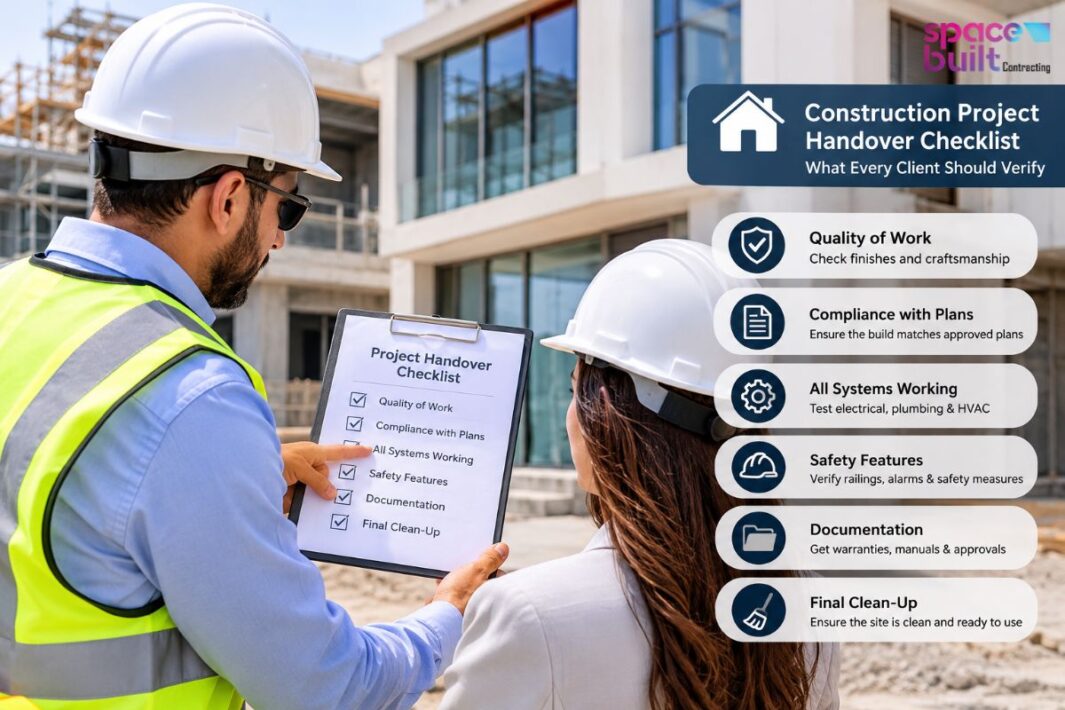
A construction project handover checklist is a detailed checklist which builds owners and developers have to ensure the fact that the construction phase is completed, building is secure, documentation is in place and allowed for use. The checks include availability of as-built drawings, completion documents, operation and maintenance manuals, warranty packs, performance tests, and a list of financial settlements.
However, it is necessary to check everything because defects discovered at the time of handover lead to expensive fixes later. The mentioned guide will describe what to check, what approvals are necessary in the UAE, and how to avoid mistakes that can unexpectedly become problems for owners.
Key takeaways
- Check all documents, including drawings, manuals, and warranties, before accepting keys, as they can lead to long-term delays if they are not provided.
- Test questions on the witness system and demand signed certificates, not verbal assurances of readings.
- Verify that all UAE approvals are for your property and are still valid for occupancy.
- Keep the retention until defects are closed and all manuals, warranties, and training sessions are completed.
What is a construction project handover checklist?
A construction project handover checklist is a document that provides a list of all tasks, records, and tests that need to be completed before a contractor can hand over a completed building to the client. It validates that the job is done in accordance with the design and that the owner is provided with all the necessary equipment to run the property. The checklist typically covers technical testing to legal paperwork.
Handover is often equated with the time when keys change hands, although that is just one part of the Handover process. It starts when the main works are near completion and ends only when all necessary records, test results, and approvals are received. The checklist is the instrument that keeps the procedure orderly and transparent to all participants.
Most projects have a checklist broken down by categories for ease of tracking. Typical categories include:
- Technical documentation and drawings
- Installed and commissioned building systems
- Records of finishes, defects and snagging.
- Legal clearance and utility services.
- Warranties, guarantees and maintenance training
- Financial closeout and release of retention.
Each category should have a named owner on both the contractor’s side and the client’s side. If it’s known who owns it, there’s less of a chance of it falling between the two teams. A weekly updated shared tracker provides a common focus to see progress.
Why is handover more than key delivery?
It is common for clients to think that they’ve done everything when they get the keys. The truth is, however, that keys are often obtainable before documentation, testing, and approval. This leaves room for risk as records are outstanding and a building is occupied.
Most owners also don’t understand the amount of technical information that is generated in a building. A modern development can have hundreds of drawings, dozens of certificates, and many records of equipment. This information is easier to organise in advance of handover than to put together several months later when the contractor’s team are engaged on another project.
Why does handover verification matter for clients?
The handover marks the point at which the responsibility is transferred from the contractor to the owner. Prior to that, the contractor is responsible for the site and takes on a significant amount of risk with regard to defects. Once you’ve done that, you’re in charge of the upkeep, operation, insurance, and repairs of the property. Verification is an important step to safeguard you throughout that process.
Often, conflicts start due to missing documents and not visible issues. The wall could be perfect, but without the electrical certificate, the AC system could never have been commissioned properly. If there are no records, it becomes a slow, expensive battle to get insurance claims done and warranty repairs completed.
These risks can be significantly minimized with the right partner. Some owners opt to work with Dubai building companies that are experienced, and they tend to be handed over more structured packages due to the fact that experienced companies have a routine when it involves records and testing. Nevertheless, consumers should check each item on their own, not just by the assurance of their client.
Additionally, verification also safeguards your cash. Retention is the amount of the contract price retained until the contract defects are corrected and documents are furnished. After the retention is released, all leverage is lost, so an open item should be closed before the final payment is made.
Which documents must you verify before handover?
Ensure that as-built drawings, operation and maintenance manuals, warranties, test and commissioning reports, material certificates, and approved specifications are received before accepting a completed building. Be sure you have the completion and occupancy approvals. Have them send you missing documents in writing before payment, so you can have them given to you in advance before you have to maintain, insure, or renovate them.
As-Built Drawings
As-built drawings illustrate the actual construction, not the original design. However, site changes, reroutes, and substitutions are common during construction and are typically not found elsewhere in the project file. A plumber or electrician attempting to work on the building many years later without accurate drawings could spend hours trying to locate the pipelines or electrical cables.
Request complete sets covering the following areas:
- Architectural Plan and Finishes Schedule
- Structural drawings and load-bearing details.
- Mechanical, Electrical, and Plumbing layouts
The set should be identified with all confirmed changes, and both PDF and editable CAD or BIM formats are valuable to request if available. Verify if the drawings correspond with the building as it is now, not at the beginning of the project.
Operation and Maintenance Manuals
Operation and maintenance manuals are the documents that describe the operation and maintenance of the equipment found in the building. If not, facilities personnel may be setting or servicing the equipment incorrectly, reducing the equipment’s useful life or potentially making the equipment inoperable due to warranty issues. There should be the following components in a good manual:
- Model number and serial numbers of the equipment.
- How often and when to service and schedule.
- Marked-up spare parts lists and supplier contact information.
- Troubleshooting guides for common faults are provided.
Keep copies of the manuals in a shared folder that your property manager can access, as hardcopy manuals can get lost during the occupancy. Request an itemized list in writing of all significant equipment that is covered.
Warranties and Guarantees
Warranties establish the scope of repairs, the mechanics involved, and duration. Review the start date of each warranty, as some warranties will begin at the time of substantial completion and others will begin upon occupancy. Ask equipment manufacturers if they will accept replacement of equipment directly or through the original manufacturer; some do not allow replacement through someone else.
Make a note of any maintenance requirements for each warranty. One of the most frequent causes of claims being denied is missing the service schedule; therefore, make it a part of your facilities plan on the very first day.
How do you verify building systems and quality?
Documents provide evidence of what is supposed to be there; testing is proof of what works. Clients should ask for a live demonstration, not a verbal assurance, when it comes to systems verification. Whenever possible, ask to see important tests performed, as much can be learned by watching a system in action as by standing by and signing a form.
Testing Mechanical, Electrical, and Plumbing Systems
Core system tests should be documented and repeatable. Typical checks include:
- Pressure Tests of Water Supply and Drainage Lines
- Therefore, electrical load testing and earthing resistance readings are conducted.
- Commissioning HVAC systems using airflow and temperature balancing.
- Test the functionality of sprinklers and fire alarm devices.
Ask the relevant consultant or qualified engineer to sign test certificates and verify any readings against the design specifications. If the reading is not within the expected range, request a written explanation and retest following correction. Do not accept a certificate that does not include the test values.
Inspecting Finishes and Workmanship
Go into every room armed with a checklist, torch, and camera. Check for things like uneven paint, gaps in the skirting boards, cracked tiles, doors that do not close properly, and windows that do not open smoothly. Take pictures of the defects, record where they are, and set a timeline for getting them fixed.
Be sure to rank the defects so that important problems will not get lost among minor issues. A simple way to prioritise your list is given in the table below:
| Defect Category | Example | Priority | Recommended Action |
| Safety-critical | Exposed wiring or missing railing | Immediate | Stop handover until corrected |
| Functional | Air conditioning not cooling | High | Resolve before key release |
| Cosmetic | Paint marks or minor scratches | Standard | Agree on a correction deadline |
Having a properly documented defect log helps to keep the contractor responsible for its actions, while giving good evidence that can be used in case any differences may come up in the future.
Which approvals and certificates are required in Dubai?
Substantial projects in Dubai typically need to obtain a number of certificates and approvals for substantial projects before they can be occupied, such as the Civil Defence certificate, utility connection and completion certificates from Dubai Municipality. Ensure that all approvals are given for your property and not just for the contractor’s file. Examine the latest rules with the relevant governmental authority before final payment, based on project type and authority.
However, requirements for approval vary based on the type of project, its intended use, and the authorities involved. The following list is not intended to provide any legal advice and should be checked with the relevant office for each item:
- Fire and Life safety systems approved by Civil Defence.
- Electricity, water and cooling utility connection confirmations
- Municipal completion or occupancy documentation
- Inspection certificates for lifts and elevators
- Documents of ownership or registration of the property.
All approvals must refer to the appropriate plot, building, and unit information. When the work is good, but the names and unit numbers are mismatched, it can cause delays of months for utility transfers and insurance registration.
This paperwork is typically prepared by established companies, many of which are the best contracting companies in UAE. Despite this, it is recommended that clients ask for originals and verify each certificate with the official record. An email copy is not the same as a verified document that is in your name.
How do you choose a contractor that supports handover?
The team you assemble at the beginning of the handover process is critical to the quality of the handover. Inquire with potential partners about their closeout, recording, and defect resolution processes before signing. Readable, written answers: This is a very positive indicator of how seriously the business takes the finish line.
The table below can help you make your evaluations when considering proposals side by side:
| Criteria | Strong Handover Support | Weak Handover Support |
| Documentation | Digital as-built set delivered in stages | Drawings promised only at the end |
| Testing | Witnessed tests with signed certificates | Verbal assurance only |
| Defect tracking | Shared log with agreed deadlines | Informal handwritten lists |
| Warranty management | Clear register of every warranty | Unclear responsibility for claims |
| Training | Recorded walkthroughs for facilities staff | One brief meeting on the day |
Don’t just compare the price when comparing companies. Completed project references, particularly handovers, demonstrate a company’s actions at the end. For many owners, a clear team with reliable closeout is worth the small extra cost as they save on the potential repair costs and disputes that may be present later in the process.
Though it is common for shortlists to begin with the search results for the top contracting companies in UAE, the rankings don’t mean much when it comes to post-completion support. You’ll hear much more from a reference call with recent clients than from a listing in a directory. Inquire from these clients directly about the handover and the time it took for any defects to be resolved.
What is the step-by-step handover process?
A set protocol ensures continuity and eliminates the risk of any missing items. Do these things in order, and in writing, agree on the time frame before the final works commence.
- Ensure that all contractual works are complete and signed off by the consultant.
- Gather drawings, manuals, certificates, and warranties, both digital and print.
- Conduct tests on mechanical, electrical, plumbing, and fire systems.
- Record all defects, set deadlines, and follow up on each defect until it is formally closed.
- Conduct practical training for facilities and property management staff.
- Ensure all Government completion and occupancy documents have been issued.
- Only sign the handover certificate when all items are closed.
Moreover, inquire with the building construction company Dubai you have selected to provide you with a written handover schedule at the beginning of closeout. Having a timeline helps to identify delays at an early stage when they are more manageable rather than becoming apparent in the last week.
What common handover mistakes should you avoid?
Even owner-experts can make predictable mistakes. If you know what to watch for, you can avoid these pitfalls when working under pressure and tight deadlines. Be alert for the following:
- Accepting keys before documents arrive
- Signing a handover certificate containing defects not mentioned in the certificate.
- Withholding retention before the closing of snags
- There is no demonstration of critical systems.
- Discounting the time of warranty and maintenance conditions
- Failure to update insurance and utility accounts after real estate transaction
All of these errors can be prevented with a checklist and rigorous review. Unfortunately, many owners only find them after the contractor’s team has demobilised, and that makes resolving much slower and more costly.
A trustworthy building construction firm Dubai should welcome these checks as it represents the expectations clients have. Don’t shrug off a contractor’s reluctance to submit documents and testing evidence, as it’s a red flag.
Final thoughts
A construction project handover checklist will help you execute a handover process when a construction project is coming to a close, and in a way that is manageable and verifiable. You safeguard your investment for years to come by verifying documents, testing systems, confirming approvals, and retaining until issues are resolved.
No matter if you are using the services of a small studio or one of the bigger construction companies in Dubai, the rule remains the same: ask for proof, not promises. For clients who are working on their next handover, they can check out practical guidance and services at Spacebuilt.
Frequently asked questions
As-built drawings, O&M manuals, warranties, test certificates, approvals, snag closure records, and training confirmation are all components of a complete checklist.
Clients require an average of 2-4 weeks to process paperwork and inspect systems. Don’t wait until the last week to start.
Yes, in the case of a safety defect. Understand exactly what your rights are in your contract; document all issues and seek legal advice if necessary.
Yes, independent verification of electrical, mechanical, and plumbing systems should be done by an independent inspector. Contractor teams might miss things during an outside check