
-
Spacebuilt
- September 16, 2026
- No Comments
What Is Included in an Office Renovation Quote in Dubai? 12 Costs to Check
Table of Contents
- Key takeaways
- Why do office renovation quotes in Dubai vary so much?
- 12 costs every office renovation quote should cover
- What’s usually excluded and why does it matter?
- How to compare quotes from different contractors?
- Typical cost ranges by office size
- Common mistakes when reading a renovation quote
- Final thoughts
- Frequently asked questions
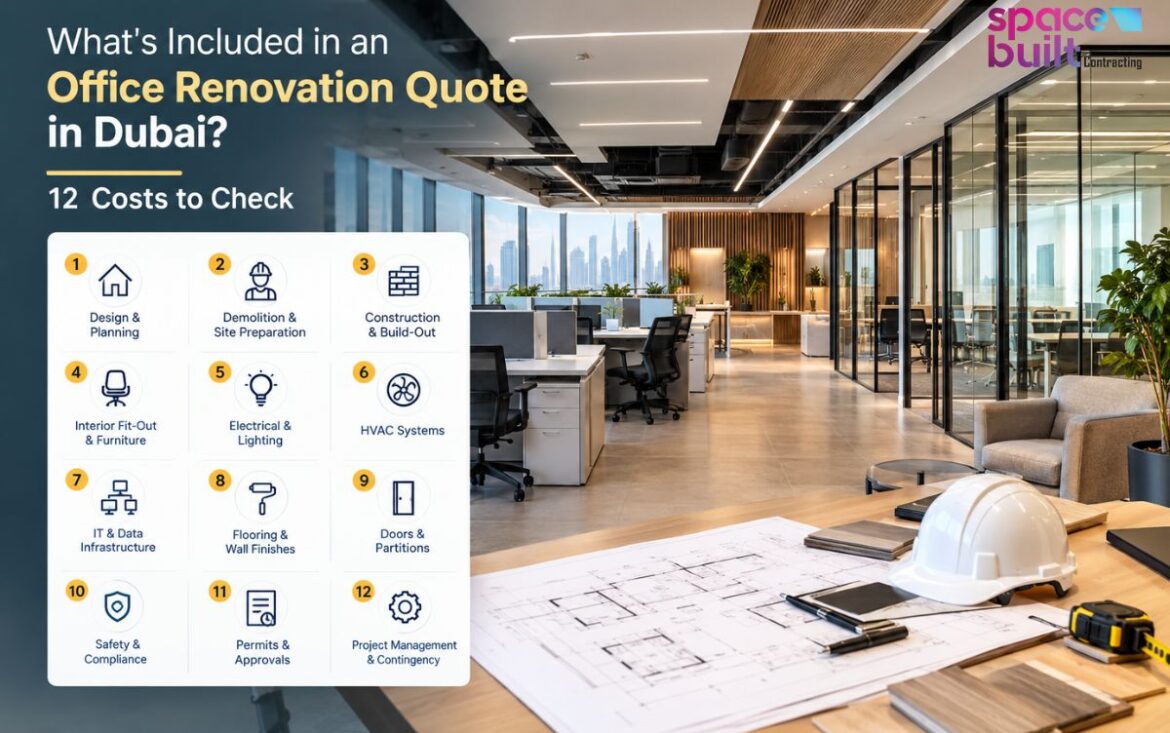
A good office renovation quote in Dubai will provide at least twelve different cost types for things like demolition, partitioning, flooring, ceiling and related work, electrical work and lighting, HVAC, plumbing if needed, painting, and finish work, IT and communications infrastructure, permitting, and project management. However, if a contractor presents just one lump sum figure for their entire service, several change orders will likely come very close to showing up at various phases of the job, and the budget will be exceeded.
Reliable office renovation contractors will show you their quotes in detail, whose final result will include costs like VAT, DEWA connection charges, and delay-related fees incurred while waiting for landlord approval, making sure you are not taken by surprise once renovation work starts.
Key takeaways
- A proper quotation must contain at least 12 different categories of expenses instead of just one amount.
- Usually, such issues as permits, NOC approvals, and DEWA charges are not taken into account in the original quotes and are added afterward.
- Comparing quotations side by side only makes sense if all contractors are estimating the same work.
- Renovation of offices in Dubai costs AED 150-400 per sq. ft. depending on the degree of finish and the scope of work.
Why do office renovation quotes in Dubai vary so much?
Two contractors can walk to the same office and come back with quotes 30 percent apart. That gap doesn’t automatically mean one of them is padding the bill. Most of the time, it comes down to what each number is actually covering.
Building regulations in Dubai are strict, and every emirate, sometimes every free zone within it, runs its own approval process for fit-out work. Some landlords won’t let a single partition go up without a No Objection Certificate first. Others require fire-rated materials for ceilings and partitions under Dubai Civil Defence rules. A contractor who prices all of that in from the start will naturally land higher than one who plans to tack it on as a change order later.
However, material specification is the other big swing factor. “Flooring” on one quote might mean basic vinyl tiles. On another, it means engineered wood or a branded carpet tile system. Without a materials list attached, the number by itself doesn’t tell you much.
12 costs every office renovation quote should cover
1. Demolition and Strip-Out
Old partitions, flooring, and fixtures usually need to come out before anything new goes in. Some contractors fold this into the main price; others quote labor and waste disposal as a separate line, so check which one you’re looking at.
2. Partitioning and Wall Construction
Glass partitions, gypsum walls, and acoustic panels are the backbone of most layouts here. What you pay depends on the partition type, whether it’s full height or half glazed, and the fire rating your building requires.
3. Flooring
Material and installation, whether that’s carpet tile, laminate, vinyl, or raised access flooring for a server room. Raised flooring in particular can jump the budget quickly if your setup needs it for cable management.
4. Ceiling Work
Suspended ceilings, gypsum board, acoustic tiles. Because ceiling work overlaps so much with lighting and HVAC ductwork, contractors often bundle all three together, which makes it harder to see what each one actually costs.
5. Electrical and Lighting
Rewiring, new circuits, power outlets, and light fixtures are usually priced by point count rather than a flat number. If the quote doesn’t show a point count, ask for it.
6. HVAC Modifications
Add partitions, and you almost always have to adjust the ductwork and diffusers to keep airflow even across the new layout. This is one of the line items that gets underestimated most often.
7. Plumbing (Where Applicable)
Mostly relevant if there’s a pantry, washroom, or wellness room involved. Pipe rerouting and fixtures should show up as their own line, separate from general MEP work.
8. Painting and Wall Finishes
Paint, wallpaper, branded graphics. The cost swings depending on paint grade and whether feature walls or custom branding are part of the plan.
9. Furniture and Fit-Out
Workstations, meeting tables, reception desks, storage. Some contractors quote this as its own procurement line, which is useful if you’d rather source furniture on your own.
10. IT and Data Cabling
Structured cabling for network points, server room setup, AV equipment for meeting rooms. This is one of the categories most often left out of the base quote entirely and handled as a specialist subcontract.
11. Permits, NOC, and Approvals
Municipality permits, civil defence sign-off, landlord NOCs. Each comes with a government fee plus the time it takes the contractor to actually manage the paperwork. Delays here are a common reason Dubai fit-outs run past schedule.
12. Project Management and Contingency
A management fee, usually 8 to 15 percent of the project, covers site supervision, scheduling, and quality checks. On top of that, a contingency allowance of 5 to 10 percent should be built in for whatever turns up once the walls are actually opened.
What’s usually excluded and why does it matter?
Even solid quotes from office renovation contractors Dubai that clients rely on tend to leave a handful of things off by default:
| Item | Why It’s Often Excluded | What to Ask |
| VAT (5%) | Quoted as base price before tax | Confirm if the total shown is VAT-inclusive |
| DEWA connection/upgrade fees | Charged directly by the authority | Ask if the contractor handles the application |
| Landlord-mandated materials | Vary by building management | Request the building’s fit-out guidelines upfront |
| After-hours work permits | Needed for occupied buildings | Clarify if renovation happens during business hours |
| Snagging and defect rectification | Assumed to be covered by warranty | Confirm warranty period and scope in writing |
Additionally, ask about these five before signing, and you’ll head off most of the budget surprises that come up during office renovation in Dubai projects.
How to compare quotes from different contractors?
Comparing quotes only works once the scope is lined up. Before setting two numbers side by side, make sure both cover the same square footage, the same material grade, and the same 12 categories above.
A few things help here. Ask for an itemized breakdown, not a single figure. Get each contractor to name actual material brands rather than vague categories like “flooring” or “lighting.” Confirm whether permit costs and management fees sit inside the headline number or get added after. And look closely at the payment schedule, since some contractors want a large chunk paid before real milestones are hit.
If one office renovation service in Dubai provider comes in well below the rest, the useful question isn’t “why is this cheaper” but “which of the 12 categories did they skip.”
Typical cost ranges by office size
Costs move with scope and finish level, but general ranges for Dubai commercial spaces tend to look like this:
- Basic renovation (paint, minor partitions, standard flooring): AED 120 to AED 180 per square foot
- Mid-range fit-out (new partitions, upgraded flooring, lighting redesign): AED 180 to AED 280 per square foot
- High-end renovation (custom millwork, branded finishes, full MEP overhaul): AED 280 to AED 400+ per square foot
Moreover, treat these as market indicators, not fixed pricing. Actual costs depend on the building itself, material choices, and how much MEP work is really needed.
Common mistakes when reading a renovation quote
Most businesses zero in on the bottom line and skip what’s behind it. A verbal estimate with nothing in writing is hard to hold anyone to later. Skipping the materials specification sheet is how people end up disappointed by finishes that don’t match what they pictured. Not confirming who’s responsible for permit applications can stall a project for weeks once nobody claims it. And a payment schedule nobody checked closely can mean handing over a large sum before there’s much to show for it on site.
Spacebuilt and other established renovation firms in Dubai tend to hand over a fully itemized quote for exactly this reason. Disputes over scope happen far more on lump-sum contracts than on ones where everything is spelled out.
Final thoughts
A trustworthy quote for office renovation in Dubai reads like a checklist, not a guess. Once you know the 12 core cost categories and what usually gets left off, you’re in a far better spot to negotiate, compare, and skip the mid-project surprises. If you’re planning a fit-out and want a full itemized breakdown for your own space, getting Spacebuilt out for a site visit is a reasonable first step before you commit to anyone.
Frequently asked questions
Four to ten weeks covers most fit-outs, depending on office size and scope. Larger jobs with MEP changes or landlord approvals in the mix can stretch to twelve weeks or beyond.
Usually, yes. Even small partitions or electrical changes often need a municipality permit or landlord NOC. Confirm before starting to avoid fines later.
Somewhere between AED 120 and AED 400 per square foot, depending on finish quality, scope, and whether MEP work is involved.
Yes, phased renovation is common, though it typically costs more because of after-hours permits and extra site protection.
It depends on the contract. Some office renovation contractors Dubai clients hire manage DEWA applications directly, while others leave that to the tenant.
Not always, so don’t assume it. Many quotes show a pre-tax figure, so confirm whether the 5% VAT is added on top before signing.
Unplanned MEP changes, HVAC and electrical rework especially, once demolition exposes what’s actually behind the walls.
Line up itemized breakdowns from at least three contractors covering the same 12 categories, rather than comparing single bottom-line totals against each other.