
-
Spacebuilt
- August 12, 2026
- No Comments
Why Modular Exhibition Stands Are Trending in 2026
Table of Contents
- Key Takeaways
- What are modular exhibition stands?
- Why is 2026 the turning point?
- Cost efficiency without compromising impact
- Sustainability is no longer optional
- Faster turnaround for busy event calendars
- Choosing among exhibition stand manufacturers
- Common mistakes brands make
- Expert insights for 2026 exhibitors
- Wrapping it up
- Frequently asked questions
Key Takeaways
- The modular systems are in high demand due to their reusability, portability, and affordability.
- Higher venue and logistics costs in Dubai make reusing designs a better option.
- Sustainability demands make it impossible for exhibitors to avoid using reused exhibition structures.
- Established exhibition design firms in Dubai strike a balance between the modularity of their designs and customization.
Walk through any major trade show in Dubai this year, and you’ll notice something. Fewer stands look like they were built once and thrown away. They are likely to show up again next season, but in a different setup, hall, and product.
Exhibiting modular stands for companies is no longer considered a cost-effective solution because it is no longer applied for a single-time event. The main cause of the trend is that in 2023, cost issues, sustainability rules, and reduced construction timetables became a problem together. Therefore, the blog tries to explore what caused this change last year and what companies should consider while choosing their portable exhibition stands in Dubai.
What are modular exhibition stands?
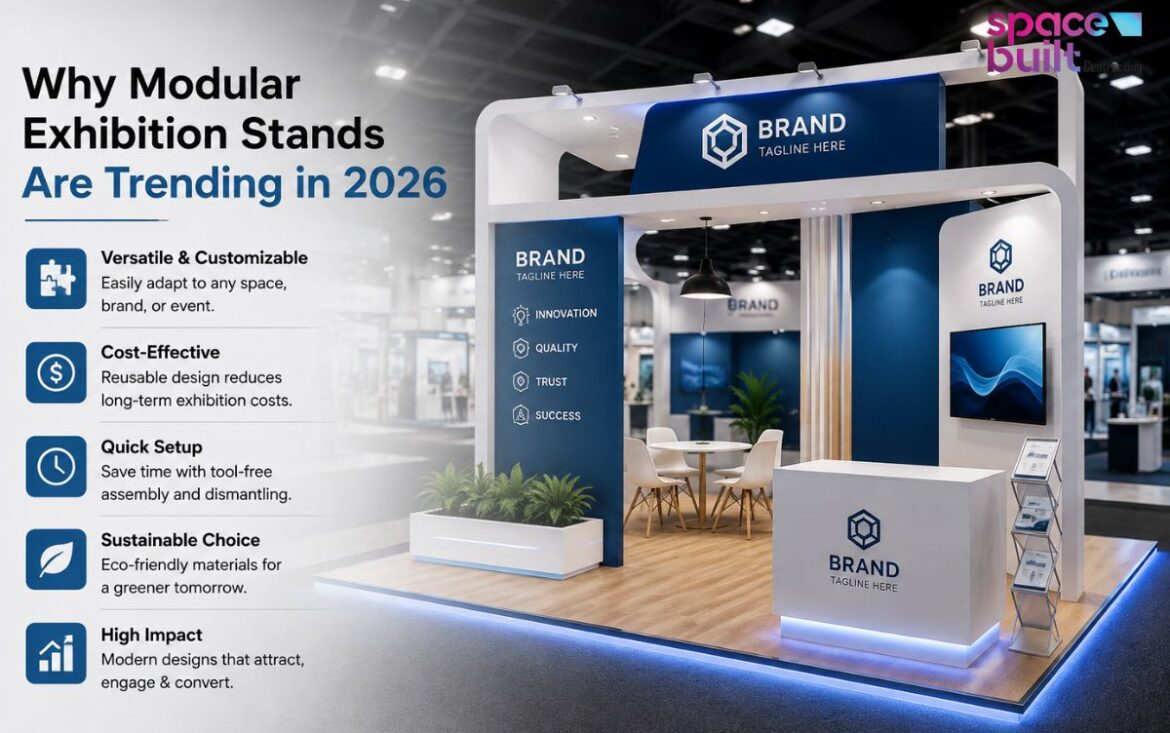
A modular exhibition stand is built from pre-engineered components: aluminum frames, reusable panels, modular flooring, and interchangeable graphics that can be reconfigured for different booth sizes and layouts. Instead of commissioning a one-off custom build for every event, you own or lease a kit of parts that gets rearranged each time.
Moreover, that’s different from a fully custom stand, which is designed and fabricated for a single event and often can’t be reused without major rework. It’s also different from a basic shell scheme, which is the bare minimum a venue provides. Modular sits in between, flexible enough to look custom, structured enough to stay cost-predictable.
Most exhibition stand design services in Dubai now offer modular as a starting point and layer custom elements on top of the base structure: reception counters, LED walls, branded flooring. That hybrid approach is largely what’s driving adoption this year.
Why is 2026 the turning point?
Several occurrences happened in quick succession, moving modular from being just a good idea to one that became commonly demanded.
Budgeting constraints meant that companies attending three or four trade shows per year began to question why they needed to construct virtually a completely new stand each time, as much of the structure can be reused. At this time, new waste and sustainability regulations in Dubai made single-use stands less justifiable. Meanwhile, the supply of many raw materials (timber in particular) became more unpredictable, and modular solutions rely on pre-fabricated components.
None of these on their own would have changed much. Together, they changed the default answer exhibitors give when asked “custom or modular?”
Cost efficiency without compromising impact
The most obvious driver is money, but it’s worth being specific about where the savings actually come from.
With a custom build, you’re paying for design, fabrication, and labor from zero every single time. With modular, the frame and core structure are a one-time investment. What changes between events is usually graphics, minor layout tweaks, and rental add-ons. For a brand attending Gitex, Arabian Travel Market, and a regional show in the same year, that difference adds up fast.
| Factor | Custom Build | Modular System |
|---|---|---|
| Upfront cost | High | Moderate to high (one-time) |
| Cost per repeat event | High (rebuilt each time) | Low (reconfigured, not rebuilt) |
| Storage between events | Not applicable | Required, but manageable |
| Design flexibility | Very high | Good, with some structural limits |
| Turnaround time | Longer | Shorter |
| Sustainability | Depends on disposal | Higher, due to reuse |
This doesn’t mean modular is automatically cheaper for every exhibitor. A company doing one show every two years may not recoup the upfront investment the same way. It makes the most sense for brands with a recurring events calendar.
Sustainability is no longer optional
Dubai’s major venues have been tightening waste-disposal expectations for exhibitors over the past few years, and 2026 is when that pressure is really showing up in booking requirements. Some organizers now ask exhibitors to declare what percentage of their stand will be reused or recycled.
Modular systems make that declaration easy to answer honestly. A stand built from reusable aluminum framing and interchangeable panels isn’t heading to a skip after three days. It’s going back into storage for the next event. That’s a genuinely different footprint compared to MDF-heavy custom builds that get demolished after a single use.
I’d push back a little on how this gets marketed, though. Modular isn’t automatically sustainable. A poorly specified system with cheap, non-recyclable panels can be just as wasteful as a bad custom build. What matters is the quality of materials and whether the manufacturer actually tracks reuse cycles, not just the word “modular” on the quote.
Faster turnaround for busy event calendars
Custom stands typically need four to six weeks of lead time for design approval, fabrication, and pre-build testing. Modular systems, because the core components already exist, can often be reconfigured and delivered in about half that time.
Therefore, for exhibitors booking Dubai shows on short notice, which happens more often than event calendars suggest, that speed matters as much as the cost savings. A brand that gets confirmation of a booth space three weeks before a show doesn’t really have the option of a full custom build. Modular is often the only realistic path.
Choosing among exhibition stand manufacturers
Not every modular system is built the same way, and this is where exhibitors run into trouble. Some manufacturers sell rigid, off-the-shelf kits that look identical to every other stand on the show floor. Others build modular systems with enough customization built in that no two stands look alike, even though they’re using the same core components.
When comparing exhibition stand manufacturers in Dubai, a few questions are worth asking directly:
- Can the system accommodate a double-height structure if you need one later?
- What’s the actual storage and maintenance arrangement between events?
- How much of the graphics and branding can change without touching the structural frame?
- Do they own their fabrication facility, or subcontract the build?
However, Spacebuilt is one of the firms in this space that leans into the hybrid model: modular structure with enough custom detailing that the stand doesn’t read as off the shelf. That distinction is worth checking for with any vendor you’re evaluating, not just taking their word for it. Ask to see photos of the same modular kit used across two different events for two different clients. If it looks identical both times, that tells you how much real flexibility you’re getting.
Common mistakes brands make
1. Choosing the cheapest quote without checking material quality
Aluminum grade and panel finish vary a lot between suppliers, and it shows within two or three uses.
2. Assuming modular means no design work needed
A modular stand still needs a layout plan, lighting strategy, and brand application. Skipping that step is how you end up with a stand that looks generic.
3. Not asking about storage logistics upfront
Where does the kit live between events, and who’s responsible for damage during storage? This gets overlooked until the second event, when something’s missing or dented.
4. Underestimating reconfiguration limits
Some modular systems can’t easily go from a 6×6 booth to a 9×6 island stand. If your booth sizes vary year to year, confirm the system handles that range before committing.
Expert insights for 2026 exhibitors
If you’re weighing custom against modular, the honest answer depends on how often you exhibit and where. A single flagship event a year, something like a major product launch, often still justifies a custom build, because the design ceiling is higher and there’s no reconfiguration compromise.
For anything beyond that, modular tends to win on practicality. The gap in visual quality between modular and custom has narrowed enough that most attendees walking the show floor genuinely can’t tell the difference anymore. That wasn’t true five years ago.
One thing worth flagging: get quotes from the best exhibition stand design companies in Dubai before deciding, even if you already have a preferred vendor. Pricing and lead times vary more than people expect, and a second proposal often surfaces options, like partial modular with a custom feature wall, that the first quote never mentioned.
Wrapping it up
In 2026, modular exhibition stands are gaining popularity. They are useful for brands to deal with increased costs, sustainability demands, and reduced deadlines. They also provide flexibility but don’t affect the overall design.
Modular stands can be used in multiple shows if multiple events are planned for 2026. Can be used more than once without looking unprofessional or unappealing. One of the best exhibition stand builders in Dubai can provide you with a stand that is flexible and customizable.
Spacebuilt will be able to assist you in selecting the modular solution that will best suit your booth size, design requirements, and event timeline.
Frequently asked questions
Custom stands are constructed from the ground up for a particular event and are typically not reused. Modular stands are built by placing reconfigurable components that are shared and repositioned between various events, with cost savings over the long-term.
Yes for each occasion, particularly the second or third. The initial investment is comparable or slightly more, and the per-use cost is much less than that.
When kept in an appropriate way and when maintained properly, most aluminum-frame modular systems can be used for several years before major components must be replaced.
Yes, with good design. The top Dubai Exhibition stand builders nowadays are actually mixing modular frames with customized graphics, lighting fixtures, and feature components, ensuring that the stand is not generic.
Most modular booth kits can accommodate a variety of booth sizes from small-sized 3 x 3 booths to larger island booths, although very large or double height booths should be confirmed with the manufacturer beforehand.
Typically, the manufacturer will provide storage facilities between events as part of the service package, but again it is wise to check and double-check, as well as any applicable charges.
Not price alone, but also the quality of the materials, the availability of factories for making the materials, past photos of their projects, and the level of design flexibility their modules have.
Yes, in most cases, because the components are reused instead of thrown away; however, this will depend on the quality of the materials and whether the manufacturer is keeping track of correct reuse cycles.
Two to three weeks is typically sufficient, while a full custom build takes four to six weeks; the sooner one is booked, the greater the design flexibility.
Yes, most systems are meant to be reconfigured at trade shows, product launches, and corporate events as long as the booth size is within the range of the system.