
-
Spacebuilt
- August 10, 2026
- No Comments
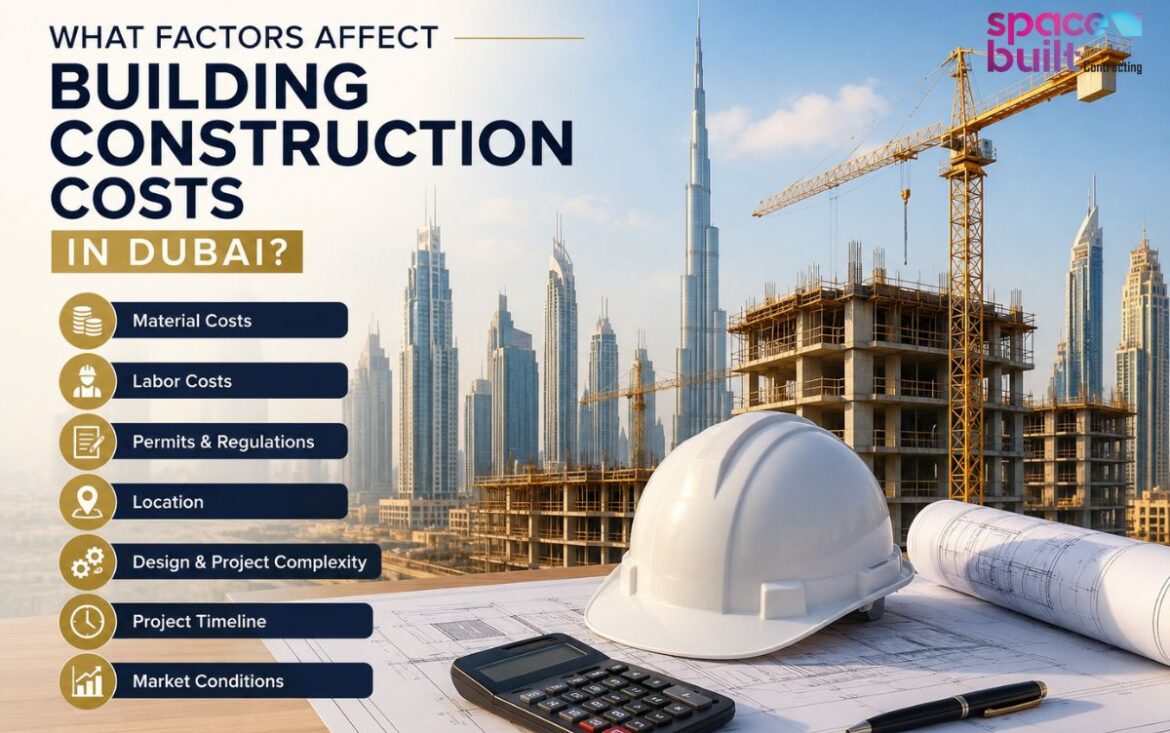
What Factors Affect Building Construction Costs in Dubai?
Table of Contents
- Key Takeaways
- Material costs and supply chain factors
- Labor availability and skilled workforce rates
- Land location and zoning requirements
- Design complexity and structural requirements
- Permits, approvals, and regulatory compliance
- Project timeline and seasonal considerations
- Common mistakes that inflate construction budgets
- Practical tips to control construction costs
- Conclusion
- Frequently asked questions
Key Takeaways
- Most of the fluctuations in construction budgets in Dubai are caused by materials and labor as well as the location of land.
- Engaging contractors in Dubai during the planning phase rather than the construction phase avoids costly changes in the middle of the construction process.
- Most people fail to appreciate the significance of permit delays and compliance issues related to Dubai Municipality.
- Choosing the right contractor from the very beginning of the construction project is much better than replacing him during the process.
Talk to a handful of developers who’ve built in Dubai over the past ten years and most will tell you the same thing: the number on day one almost never matches the final invoice. Material availability shifts, plots come with restrictions nobody flagged upfront, and approval timelines drag on longer than the brochure suggested. None of that shows up in an early estimate.
Knowing what actually moves these numbers gives you real leverage before you sign with any of the building construction companies in Dubai. Prices here can shift within a single quarter, tied to steel and cement supply, how many active projects are competing for the same labor pool, and how tightly the new sustainability codes are being enforced. What follows covers each factor and where owners tend to lose money without noticing.
Material costs and supply chain factors
Material costs generally eat up between 50 percent and 60 percent of the overall costs of a project, with many materials imported into Dubai. Steel and glass often come from India or China, and some of the specialized finishing materials come from Europe, so any shipping delay or currency fluctuation will directly impact your quotation.
In this way cement and concrete are generally manufactured locally, which is useful for keeping the prices stable when compared to imported materials.Finishes are a different story. Marble, imported tiles, custom glazing all move with global demand. Spec Italian marble instead of regional stone and you’ll see a very different final number, even on identical floor plans.
Solid construction companies in Dubai lock material rates early through supplier contracts, which shields the client from price jumps partway through. If a contractor won’t commit to locking rates on the big-ticket materials, that’s worth pushing on before you sign.
Labor availability and skilled workforce rates
Labor costs in Dubai track trade specialization more than anything else. General laborers cost less than certified electricians, MEP technicians, or finishing carpenters, and when skilled trades get scarce during peak season, day rates climb fast.
A few things move this line item more than people expect:
- Visa and accommodation costs for imported labor, usually folded into the contractor’s overall rate
- Overtime once a timeline gets compressed
- Specialized trades like glazing, marble work, and structural steel, which command premium rates simply because there aren’t many local hands who do them
The building contracting companies in Dubai that actually plan crew allocation months in advance tend to avoid this problem. Wait until the project starts to source skilled labor and you’ll almost always pay more for it.
Land location and zoning requirements
The site location of a construction project affects the building regulations and associated costs. For example, the site on which a building is constructed in Dubai Marina and downtown Dubai has stricter regulations related to the facade, height, and logistics of construction. This means that the cost of building a villa in Arabian Ranches differs greatly from the price of building a commercial skyscraper on Sheikh Zayed Road.
Moreover, zoning gives specifics for setbacks, plot ratio, and use of the land which also affect construction cost. Sites needing soil remediation or extra foundation work, common near the coast, add expenses that often don’t surface until the geotechnical survey comes back.
Design complexity and structural requirements
A straightforward rectangular building costs less than one with curved facades, cantilevered floors, or heavy glazing. That part’s obvious. What surprises first-time developers is the size of the gap: complex geometry can add 15 to 30 percent to structural costs alone.
Structural requirements associated with Dubai’s building codes, especially the wind loading and seismic requirements of high-rise structures, introduce a different factor to the equation. Tall buildings require a stronger foundation system and more structural steel than shorter buildings, but that cost does not follow a linear path with respect to height; it increases more quickly than one may expect.
Nonetheless, if budget certainty is more important than architectural ambition, you can accomplish what you want by simplifying the design before the drawings are done. After all, that is the least costly place in which to make that tradeoff.
Permits, approvals, and regulatory compliance
Dubai Municipality, DEWA, Civil Defense, and Trakhees all have different approval processes. Each of them has an impact on both your cost and timeline. A pending permit isn’t just an administrative headache. Every week it sits unresolved, your financing costs and site holding costs keep piling up.
Green building compliance under the Al Sa’fat rating system is now mandatory for most new developments. Meeting it, through efficient HVAC systems, water-saving fixtures, better insulation, adds cost upfront but pays it back in lower operating expenses over time. Skip the documentation to save a week now and you’ll usually pay for it later in fines or rework.
Project timeline and seasonal considerations
Dubai’s summer brings restricted outdoor working hours under UAE labor law, which slows down exposed structural work. Most contractors plan around this. Projects that don’t, and try to push through the restrictions anyway, end up paying overtime premiums just to hit the original deadline.
Longer timelines also mean longer site overheads: equipment rental, security, site management staff, all billed monthly whether or not the project is moving. A six-month delay on a mid-sized commercial job can add a real chunk to the total budget through overhead alone, separate from any change in material or labor prices.
Common mistakes that inflate construction budgets
| Mistake | Why It Costs More |
|---|---|
| Finalizing design after construction starts | Mid-build change orders cost far more than pre-construction revisions |
| Choosing the lowest bid without checking scope | Missing scope items resurface later as costly extras |
| Skipping soil and site surveys | Foundation issues found late mean redesign and delay |
| Ignoring supplier lead times | Rush shipping and site idle time add up fast |
| Underestimating permit timelines | Financing and holding costs run while approvals sit pending |
Practical tips to control construction costs
- Ask for a detailed, itemized quote, not a lump sum, so you can see exactly where the money’s going
- Lock material pricing with suppliers before construction starts, especially on imported items
- Finalize architectural and structural drawings before breaking ground
- Build in a 10 to 15 percent contingency for unforeseen site conditions
- Pick a contractor who handles permit applications directly, since that’s often where avoidable delays creep in
Furthermore, Spacebuilt has worked across renovation, fit-out, interior projects and building construction companies in Dubai long enough to notice a pattern: most budget overruns trace back to decisions made before the first brick goes down, not to anything that happens on site.
Conclusion
Once you understand the factors that contribute to construction costs in Dubai, the amounts being charged become rather predictable. These factors include materials, labor costs, geographic location, design complexity, and the degree of efficiency with which permits are secured in good time. The projects that are successful at sticking to a budget are typically the ones where design decisions were made early on and the contractor contributed to planning the project rather than being called in later to fix any issues.
If you’re in the process of planning a construction project or renovation of your property and you want to get a reliable, detailed estimate before moving forward with your plans, just get in touch with Spacebuilt and organize a meeting.
Frequently asked questions
Usually 50 to 60 percent of total cost. Imported finishes like marble and glass tend to drive the biggest swings, depending on what you specify.
Yes, commercial projects carry stricter structural and fire safety codes, which pushes the per-square-foot cost above residential villa construction.
A lot. The central plots, such as Downtown Dubai, have more stringent facade and access regulations and higher site logistics expenses than suburban plots.
Not usually. Labor law limits the hours spent outside, and, as a result, progress is slow- this is often accompanied by overtime charges if the time frame is not factored in.
This varies depending on the authority and project type, but typically approval from Dubai Municipality and DEWA will take between a few weeks and a few months.
A little up front, yes, to meet Al Sa’fat compliance. However, efficient systems will reduce operating and utility costs for the building throughout its life.
Changes to the design, which are implemented after construction has started. It’s much more expensive to change drawings during the build than it is to be correct initially.
Not without taking a look at the scope line by line. Sometimes low bids include items that are then added to the price as an add-on.
The majority of Dubai building contracting firms recommend 10-15 per cent as a buffer against any contingencies on site and changes in material costs.
Yes. The more floors that are needed, the greater the total cost will be, and the more structural steel and building foundation that will be required, the taller the structure will be.