
-
Spacebuilt
- July 29, 2026
- No Comments
What Size Exhibition Stand Should You Choose for Your Event?
Table of Contents
- Key takeaways
- Common exhibition stand sizes explained
- Factors that should guide your size decision
- Matching stand size to your event goals
- Budget considerations for every size category
- Common mistakes exhibitors make when choosing size
- How does the right design team make a small stand feel big?
- Expert recommendations by business type
- Final thoughts
- Frequently asked questions
Key takeaways
- The dimensions of the stand should be compatible with business objectives, audiences, and products, not only budget requirements.
- Well-designed exhibition stands of 18–30 square meters may work better than huge, inefficient booths of other designs.
- Both corner layout and island stand types are popular among clients due to their visibility.
- The assistance of exhibition stand design professionals will help eliminate costly layout errors before stand installation.
Choosing the ideal exhibition stand size is based on the following three practical queries: what budget are you allocated, what do you wish to achieve during the event, and how much space do you actually require to showcase the exhibits, keeping the visitors from feeling crammed in. Selecting a stand that is too small may make your business look less professional when compared to your competitors. To big of a stand means paying for space that you don’t really use. The dimensions will also depend on your business area niche, the type of visitors you expect, and the way your team plans to use the premises.
Find out what criteria to take into account before booking the stand.
Common exhibition stand sizes explained
Dubai’s trade show organizers work with a handful of standard size brackets. Knowing what each one is actually good for saves you from committing to the wrong tier before you’ve even seen the floor plan.
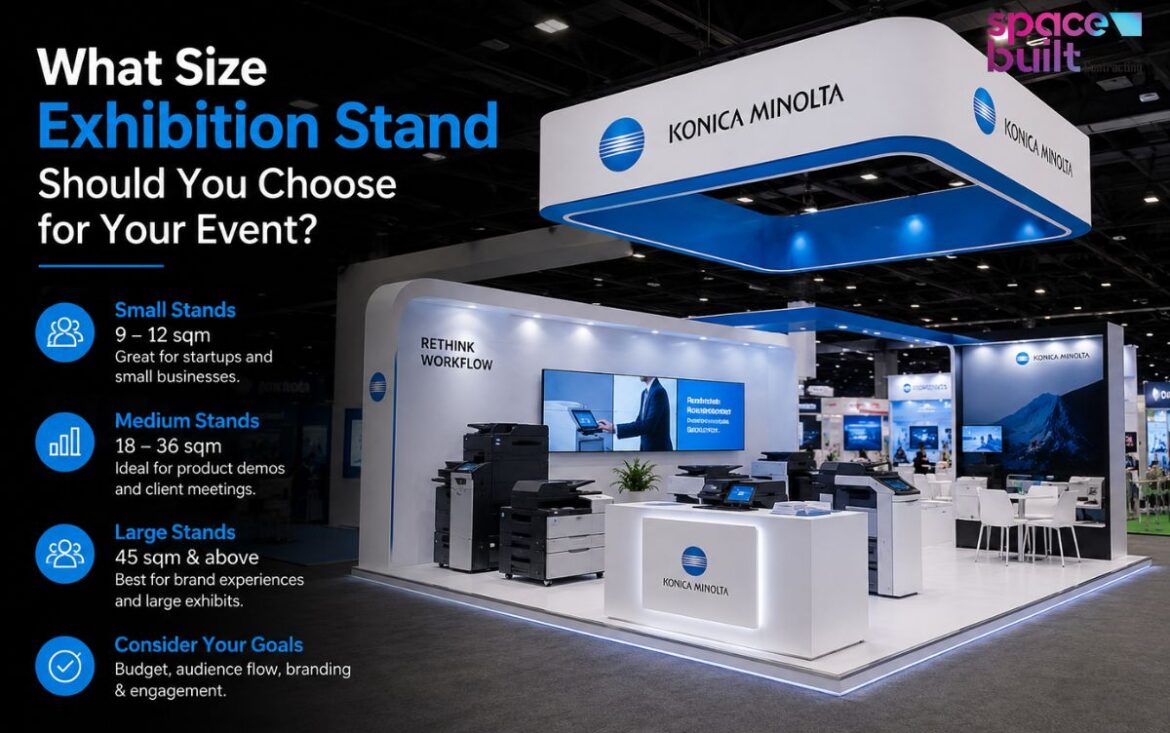
- Small Stands (9–18 sqm)
Well suited to startups, service businesses or anyone trying to find their way into a new market. It does not allow for any elaborate design, but in the context of clean design and good branding, the presence of a reception area and even a small meeting nook can make a good impression.
- Medium Stands (18–36 sqm)
The most common range for established SMEs. Enough space for product displays, a small lounge, and two or three conversations happening at once without anyone bumping elbows.
- Large Stands (36–80 sqm)
Suits companies that need demo areas, several meeting pods, or dedicated product zones. Manufacturing firms, automotive brands, and tech companies with physical hardware to show usually land here.
- Island Stands (80 sqm and up)
Open on all four sides, and typically booked by market leaders or headline sponsors. They require real investment in structure, lighting, and staffing, but they also pull the most attention on the show floor.
| Stand Size | Typical Use Case | Approx. Visitor Capacity | Best For |
| 9–18 sqm | First-time exhibitors, service firms | 3–5 people at once | Testing a new event or market |
| 18–36 sqm | Established SMEs | 8–12 people at once | Regular exhibitors with clear branding needs |
| 36–80 sqm | Product-heavy industries | 15–25 people at once | Companies with physical demos or machinery |
| 80 sqm+ | Market leaders, sponsors | 30+ people at once | Flagship presence, major product launches |
Factors that should guide your size decision
You don’t have to guess. A few practical questions usually settle the size decision faster than an hour of staring at a floor plan.
- What Are You Actually Displaying?
A software company selling a subscription needs far less physical space than a machinery manufacturer bringing a working prototype. Write down what has to physically sit on the stand before you start thinking in square meters.
- How Many Staff Will Be Working the Booth?
Budget roughly 2 to 3 sqm per staff member so people can move without tripping over each other. Cramped staff look rushed, and rushed staff rarely close good conversations.
- What’s Your Expected Footfall?
Halls near entrances, food courts, or keynote stages pull far more traffic than corner spots. A small stand in a high-traffic zone can bottleneck fast, and frustrated visitors just walk past.
- Are You Launching Something New?
Launches need open floor space for demos, press interactions, and photo moments. A cramped launch doesn’t photograph well, and those photos are doing a lot of work in your post-event marketing.
Matching stand size to your event goals
The same organization may require various space sizes for various occasions. The demand for a larger area for an advertising campaign at a large public exposition may be greater than for that of a smaller B2B event where the only purpose is to arrange just a few meetings.
Nevertheless, if generating sales is the main goal, then the square area should be allocated to seats and semi-private meeting places rather than open spaces. If you wish to be noticed, then such factors as height and visual attractiveness become more significant than area dimensions. A tall, well-lit structure on 18 sqm can outshine a flat 40 sqm layout that nobody notices from across the hall.
This is one place where experienced exhibition stand design services in Dubai earn their fee. A good designer asks about your goals first and recommends a size around that, instead of steering you toward whatever’s easiest for them to build.
Budget considerations for every size category
Cost doesn’t scale neatly with square meters. Custom builds, premium finishes, AV equipment, and rental furniture can push a smaller stand’s price above a larger, more basic one.
As a rough guide, design and build usually account for 60 to 70 percent of total exhibition spend, with space rental, logistics, and staffing making up the rest. Before locking in a size, get quotes from a few exhibition stand manufacturers in Dubai so you know what’s realistic at each tier, not just the headline space rental figure.
Moreover, it’s also worth asking whether a modular structure makes sense for you. Companies that exhibit several times a year often save a meaningful amount by building one modular system that gets reconfigured for different sizes and shows.
Common mistakes exhibitors make when choosing size
- Copying last year’s size without revisiting this year’s goals-. Objectives shift, and the stand should shift with them.
- Underestimating storage- Brochures, giveaways, and staff belongings need a home that isn’t the visitor-facing floor.
- Ignoring sightlines from the aisle- A stand can be big and still feel invisible if the layout blocks it from view.
- Overcrowding a small footprint- Not all empty space is wasted space. Visitors can stop, browse, and engage with your booth without feeling rushed.
- Choosing size before location- A corner spot near an entrance behaves nothing like a back-row position, even at the same dimensions.
How does the right design team make a small stand feel big?
The size of the stand, by itself, does not determine the amount of impact that the stand will have. By using vertical branding, mirrors, and effective lighting, an otherwise small space can be made to feel larger than its floor area implies.
Spacebuilt has seen this recurring issue across many industries, and the solution is usually not about size but about hierarchy. So, rather than putting emphasis on a number of elements, it’s advisable to design the stand using a single focus point that would grab people’s attention and make the stand seem spacious.
One of the best exhibition stand design companies in Dubai that gets successful in what it does is the one that knows how to treat space planning not merely as construction, but as a process. Most of the first-timers don’t understand how vital this difference is until they experience the exhibition process in real life.
Expert recommendations by business type
- Startups and service businesses: Stay small, around 9 to 18 sqm, and spend the budget on a striking backdrop and a confident, well-briefed team rather than a structure you can’t fill with content.
- Retail and lifestyle brands: Medium stands with an open frontage tend to work best, since these categories rely on visual browsing and impulse engagement.
- Manufacturing and industrial firms: Go larger, 36 sqm or more, so there’s room for the equipment that’s usually the whole reason people stop by.
- Enterprise and market leaders: Island stands make sense once prestige and headline visibility matter as much as lead count.
Whatever category you fall under, it is best to consult with some of the best exhibition stand builders in Dubai to get a second opinion before you make the booking. A short consultation can provide alternative size options that may not have been thought of, specifically concerning corner placements or split-level constructions that can maximize a minimal footprint.
Final Thoughts
There is no one correct stand size. The size depends on your objectives, your product, your budget, and how your team plans to use the space on the day. What is important is making the choice consciously rather than settling for the same solution as before.
If you’re planning your next event and not sure where to start, exhibition stand design services in Dubai can walk you through sizing based on your actual objectives instead of a template. Spacebuilt offers this kind of consultation directly, helping exhibitors land on a size and layout that fits both the budget and the ambition behind the show.
Ready to plan your next stand? Get in touch with Spacebuilt for a tailored consultation on sizing, design, and build options for your upcoming exhibition.
Frequently Asked Questions
Most SME exhibitors book somewhere between 18 and 36 sqm. That’s usually enough for branding, product displays, and a small seating area without high rental costs.
It depends heavily on venue and finish level, but a basic 9–18 sqm stand starts in the mid-range, and custom branding or furniture adds on from there.
No. A well-designed smaller stand with a clear message often out-converts a large, poorly organized one.
An inline stand has one open side facing the aisle. A corner stand has two, which gives noticeably more visibility for the same square footage.
Three to six months is a safe window, especially for larger or island stands, since the best locations and sizes go early.
Sometimes, depending on what the venue has left, but late changes tend to limit your design options and push up costs.
Yes. They’re built to reconfigure across formats, which makes them a solid option if you’re exhibiting at several events a year.
Around 2 to 3 sqm per staff member is a reasonable baseline, enough room to greet visitors without feeling cramped.
At least 36 sqm, generally, to leave room for demo zones, photography, and press interactions.
Yes, probably more than for a large one. Every square meter on a small footprint has to earn its place, and that takes planning.