-
Spacebuilt
- November 10, 2026
- No Comments
Green Building Construction in Dubai: Benefits, Costs and ROI
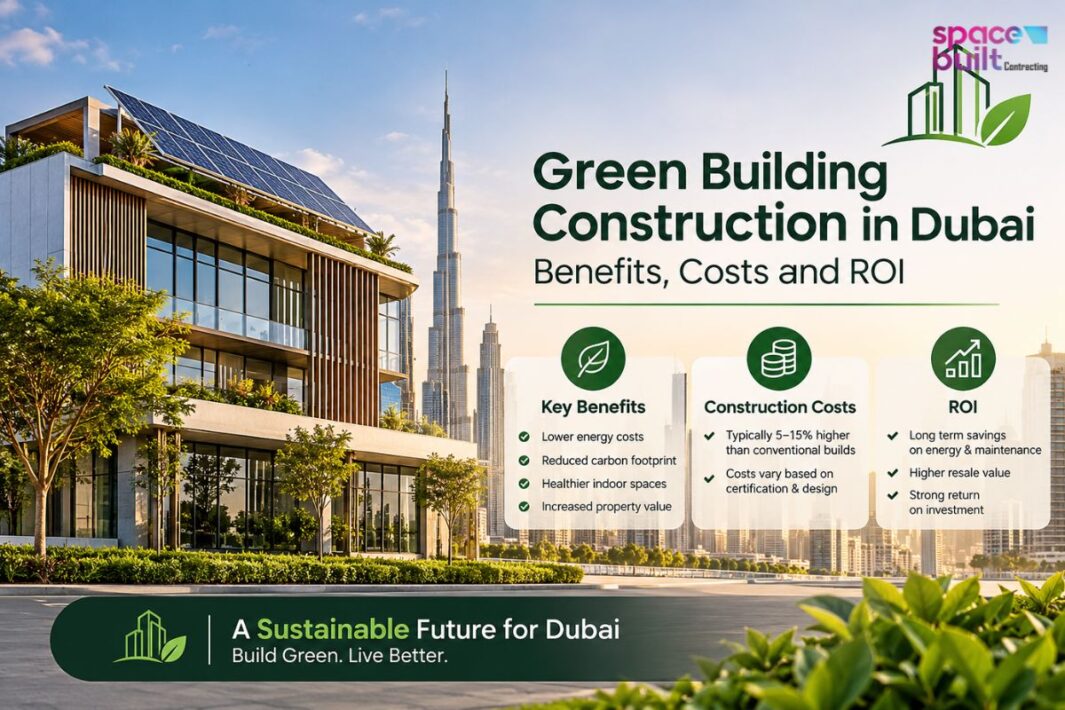
In Dubai, green building construction refers to the creation of structures that consume less energy and water, generate smaller amounts of waste, and create a healthier living environment for their inhabitants than typical buildings. This technology incorporates such elements as high-performance insulation, effective cooling systems, solar energy panels, water-saving devices, and less harmful materials.
However, developers need to go this way for three main reasons: to pay lower utility bills, to get higher rental and resale prices for the buildings, and to comply with the developing rules of sustainability that are being implemented in Dubai. The price is usually higher at first, but after some time the project’s owners are able to earn back the initially high expenses.
Key takeaways
- Green building construction in Dubai conserves energy and water, enhances comfort for users, and enhances the value of the property.
- Initial investment tends to be more expensive, but effective design and planning will reduce the premium and payback periods.
- It’s vital to select building contracting companies in Dubai that have a history of successful projects with a focus on sustainability.
- Green building certifications like LEED, Pearl Rating and BREEAM are independent certifications that give recognition to performance and aid in tenant and buyer recruitment.
What is green building construction in Dubai?
In Dubai, green building construction is about designing and building structures that cause the least possible harm to the surrounding environment during their entire lifetime. Emphasis is placed on the efficient use of energy and water, the availability of eco-friendly materials, and the quality of air in the building. In essence, the objective is to create a building that will serve well for years to come while providing high energy efficiency.
It may seem to many people that the concept of green building is some kind of specialized concept, yet the principles apply to almost all constructions. It may be applied to villas, high-rise residential buildings, office buildings, schools, hotels, and warehouses. What matters most is the approach to making decisions in the very beginning stage of planning.
Ordinary construction always prioritizes the speed of the building process and low initial costs. Green construction considers all these aspects together with the future performance of the construction. Here you may see the major differences.
| Factor | Conventional Construction | Green Building Construction |
| Design focus | Meeting minimum code and budget | Optimizing energy, water and comfort over the building’s life |
| Cooling systems | Standard air conditioning | High-efficiency HVAC with smart controls |
| Building envelope | Basic insulation and glazing | High-performance insulation and low-emissivity glass |
| Water use | Standard fixtures | Low-flow fixtures, greywater reuse, rainwater harvesting |
| Materials | Lowest-cost options | Locally sourced, recycled or low-emission materials |
| Upfront cost | Lower | Typically higher |
| Operating cost | Higher over time | Typically lower over time |
Dubai’s hot and dry climate influences the design requirements of structures in a different way from buildings situated in cooler areas. The main energy requirement of a number of buildings is cooling; therefore, it is vital to minimize solar heat gain.
Therefore, this requires using shading devices, highly reflective roofs, and high-quality glazing. It is also important to consider the orientation of the building so as to face the sun in such a way that heat gain is minimized while making the most of daylight.
Why is Dubai pushing toward green buildings?
Dubai has integrated sustainability into its long-term strategy. The emirate aims to have a significant share of the total energy mix come from renewables in the future, as outlined in its Dubai Clean Energy Strategy 2050. Dubai Municipality also has green building regulations and specifications, which dictate the process of designing and building new projects.
- Regulation and government vision
One of the most potent factors driving the change is government direction. The authorities establish energy performance, water efficiency and building material criteria; and these tend to get tighter over time. Planned-in green features can be designed up front and provide a more cost effective solution for meeting requirements and future requirements.
It is often true that public sector projects pave the way and the private sector developers follow. Today, many investors are looking for sustainability credentials as a minimum, not a maximum. There is a changing expectation that affects the financing, marketing and valuing of projects.
- Climate and resource pressures
Efficiency has a clear economic and strategic benefit to Dubai, because it is dependent on desalinated water and imports of energy. Decreasing use helps relieve stress on these resources. It also safeguards homeowners against higher utility bills that may result from utility rate increases.
Cooling accounts for the greatest share of energy use in most buildings, especially in the summer months. Energy efficient buildings require less electricity for cooling and lower carbon emissions. This is why it is no longer a luxury to make climate responsive design part of the building equation for any building seeking to stay competitive.
Key benefits of green building construction
Green buildings provide multiple benefits. The benefits are not just environmental, but also financial, for the building, for its users and for prospective tenants and buyers.
- Save on utilities: Effective cooling, lighting and water systems can save a lot of money on a monthly basis over the life of the building.
- Increased rent and resale value: Tenants and buyers are more willing to rent and buy buildings that demonstrate its efficiency and sustainability.
- Healthier indoor air: Low emission materials and improved ventilation contribute to better indoor air quality and thus to the well-being and productivity of the occupants.
- Lower maintenance costs: Afterall good materials and system designs will require fewer repairs and replacements.
- Better regulatory readiness: Green buildings built to the current standards will be better equipped to adjust to changes in regulations.
- Better brand image: Companies that are housed in green offices can demonstrate their own efforts towards sustainability to their clients and their staff.
Financial advantages in practice
Energy savings are the most directly quantifiable savings. A building designed well with efficient HVAC, LED lighting and smart controls will consume significantly less electricity than a typical building of similar size. The longer the time frame, the larger the savings will be, and this is often enough to make up for the premium in the long run.
Moreover, water savings are significant too. Incorporating low-flow fixtures, water-efficient irrigation, and greywater use help to decrease the need for city water. These measures are both practical and cost-effective, particularly in a city where water is a precious resource.
Health and comfort benefits
There can be a lot of money that goes into looking after the people who are in your house. Insulation keeps hot spots and drafts to a minimum and proper ventilation helps maintain good air quality. Natural daylighting may affect people’s mood and help people feel better during the day without the need for artificial lighting.
These benefits become real assets to the business. Happy and healthy workers are less likely to take sick time and more likely to be happy in the office. People living in a well-designed home find that their indoor environment temperature remains more stable and humidity and stuffiness issues are reduced.
How much does green building construction cost in Dubai?
The first question that most developers ask is cost. Compared to conventional build, green construction typically has a higher initial cost, as it uses higher quality materials, more sophisticated systems and more thoughtful design. The cost of a premium is estimated to be around 2-10% higher than traditional construction, depending on certification goals, building type, and level of ambition.
The following table shows where the additional spending is usually allocated. Figures are indicative and will vary by project.
| Cost Component | Typical Impact on Budget | Why It Costs More |
| Building envelope (insulation, glazing) | Moderate increase | High-performance glass and insulation cost more than standard options |
| HVAC and cooling systems | Moderate to significant increase | Efficient, variable-speed equipment and smart controls |
| Renewable energy (solar panels) | Significant increase | Equipment, installation and integration with the grid |
| Water systems (greywater, rainwater) | Low to moderate increase | Additional piping, storage and treatment |
| Sustainable materials | Variable | Some are comparable in price; others carry a premium |
| Design and consultancy | Low to moderate increase | Energy modeling and certification documentation |
| Certification fees | Low increase | Registration, audits and compliance reviews |
Where does the extra money go?
The majority of the premium is used for decades-long systems. A significant portion of the additional expense is due to solar panels and efficient cooling systems. Other added costs include better insulation and glazing, but they also mean that the cooling system required is smaller, which can help compensate for some of the cost.
The costs for the design also need to be considered. Daylight analysis and detailed documentation are frequently needed for green projects, as are energy models. These are additional items which will be added up to professional fees, but they tend to avoid costly errors down the road.
Factors that raise or lower the premium
The size and complexity of the project is important. Higher buildings will have a greater square footprint to distribute fixed certification and design costs. When building a sustainable school from the outset of design, it is more affordable than when sustainability initiatives are added as something extra at the end of the design process.
Other factors such as location and supply chains, and availability of local materials also influence price. Local production of materials can help reduce transportation expenses and in some cases the total premium. Last but not least, so do the certification levels. The cost of a basic green rated project will typically be lower than that of a project that is rated high.
What is the ROI of green buildings in Dubai?
The strongest argument for green construction is the return on investment. The initial premium is genuine but the benefits add up over time. For many projects, the cost of the premium is paid back in a reasonably short period of time, after which the building provides financial benefits.
Calculating a simple payback period
The easiest measure of ROI is the payback period. Calculate the number of years it will take for the extra upfront cost to be covered by the annual savings. In the following example, the logic is shown using approximate numbers.
Assume the conventional construction of a building costs AED 10 million, while the green features increase this cost by 5% (AED 500,000). AED 100,000 in annual utility and maintenance savings equates to a simple payback of five years if those features were in place. From then on, the savings go directly to the owner.
Actual results are dependent upon building use, fluctuations in energy costs and maintenance of the systems in actual practice. However, for most green projects, the cost premium can be recouped within a few years, usually 5 to 10, depending on the amount of energy saved and how it is used.
Non-financial returns
Not all of the returns are to be found on a spreadsheet. Green buildings have a tendency to fill up quicker and keep tenants longer, resulting in less vacancy. They may also receive higher rent/sale prices in competitive markets. Actively looking for certified offices might be a tactic used by corporate tenants with sustainability goals. Some corporate tenants with sustainability goals may actively go out and look for certified offices.
There’s also a risk management factor. High-performance buildings will not be as vulnerable to expensive retrofits if the regulations evolve. They tend to have a greater firmness as well since they’re ready for the future already.
How to shortlist contractors for your project?
In any green project, choosing the right builder is one of the most important decisions. Experience in the energy system, sustainable materials, and certification processes is essential to green construction, and not all contractors have a background in these areas. Begin by checking out the portfolios of the best construction companies in Dubai, and find a completed project with similar buildings and certification requirements.
Additionally, many owners are comparing building construction companies in Dubai that specialize in sustainable work. Request actual case studies detailing energy performance, not design renderings. It’s better to work with a contractor who has a history of providing measured outcomes for buildings than one that simply guarantees savings in the future.
References are important, too. Talk to past customers regarding the budget, on-time work, and the contractor’s solution to issues. Communication skills are as important as technical skills when it comes to green projects, as there is often a greater level of coordination between trades.
What to look for in a contractor partner?
As soon as you have a short list of candidates, sift through them based on a well-prepared list of requirements. Green construction is a specific specialty, so the right partner should not only be technically proficient but also possess the experience and expertise needed for successful project management.
- Relevant experience: Check for projects that have similar scale, use, and certification objectives.
- Green certification knowledge: Awareness of documentation and testing requirements for green certification systems.
- Expertise in energy and water: Inquire about HVAC design, insulation requirements, and renewable energy integration.
- Strength of the supply chain: Access to certified materials ensures that there is no costly delay.
- Clear pricing: Transparent bidding practices with clear examples of the extra costs involved with green components and the standard services.
- Commissioning or handover support: Systems need to be tested and adjusted to meet the desired performance.
The selection of building contracting companies in Dubai has a more impactful influence on the outcome than any of the other design choices made by many owners. A competent contractor can identify issues early on, offer cost-effective solutions, and ensure the project stays on schedule. Select a partner willing to commit to the project for the long term, rather than just a construction project.
It is also important to set the performance goals in the contract. Setting tangible targets like energy use intensity or water consumption goals provides a benchmark for both parties. The building is kept on track towards those goals through regular reviews during the construction process.
Green building certifications explained
Certifications are a third-party approach to building performance verification. They also provide a common language to enable buyers, tenants, and regulators to compare projects. There are several systems used in the region, each with a focus.
| Certification | Origin | Main Focus | Best Suited For |
| LEED (Leadership in Energy and Environmental Design) | United States (USGBC) | Energy, water, materials, indoor environment | Offices, commercial and mixed-use projects seeking global recognition |
| Pearl Rating System (Estidama) | Abu Dhabi | Sustainable design across the whole community and building | Projects in Abu Dhabi and those following local standards |
| BREEAM | United Kingdom (BRE) | Management, energy, health, materials and ecology | International projects and institutional clients |
| Dubai Municipality green requirements | Dubai | Local regulatory compliance for energy and water | All projects subject to Dubai building rules |
Furthermore, the different systems award different strategies, so it is important to certify for the goals of your project and not the other way around. International tenants might consider LEED, whereas a project that is seeking local compliance might give the Dubai Municipality requirements first consideration. Many projects are made by incorporating components of more than one framework.
Common challenges and how to avoid them
There are many benefits to green construction; however, there are also some drawbacks. With good planning, most of the problems are predictable and can be avoided. Owners who know what potential issues there may be in the future will be better equipped to safeguard their budgets and timelines.
- Sustainability as an afterthought: Any features added after the design is complete tend to be more costly and less effective. Plan at the concept stage.
- Failure to operate and maintain: If a high-performing system is poorly maintained, it will perform less efficiently. Include building maintenance needs in the handover plan.
- Selecting materials without seeking out supporting reports: Do not take “green” labels for granted without requesting test reports and certifications.
- Too little coordination: There is a higher need for more collaboration between architects, engineers, and installers in green systems.
- Avoiding commissioning: Systems need to be tested in the real world. If no commissioning is done, potential savings could never be realized.
- Setting unrealistic payback expectations: Savings are dependent on usage. Design for the worst-case scenario and monitor actual results once the building is built.
Most of these issues can be overcome with care in planning. Working with people who have experience in these types of things, setting clear goals, and setting a budget for commissioning can help you avoid many unexpected expenses. Ongoing reviews ensure that any issues are identified in time to prevent escalation.
Conclusion
Green building construction in Dubai has become a mainstream option. tackles practical challenges of energy, water, and climate and provides straightforward financial and comfort gains. The first premium is the real premium, but for most projects the savings and the increased property value over time make up for the premium. The key to achieving a green label is careful planning, measurable performance targets, and the right partner.
No matter if you are working on a villa, an office tower, or a mixed-use project, you should start with the right planning and budgeting. Utilize the services of skilled companies that can provide you with evidence-based results, and keep sustainability as a priority from the very beginning. Project owners who proceed this way have a much better chance to create properties with enduring value. If you are interested in sustainable construction methods and techniques, visit Spacebuilt and consult with construction companies in Dubai that support green construction as you do.
Frequently asked questions
Dubai Municipality issues green building regulations for a large number of new projects; requirements vary by the type of building and its scale.
The payback of the green premium is approximately 5 to 10 years, depending on energy savings and operating patterns.
Neither is best in all circumstances; one is internationally accepted, and the other is only applicable locally in Abu Dhabi.
Yes, typically, with the premiums being paid upfront and typically estimated to be around 2-10%, but the difference can be substantial due to the efficiency of the design.