
-
Spacebuilt
- September 14, 2026
- No Comments
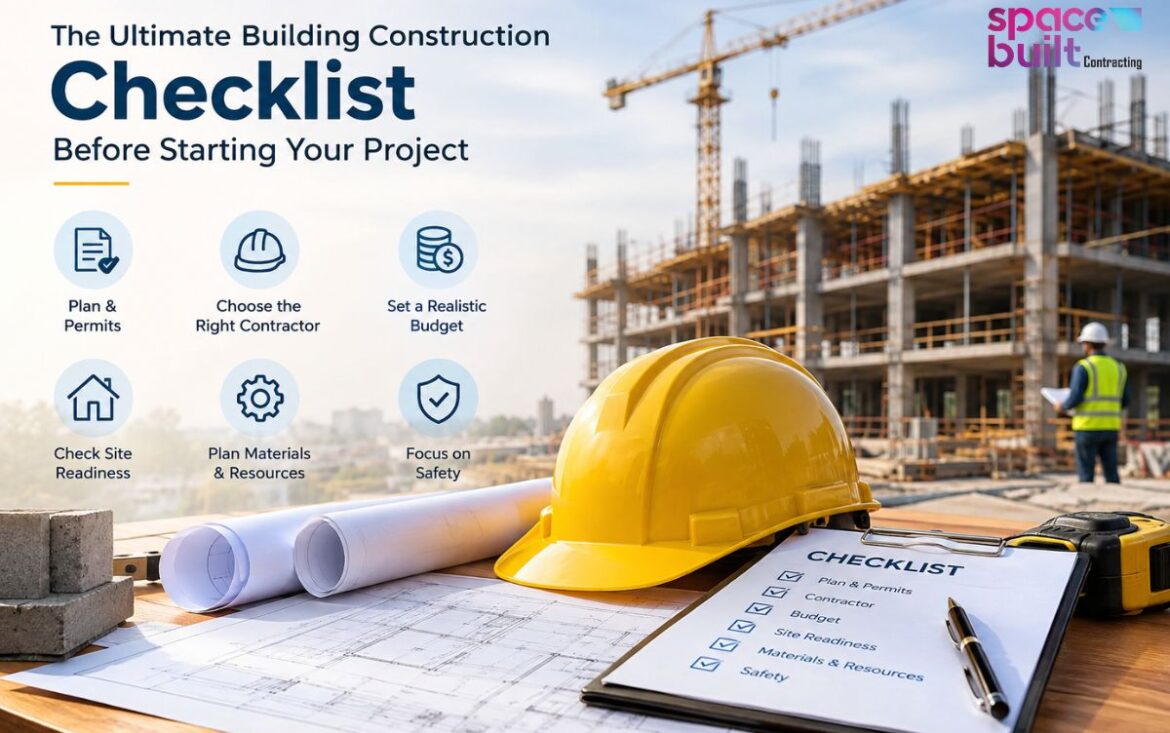
The Ultimate Building Construction Checklist Before Starting Your Project
Table of Contents
- Key takeaways
- Why does a pre-construction checklist matter?
- Budget, land, and legal approvals
- Choosing a construction company Dubai developers trust
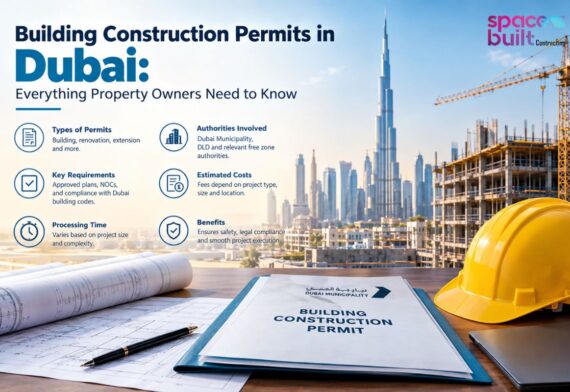
- Design approvals and municipal permits
- Comparing Dubai building contracting companies
- Site preparation and construction phase checklist
- Common mistakes to avoid
- What do top construction companies do differently?
- Final thoughts
- Frequently asked questions
Before starting any construction project in Dubai, there are four important factors that you need to consider. First of all, calculate how much you are ready to spend and include 10-15% to your budget as a contingency fund for unforeseen costs. Secondly, verify the title and zoning status for the land you are looking to buy. Additionally, your project design is required to conform to the regulations set by Dubai Municipality and should be submitted through their BIM platform.
Last but not least, choose a construction company licensed by Dubai authorities. Failing to adhere to these steps can make the process of building quite costly due to potential delays. It has been estimated that the worth of the UAE construction industry will reach AED 163.5 billion by 2026 and AED 204.9 billion by 2031. Dubai makes a significant contribution to this statement.
Due to high competition among contractors, it is more essential now than ever to make a list of reliable construction companies in Dubai. Find out whether they have proper licenses, how long they have been in the business, what works they have already done, and what they charge for their services.
Key takeaways
- Inspect financial allocations, ownership documents, necessary permits, and contractor qualification prior to beginning site works.
- In 2026, Dubai’s construction industry will be around AED 165 billion, thus requiring qualification of contractors.
- Ensure that local administration approval procedures and BIM proposals are known to prevent any issues.
- Research three contractors with respect to their background, portfolio, rates, and payment methods.
Why does a pre-construction checklist matter?
Dubai’s construction development is advancing quickly. According to industry data from IMARC, approximately 40% of total market activity is made up by residential work. Thus, there is a continuous demand for contractors, materials, and municipal approvals throughout the year. When permit offices and suppliers are crowded with business, an unplanned project is the one that suffers delay.
I have seen clients think that the architects’ drawings were ready for approval, but later learn that three resubmissions are needed because the zoning classification was not checked beforehand. Such delays can be avoided, so it is about a lack of planning rather than about bad luck.
Budget, land, and legal approvals
Get these three sorted before you talk to anyone about design.
- Land title verification: confirm ownership is clean through the Dubai Land Department, with no disputes or liens attached.
- Zoning classification: residential, commercial, and mixed-use plots each carry different height and setback rules.
- Budget with contingency: set aside 10-15% above your base estimate for material price shifts and change orders.
| Approval Step | Typical Authority | Average Processing Time |
| Land title check | Dubai Land Department | 3-5 working days |
| Zoning confirmation | Dubai Municipality | 1-2 weeks |
| Building permit (BIM submission) | Dubai Municipality | 2-4 weeks |
| No Objection Certificate (NOC) | Relevant authority (DEWA, Civil Defence) | 1-3 weeks |
These timelines shift depending on plot location and project size, so treat them as planning ranges, not guarantees.
Choosing a construction company Dubai developers trust
This is where most of the actual risk in a project sits. A building construction company Dubai clients keep coming back should have three things: a valid trade license, a portfolio of completed, not just started, projects, and payment milestones tied to verified progress rather than arbitrary calendar dates.
Furthermore, ask to see their DED trade license and confirm it covers the scope you actually need, whether that’s structural work, interior fit-out, or full turnkey delivery. A company licensed only for interiors has no business quoting you on structural steel.
What to Ask Before Signing
- Can I visit a project you completed in the last 12 months?
- Who handles NOC and permit submissions, you or me?
- What happens if material costs rise mid-project?
- Is your quote fixed-price or cost-plus?
Design approvals and municipal permits
From January 2024, the Dubai Municipality will impose the necessity of submitting BIM for permit processing. This has made the process of approval increasingly detailed. Nevertheless, BIM allows designers to discover design conflicts before the construction starts. Hence, architects and engineers should apply the correct BIM software from the very beginning, avoiding the conversion of the drawings at later stages.
Moreover, structural drawings, MEP layouts, and civil defence clearances now get reviewed together. Submitting incomplete BIM files is one of the fastest ways to get a permit application sent back.
Comparing Dubai building contracting companies
Not all building contracting companies in Dubai work the same way, even within the same budget range. Some run lean and subcontract everything out; others keep core teams in-house for structural and MEP work.
| Factor | In-House Model | Subcontracted Model |
| Quality control | Direct, easier to enforce | Depends on subcontractor vetting |
| Cost | Often higher base rate | Can be more competitive |
| Timeline flexibility | Faster internal coordination | More scheduling dependencies |
| Best for | Complex or high-spec builds | Standard residential or commercial fit-outs |
Neither model is automatically the right choice. A villa renovation with straightforward finishes doesn’t need the same setup as a multi-story commercial build with tight structural tolerances, and paying for an in-house team you don’t need just eats into your budget.
Site preparation and construction phase checklist
Once approvals and contractor selection are locked in, the physical checklist takes over.
- Site survey and soil testing done before excavation starts.
- Utility connections (water, power, drainage) confirmed with DEWA.
- Safety fencing and Civil Defence sign-off in place.
- Material delivery scheduled to match construction phases instead of arriving all at once.
- Weekly progress reporting agreed with the contractor in writing.
However, weekly reporting sounds like a small detail. It isn’t. Projects that skip it tend to discover budget overruns only at the final invoice, when there’s no room left to adjust anything.
Common mistakes to avoid
- Starting design before confirming zoning- A redesign after rejection costs more than the week it takes to check first.
- Choosing the lowest quote without checking scope- A cheaper bid often leaves out items a complete quote would include, like waterproofing or snagging.
- Not verifying payment milestones against actual progress- Paying on calendar dates instead of completed work stages hands away your leverage the moment there’s a delay.
- Assuming verbal agreements hold up- Get variations, material substitutions, and timeline changes in writing, every time.
What do top construction companies do differently?
The top construction companies don’t necessarily win on price. They win on documentation: every variation logged, every material substitution approved in writing, every inspection photographed before the work gets covered up, foundations and plumbing especially.
That habit matters more once a dispute happens. Without a paper trail, disagreements over what was actually agreed tend to favor whoever kept better records, and that’s rarely the client if nothing was written down along the way. It’s a small discipline that separates the top construction companies in Dubai from the ones who cut corners on paperwork to move faster.
Final thoughts
A construction project rarely fails because of one bad decision. It fails because small gaps, an unchecked zoning rule, a verbal-only agreement, a skipped NOC, pile up until the timeline and budget both give way. Working through this checklist before breaking ground removes most of that risk. Spacebuilt runs new clients through exactly this process, from land verification through final handover, and the projects that follow it end up with far fewer surprises than the ones that skip straight to design.
If you’re comparing your options for a build in Dubai, that’s the kind of groundwork worth asking any building contracting companies in Dubai shortlist about before you sign anything, and it’s the approach Spacebuilt builds every project around from day one.
Frequently asked questions
Typically 2-4 weeks for the BIM-based building permit, followed by other processing times by NOCs depending on the project’s scope and location.
Most contractors will suggest that you include 10-15% on top of your construction estimate to cover changes in material prices and conditions at the site.
Yes. Permit applications are often needed for interior refurbishment in Dubai as well, and a licensed contractor.
Fixed-price guarantees that your total cost won’t change. Cost-plus actually costs plus a contractor margin – which can fluctuate if material prices change during construction.
Yes, but typically it also increases the cost and delay for handover paperwork, so proper due diligence is better before signing than after.
Dubai Municipality has mandated Building Information Modeling since January 2024, when it is submitted for permit applications, and these digital designs identify design conflicts at an earlier stage than previously.
Request the DED trade license number and ensure the activity listed in the trade license applies to the project scope, whether it is structural, MEP, or fit-out works.
Incomplete permits or NOCs, closely followed by poorly documented verbal changes in scope that become an issue later in the project.