
-
Spacebuilt
- August 14, 2026
- No Comments
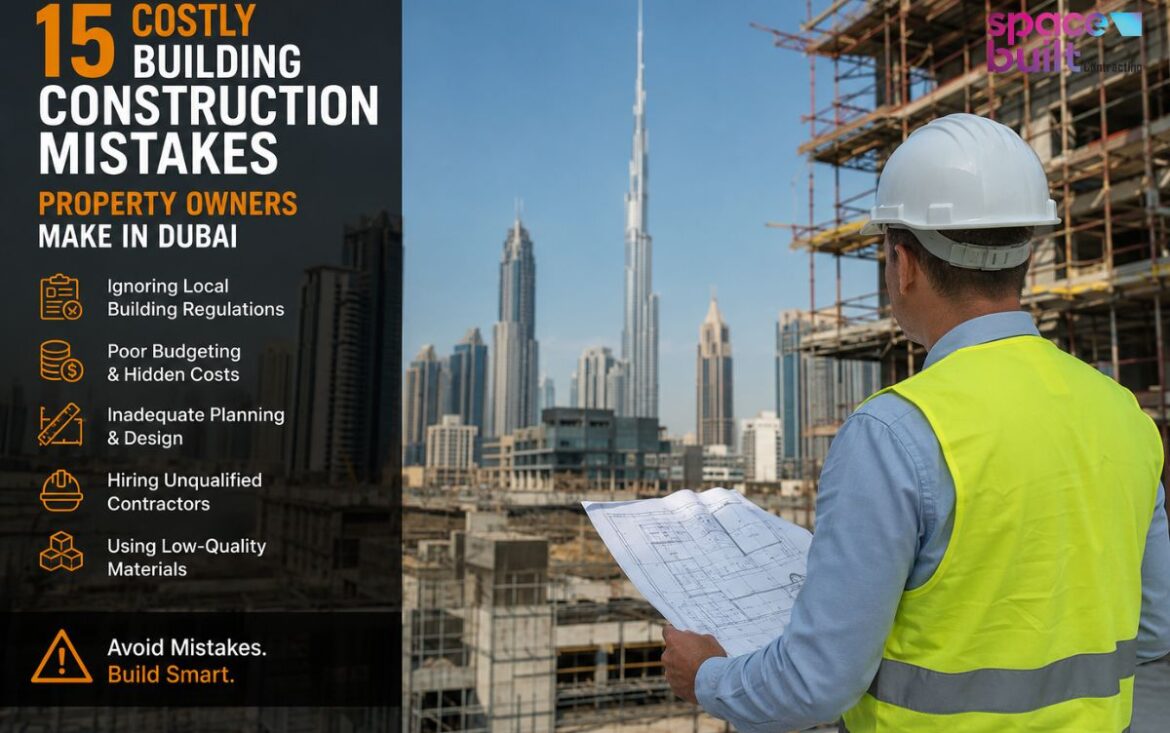
15 Costly Building Construction Mistakes Property Owners Make in Dubai
Table of Contents
- Key Takeaways
- Where do Dubai projects go wrong?
- Top building construction mistakes you should know
- Quick-reference table
- Bottom line
- Frequently asked questions
Upon asking ten property owners about the main reasons behind the over expenditure of their buildings, it turns out, the replies are likely to be more or less the same: absence of soil testing, poorly formulated contract, contractor selected because lowest bid was given, or the approvals from Dubai Municipality were not acquired in time. In addition to that, the stakes in this game are high: according to the experts from Dubai Land Department, the value of transactions in the Q1 of 2026 is estimated to be AED 252 billion, which means 31% increase as compared to the previous year and villa prices per square foot are higher than the prices of apartments by almost 16% year-on-year.
Several conclusions can be drawn from these points:
- Mistakes will ultimately cost real cash;
- The choice of a contractor is far more crucial than most first-time developers believe;
- Being in a hurry at the beginning is almost always a guarantee of losing money in the end.
If there is one habit that prevents all of this, it is the hiring of a reputable villa construction company in Dubai before the work begins.
Key Takeaways
- Most budget overruns happen because contractors were not thoroughly vetted.
- If you skip soil testing or MEP planning, you’re just going to end up paying twice for the same thing.
- You can’t treat RERA or Dubai municipality approvals as red tape. Your project can be stopped cold if you miss approvals.
- Nothing reassures an owner like a milestone-based contract.
Where do Dubai projects go wrong?
The construction industry of Dubai is proving relentless. UAE has a market value of somewhere between USD 44 billion and USD 48 billion in 2026 and is growing at a rate of just over 5% every year, with Dubai accounting for almost 50% of all construction activities. The biggest sector of the market is residential construction, constituting nearly 38% of the total market value, driven by population growth and unbridled demand for private houses and towns.
This growth brings about many contractors, some of them very good, while some would be “project managers” who have never managed any projects until completion. First-time clients cannot notice the difference until it is too late. Here, we are listing fifteen mistakes which keep noticing, their reasons, and the ways to deal with them.
Top building construction mistakes you should know
1. Choosing a contractor on price alone
The cheapest quote rarely stays the cheapest option. Contractors who bid low tend to make it up elsewhere: thinner materials, skipped inspections, or a string of “unforeseen” change orders once you’re already committed. Get three quotes minimum and read the scope line by line. The bottom number tells you almost nothing on its own.
2. Skipping contractor licensing checks
Plenty of companies advertise construction services in Dubai without holding the right Dubai Municipality trade license, or without the classification your project actually needs. Ask to see it. Confirm it covers what you’re building: villa, fit-out, commercial, whatever it is. This one check alone rules out a surprising number of the disputes I’ve seen.
3. Signing a vague or incomplete contract
“Villa construction, AED X” is not a contract; it’s a promise with no teeth. You need defined scope, material specs, payment tied to milestones, and a penalty clause if deadlines slip. Every cost dispute I’ve ever looked into traces back to something the contract left unsaid.
4. Skipping soil testing and site surveys
The soil in Dubai isn’t uniform. Some plots need deeper foundations, some need the soil replaced entirely before anything else can happen. Skip the test to save a few thousand dirhams and you might be looking at a structural bill worth hundreds of thousands down the line. Any of the best construction companies in Dubai will want this done before they’ll even give you a firm quote.
5. Underestimating the real project budget
Owners often budget for construction and forget everything around it: DEWA connections, landscaping, snagging, contingency. The industry norm is to set aside 10 to 15% of the total budget for the unplanned stuff, because on nearly every build, something unplanned shows up. Not sometimes. Nearly every time.
6. Ignoring climate-appropriate materials
Heat, humidity swings, and sand exposure are hard on materials that would be fine somewhere else. Cheap paint fades and cracks within a year or two. Standard sealants give out around window frames faster than most owners expect. Paying more upfront for UV-resistant, heat-tolerant materials usually costs less than the maintenance bill that follows if you don’t.
7. Missing RERA or DM approval requirements
Villa projects, extensions, even some interior changes need sign-off from Dubai Municipality, and sometimes RERA, depending on the development. Start before approvals clear, and you’re risking stop-work orders, fines, or in worse cases, tearing down what you’ve already built. A villa construction company in Dubai worth hiring treats this as routine, not something to figure out later.
8. Leaving MEP planning until late
Mechanical, electrical, and plumbing systems need mapping before the walls go up. I’ve watched crews rip into finished drywall to reroute plumbing that should’ve been planned six months earlier. It’s one of the most expensive kinds of rework there is. Ask for MEP drawings at the design stage. Not during construction, at the design stage.
9. Skipping independent structural review
Leaving structural sign-off entirely to the contractor’s own engineer removes a layer of protection that exists for a reason. An independent second opinion on load calculations and foundations doesn’t cost much compared to what a design flaw costs once the concrete’s already poured.
10. Overlooking local building codes
Setbacks, plot coverage ratios, height limits, parking requirements- Dubai Municipality’s codes cover all of it, and they shift depending on area and zoning. A design that looks perfectly fine on paper can get bounced at the permit stage for reasons nobody flagged early. Building construction companies in Dubai that actually know the local code save you months you don’t need to lose.
11. No defined project timeline or milestones
“About eight months” is not a timeline. It’s a guess dressed up as a plan. Every phase needs a real date attached: foundation, structure, MEP, finishing, handover, with consequences written in for missed ones. No milestones means no way to hold anyone accountable when things slip.
12. Insufficient on-site quality supervision
Owners who don’t visit regularly, or who don’t hire someone independent to do it for them, tend to find out about quality problems at handover, right when fixing them means tearing into work that’s already finished. Weekly visits with photos catch problems while they’re still cheap.
13. Finalizing construction before the design is locked
Starting construction while layouts, electrical points, or finishes are still undecided is a guaranteed source of change orders, and every one of them costs money and time. Lock the design first. Structural, interior, exterior, all of it, before breaking ground.
14. Ignoring green building requirements
Al Sa’fat, Dubai’s green building system, sets mandatory requirements around energy efficiency, water use, and material sourcing. Projects that treat it as an afterthought usually end up paying for retrofits just to pass final inspection. This is genuinely one of the things that separates the best construction companies in Dubai from the ones just aiming for minimum compliance.
15. No plan for snagging or post-handover maintenance
Handover feels like the finish line. It isn’t. A proper snagging inspection, checking every fixture, finish, and system before final payment goes out, catches defects while the contractor is still on the hook to fix them free of charge. Skip it, and those same defects become your bill six months later.
Quick-reference table
| Mistake | Main Risk | Simple Fix |
| Choosing on price alone | Hidden costs later | Compare scope, not just price |
| No licensing check | Legal disputes | Verify DM trade license |
| Vague contract | Payment disputes | Milestone-based contract |
| No soil testing | Foundation failure | Test before quoting |
| Underestimated budget | Mid-project cash gap | Hold 10 to 15% contingency |
| Wrong materials | Early degradation | Climate-rated specs |
| Missing approvals | Stop-work orders | Confirm RERA/DM sign-off |
| Late MEP planning | Expensive rework | MEP drawings at design stage |
| No structural review | Design flaws | Independent engineer check |
| Ignoring building codes | Permit rejection | Local code review upfront |
| No timeline milestones | Open-ended delays | Written phase deadlines |
| No site supervision | Late-discovered defects | Weekly inspections |
| Unlocked design | Change-order costs | Finalize design pre-construction |
| Ignoring green codes | Retrofit costs | Al Sa’fat compliance from start |
| No snagging plan | Post-handover repairs | Formal snagging inspection |
Bottom line
Strip away the details and most of these fifteen mistakes come from the same place: rushing the decisions that happen before construction even starts. Vetting a contractor properly, testing the soil, writing a contract that actually holds up, chasing down approvals, none of it feels urgent at the moment. Skip it anyway and it becomes the thing that costs you time and money later. If you’re planning a build and want a team that treats licensing, MEP planning, and Dubai Municipality approvals as standard practice rather than an afterthought, Spacebuilt has been through this enough times to know exactly where projects tend to go wrong, and how to keep yours from being one of them.
Frequently asked questions
Depends heavily on finish level and location. With villa prices up nearly 16% year on year, it’s worth budgeting above last year’s numbers, not at them.
Usually 8 to 14 months from groundbreaking to handover, though size, design complexity, and how fast approvals move can push that either way.
For structural changes, extensions, and most exterior work, yes. Minor interior finishing usually doesn’t need it.
Hesitation to put scope, materials, and timelines in writing. If it isn’t in the contract, it isn’t real.
For anything beyond a small project, yes. They work for you, not for the contractor.
Dubai’s mandatory green building rating system. Most new residential and commercial builds fall under it whether owners realize it or not.
10 to 15% of total project cost, kept separate from the main budget rather than folded into it.
RERA regulates real estate transactions and development activity. DM handles building permits, codes, and construction compliance.
You can, but you’re removing a safeguard against errors that might otherwise go unnoticed until they’re expensive.
Every fixture, finish, electrical point, plumbing connection, and structural detail, checked before the final payment clears.