

-
Spacebuilt
- March 26, 2026
- No Comments
Common Delays in Interior Fit-Out Projects and How to Prevent Them
Table of Contents
- Key takeaways
- Why do interior fit-out projects get delayed?
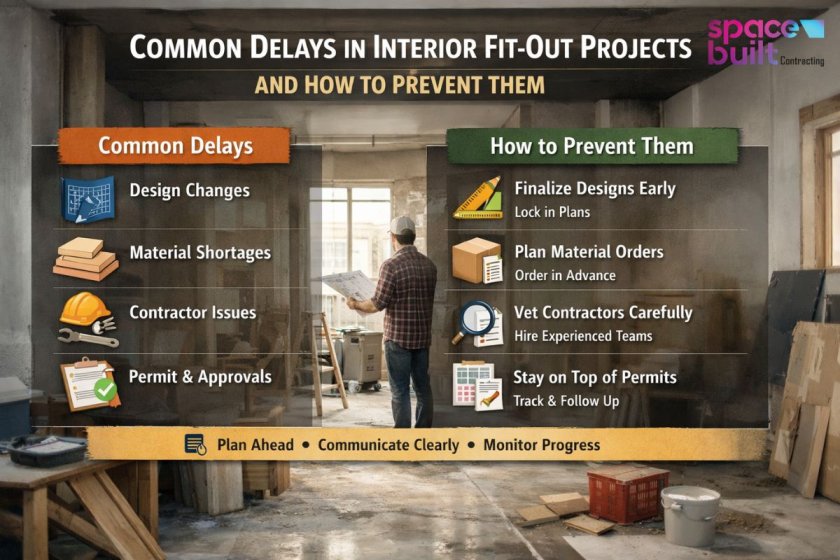
- What are the most common delay factors?
- How does poor planning slow down projects?
- Why do approvals and permits take time?
- How can material issues affect timelines?
- What role does workforce management play?
- How to prevent delays effectively?
- Wrapping
- Frequently asked questions
Key Takeaways
- Delays normally result from poor planning and lack of communication
- Approvals and material planning help in reducing major project risks
- Effective workforce management improves project speed and quality
- The right partner guarantees smooth and timely completion
Planning gaps, approval problems, and issues with coordination usually lead to project delays in interior fit-out projects. Such delays are costly and increase timelines. Nevertheless, the majority of delays can be prevented with the help of the appropriate strategy and professional assistance of Spacebuilt, which presupposes the enhancement of planning, communication, and implementation at the initial stages of the project.
Why do interior fit-out projects get delayed?
The poor planning, slow approvals, shortages of materials, and poor coordination are some of the factors that cause interior fit-out projects to be delayed. These cost and stress delays. Nevertheless, through a good plan, effective communication, and professional guidance of teams such as Spacebuilt, most of the delays can be avoided at an early stage.
Interior fit-out work may seem easy on the surface, but in actual sense, it is a series of steps that occur simultaneously. Therefore, a minor error in one of the stages can influence the entire schedule. However, not all delays can be attributed to a single large problem- a thousand small problems accumulate.
For example:
- Last-minute design changes.
- Lack of proper scheduling
- Unclear project scope
Additionally, lack of proper communication between teams leads to more confusion. This results in rework, which is a waste of time and money. The initial step to prevention of these root causes is to understand them.
What are the most common delay factors?
The interior project can be slowed down by many factors, particularly when they are not addressed in the initial stages. The first reason is the selection of the wrong interior fit-out contractor Dubai that may influence quality and schedules.
The most frequent delay causes are the following:
- Unclear project scope– Failure to define requirements leads to teams making subsequent changes.
- Frequent design changes- As much as changes are natural, excessive revisions cause confusion.
- Budget issues- The lack of finances midway slows everything down.
- Poor communication- The misunderstanding between the client, designer, and contractor causes mistakes.
- Dependency on multiple vendors- Delays from one supplier can stop the entire work.
Moreover, these problems interact and form a chain reaction when they are combined. So it becomes relevant that these risks should be identified and controlled at the initial stage itself.
How does poor planning slow down projects?
The success of any fit-out project is based on planning. In its absence, delays are virtually assured. A lot of businesses do not develop a detailed timeline prior to commencement.
As an example, a collaboration with specialists that provide interior fit-out services in Dubai is a guarantee of improved planning and implementation.
Planning errors are common, and they include
- No definite deadlines or milestones.
- Ignoring risk factors
- Not allocating buffer time
- Poor budget estimation
Furthermore, in case of weak planning, teams respond to issues rather than avoid them. This responsive strategy is time-wasting.
The following planning table can be useful:
| Stage | Risk If Ignored | Solution |
| Design phase | Frequent changes | Finalize design early |
| Procurement | Material delay | Pre-order materials |
| Execution | Work mismatch | Daily coordination meetings |
Therefore, proper planning will guarantee a well-organized working process and minimize any unforeseen delays.
Why do approvals and permits take time?
One of the largest unknown causes of project delays is approvals. In such cities as Dubai, there are strict rules to be observed prior to working.
There are several authorities involved in getting approvals. When documents are not complete, the process is time-consuming. Additionally, rejection can be caused by any design error.
Delays associated with common approval:
- Missing documents
- Non-compliant designs
- Submission of applications late.
- Changes after approval
But such companies as Spacebuilt are aware of such processes. They make sure that all the documents are prepared properly and submitted. Moreover, it is possible to save a significant amount of time by beginning approval work early. It is a common occurrence that many projects are delayed due to lack of prior approvals.
How can material issues affect timelines?
The choice of materials and their delivery significantly contributes to the project schedules. Any delay in materials can halt the whole project. Such risks are typically mitigated when turnkey design services in Dubai because material planning is often done better.
Some of the problems that are related to materials are:
- Delayed supplier delivery.
- Out-of-stock materials
- Wrong specifications
- Damaged materials
Additionally, imported materials are usually delayed by shipping and customs. Hence, it is risky to rely on them much.
To avoid this:
- Finalize materials early.
- Keep backup options ready.
- Work with trusted suppliers.
- Monitor deliveries on schedule.
Furthermore, the coordination of design and procurement teams is done properly to enable a smooth flow without interruptions.
What role does workforce management play?
Proficient employees are needed to accomplish projects in a timely manner. Nevertheless, inadequate management of the workforce may lead to severe delays.
Common workforce issues:
- Shortage of skilled labor
- Poor supervision
- Lack of training
- Miscommunication on-site
Moreover, productivity declines when employees are not handled in the right way. This has a direct influence on project deadlines.
For example:
- Work is done more slowly than anticipated.
- Mistakes are on the rise, and this results in rework.
- The communication between teams is weakened.
Nonetheless, established business organizations such as Spacebuilt are concerned with powerful site management. They make each team very clear on its responsibility.
However, frequent monitoring of the sites and appropriate scheduling enhance efficiency and minimize delays to a large extent.
How to prevent delays effectively?
It is not hard to prevent delays when the appropriate measures are taken in time. The trick is to plan, communicate, and execute.
The following are some of the practical methods of preventing delays:
- Start with clear planning- Scope, budget, and timeline are to be defined.
- Recruit qualified personnel- Select the appropriate team that is experienced.
- Fix the design before execution– Change should not be done frequently.
- Track progress regularly- Weekly updates are used to identify issues in time.
- Keep buffer time- Always anticipate unforeseen delays.
- Ensure strong communication- Hold the entire team in line.
Furthermore, project tracking with the help of modern tools enhances transparency. Thus, problems can be resolved promptly before they become larger.
Wrapping up
Delays in interior fit-out are not unique and can be prevented through the appropriate strategy. Projects can be run smoothly by concentrating on planning, approvals, materials, and workforce. The selection of the best interior fit-out company in Dubai is also significant in the timely delivery. Under the professional advice of Spacebuilt, companies will be able to accomplish projects in a shorter, smarter, and stress-free manner.
Frequently asked questions
The most common reasons are poor planning, design changes, approvals, and material delays.
Design, track progress, hire experienced professionals early, and finalize design to achieve better results.
Yes, slow approvals may halt the work and unnecessarily prolong the project schedules.
Delays in material delivery may halt the work and raise the total time of the project completion.