
-
Spacebuilt
- September 18, 2026
- No Comments
Building Construction Permits in Dubai: Everything Property Owners Need to Know
Table of Contents
- Key takeaways
- What does a building permit actually cover?
- Who needs one and who gets caught out?
- The permit process- step by step
- Documents your consultant will ask for
- Timelines, fees, and where projects get stuck
- Mainland Dubai vs free zones: different rulebooks
- What happens if you skip the permit?
- Choosing the right team for the job
- Bottom line
- Frequently asked questions
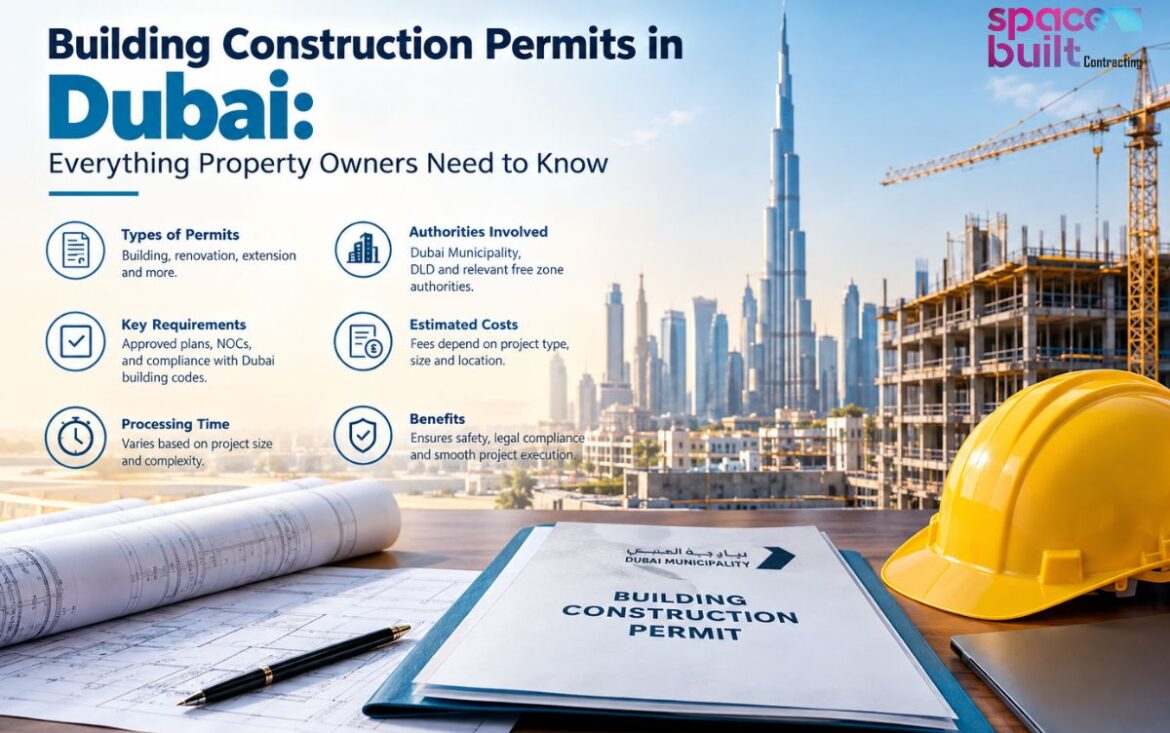
If you are the owner of a property in Dubai and would like to get some construction done on the property or change the nature of the use of the building, then you will need to go through the procedure to obtain a building permit from the Dubai Municipality or Trakhees in case your property is located in a free zone.
However, the entire application process runs through BPS (Building Permit System) and requires you to submit plans drawn by a DEQ-approved consultant. The building permit is essential for a wide variety of work, such as villa extensions and new building projects. The best way to avoid getting in trouble while completing this step is to collaborate with an experienced construction company in Dubai.
Key takeaways
- Work on the Dubai mainland must always seek approval from Dubai Municipality.
- Design drawings for Dubai Municipality have to be prepared by DEQ-registered experts.
- Free zone buildings are sanctioned by different authorities, and their approval processes do not overlap with Dubai Municipality’s approval process.
- If building work is done without proper authorization, the responsible party will incur fines and will have trouble obtaining Building Completion Certificates.
What does a building permit actually cover?
Most people picture a building permit as something you only need for a brand new tower or villa. The definition of Dubai Municipality is not just limited to a construction permit. The construction permit includes not only building construction, but also structural work, changes in facades, MEP work (mechanical, electrical and plumbing work) and interior decoration as long as it has an impact on a wall, ceiling or other utilities.
However, it becomes clear once one thinks about the rationale behind it. The building regulations in Dubai are aimed at securing structures from fire and other threats. Even apparently insignificant actions like knocking a wall between two rooms can change the balance of loading or block an escape route in case of a fire. The DM wants eyes on that before the work happens, not after the fact.
You’ll run into several permit categories, and picking the wrong one is a common reason applications bounce back:
- Mobilization permit – lets a contractor bring equipment and manpower onto site before formal construction approval, usually for site prep.
- Building permit – the core approval for new construction or major structural work.
- Renovation or modification NOC – for changes to an existing approved structure, common with older villas.
- Fit-out permit – for commercial spaces, retail units, restaurants, and clinics.
- Demolition permit – required before tearing down any existing structure.
Who needs one and who gets caught out?
Villa owners are probably the most surprised by how far these rules reach. Adding a majlis, extending a kitchen, converting a garage into a room, all of it needs DM sign-off. Business Bay and Al Quoz each have their own quirks too. Al Quoz in particular has a lot of older buildings where the original approved drawings were never digitized. Before you can even apply for a modification permit there, you may need an as-built survey done by a licensed surveyor just to reconstruct what DM has on file.
Therefore, commercial tenants fitting out a shop or office hit a different version of the same problem. Even if the landlord already holds a base building permit, your interior fit-out is a separate approval, and it has to be filed under a trade license that actually covers what you’re doing. A retail license doesn’t cover a restaurant fit-out. That mismatch alone accounts for a fair share of rejected applications.
The one group that sometimes assumes it’s exempt: homeowners doing “cosmetic” work. Repainting or replacing flooring generally doesn’t trigger a permit. The moment plumbing, electrical routing, or structural elements come into it, though, you’re back in permit territory.
The permit process- step by step
On paper the sequence looks simple. In practice, each stage has enough detail to slow down anyone doing this for the first time.
1. Confirm the plot and identify the right permit category
You’ll need the current DM affection plan for the plot, which shows the legal boundaries and any recent subdivisions. Applications built on outdated boundary data get sent back for correction more often than you’d think.
2. Appoint a DEQ-registered consultant
Dubai Municipality only reviews drawings prepared by an engineer or firm registered under the DEQ (Dubai Engineering Qualification) system. Not optional. This is exactly why most property owners bring in a building construction company Dubai instead of trying to self-file.
3. Prepare and submit drawings via the BPS portal
Architectural, structural, and MEP drawings go in together, along with plot ownership documents. Everything now has to meet Al Sa’fat 2.0 Silver sustainability benchmarks, covering things like insulation values and water efficiency, so older drawing templates that predate this framework get flagged fast.
4. Technical review and possible revisions
DM engineers check the submission against zoning rules, setback requirements (typically 1.5 to 3.0 meters from neighboring plots and road reserves), height and coverage limits, and land use classification. Getting revisions back at this stage is normal. It’s not a red flag.
5. Parallel authority clearances
Depending on the project, you’ll also need Dubai Civil Defence sign-off for fire safety, a DEWA clearance for utility connections, and a structural NOC. These can go in alongside the DM application rather than waiting for DM approval first. That alone saves real time, if your consultant knows to do it.
6. Permit issuance and site inspections
Once approved, construction can start, but the paperwork isn’t done. DM inspectors check progress against the approved drawings at set milestones.
7. Building Completion Certificate
The final document confirming the finished structure matches what was approved. Without it, expect trouble transferring title, getting a mortgage, or securing building insurance.
Documents your consultant will ask for
A standard submission package usually includes:
- Architectural drawings (floor plans, elevations, sections, site plan)
- Structural calculations and drawings
- MEP drawings showing coordination between electrical, plumbing, and HVAC
- Plot ownership document (title deed)
- Trade license, if the applicant is a business
- Consultant registration details
Furthermore, if original drawings for an older property can’t be traced in DM’s records, add a surveyor’s as-built drawing to that list. It can cost AED 3,000 to 10,000 and take three to seven working days. Worth checking early whether your property falls into this bucket instead of finding out mid-application.
Timelines, fees, and where projects get stuck
Rough industry timelines for 2026: a standard fit-out permit through the BPS portal takes about 5 to 10 working days. A villa modification NOC runs 7 to 15 working days. New build permits stretch to 3 to 8 weeks depending on gross floor area and structural complexity.
Those numbers assume a clean submission, which is the part people forget. Most delays trace back to outdated boundary plans, drawings from a non-DEQ-registered engineer, or a trade license that doesn’t match the proposed activity. Any one of those sends the application back to square one, and each round trip adds days you didn’t budget for.
Mainland Dubai vs free zones: different rulebooks
This one trips up more property owners than you’d expect. If your plot sits in a free zone area, parts of JAFZA, DMCC, or certain Palm Jumeirah developments, your permit authority isn’t Dubai Municipality at all. It’s Trakhees, with its own approval system, its own forms, its own timelines. A permit approved by DM has no standing in a Trakhees jurisdiction, and it doesn’t work the other way either.
However, before appointing a consultant or a building construction company in Dubai, confirm which authority actually governs your plot. Get this wrong and you’re redoing the paperwork from a completely different set of requirements.
What happens if you skip the permit?
Fines for unauthorized construction or modification work in Dubai can reach AED 50,000 to 100,000, depending on how serious the violation is. Beyond the fine, DM can issue a stop-work order, which halts the project until the unauthorized work is removed or brought into compliance retroactively. Retroactive approval is rarely as simple as it sounds.
There’s a longer-term cost too. Unpermitted work surfaces during due diligence when you try to sell, refinance, or insure the property. Buyers’ lawyers check for a Building Completion Certificate as a matter of course now, and a property without one is a harder sell, even when the work itself was done properly.
Choosing the right team for the job
This is where the gap between a general contractor and a firm that actually specializes in permit-heavy projects shows up. Established construction companies in Dubai, and building contracting companies more broadly, deal with DM, Trakhees, DCD, and DEWA submissions often enough to know which document a given plot type needs before the first drawing is even finalized.
Spacebuilt works across renovation, interior fit-out, and space planning projects in Dubai, and the issue that keeps showing up with clients is the same one above: people underestimate how much of the timeline is paperwork rather than actual building. A firm like Spacebuilt that’s used to filing through the BPS portal and running parallel NOCs can shave real weeks off a project just by not making the common documentation mistakes. If you’re comparing building contracting companies in Dubai, ask directly about their DEQ registration status and their track record with DM submissions. That question alone tells you more than most portfolios will.
Bottom line
Getting a building permit in Dubai isn’t complicated in concept. It comes down to the right consultant, the right documents, and the right authority for your specific plot. Projects lose time in the details: an outdated boundary plan, an unregistered engineer, a trade license that doesn’t quite match the work.
If you’re planning a project, start by confirming which authority governs your plot and lining up a DEQ-registered consultant before you touch a single drawing. Reaching out to experienced building construction companies in Dubai, one with an actual track record of DM and Trakhees submissions, is usually what keeps the timeline from slipping in the first place.
Frequently asked questions
If the work touches structural elements, plumbing, or electrical routing, yes. Purely cosmetic changes like paint or flooring typically don’t require one.
Usually 3 to 8 weeks, depending on the project’s size and structural complexity, assuming the submission is complete and accurate on the first attempt.
No. Only consultants registered under the DEQ (Dubai Engineering Qualification) system can submit drawings for DM review.
DM governs Dubai mainland. Trakhees governs specific free zones like JAFZA and parts of Palm Jumeirah. They operate independently, with separate forms and timelines.
It’s the final document confirming that finished construction matches the approved drawings. It’s required for legal occupancy and matters during resale or insurance.
Yes. Fit-out permits cover interior work in commercial spaces and generally move faster, often 5 to 10 working days, than new build permits.
You risk fines that can reach AED 50,000 to 100,000, a stop-work order, and complications getting a Building Completion Certificate later.
If original approved drawings aren’t on file with DM, an as-built survey by a licensed surveyor is required first, adding cost and a few days to the timeline.
Yes, most established firms manage drawings, consultant coordination, and submissions across DM, DCD, and DEWA as part of the project scope.
For commercial projects, yes, and it must specifically cover the activity being carried out. A mismatch is one of the most common reasons applications get rejected.